
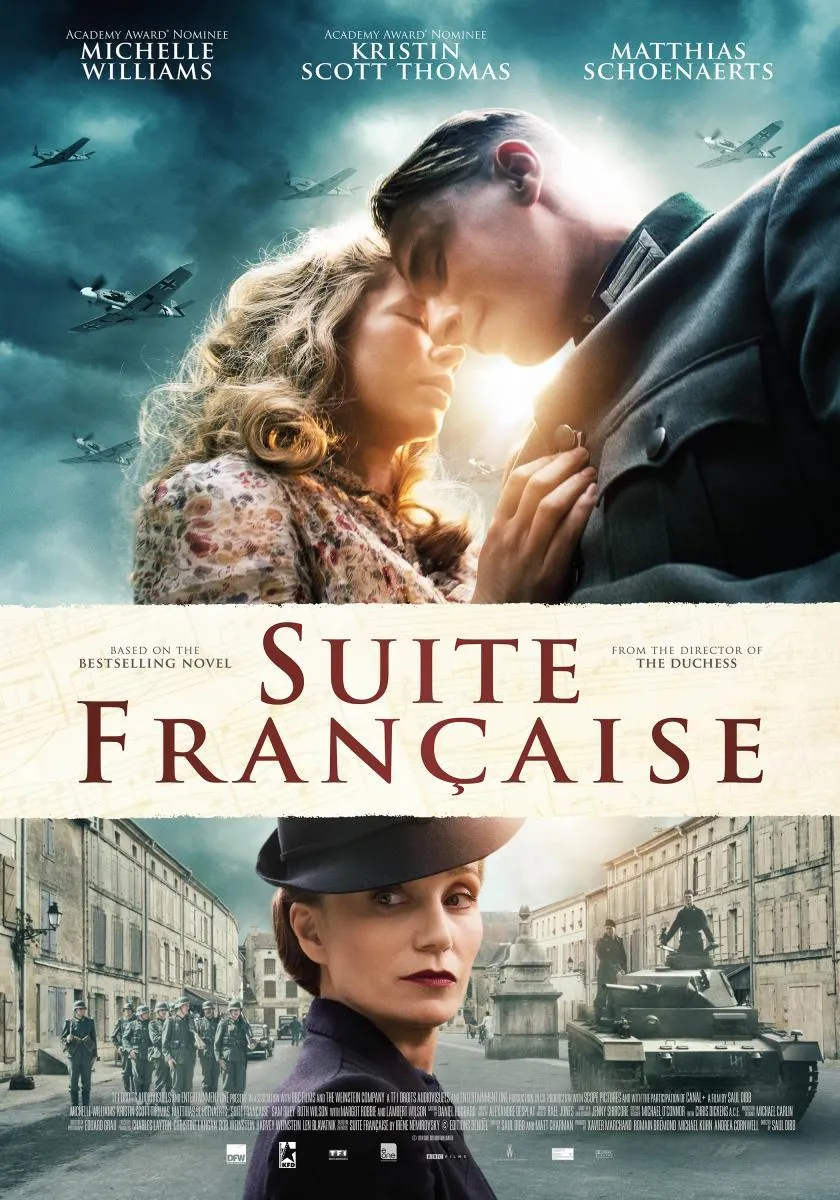
For any cinephile, it is impossible to simply follow the plot of a film or its underlying narrative.
Instead, one must also delve into the intricacies of the fictional world that has been created, for it is this complete product that truly captivates us.
It is not a question of which medium, film or literature, resonates more deeply, but rather the sheer admiration we feel for the genesis of the dramatic love story that has been brought to life on screen.
My personal experience with The French Suite, a film produced in collaboration between Britain, France and Belgium, made me realise that the origin of a story can greatly influence the aesthetic experience and the message conveyed by the film.

To express my intention, I tried to compile a collage that would present the conventional team effort behind the cover of the film.
However, I also intended to incorporate the poignant epigraph of Irene Nemirovsky's daughter found in the novel, as well as the cover of the novel by the Jewish writer who, like many other invaluable individuals, perished in Auschwitz.
The aesthetic experience is affected by this perspective because the drama narrated in the film parallels the novelist's life and describes the experience of those of us who make a career out of writing: we leave our own lives behind.
No matter how difficult life is, we work at writing projects that appeal to us.
Eileen knew she was going to die when she wrote her novel, of which only two of five remain.
This happened to me in Saul Dib's The French Suite (influenced by examining the novel's origins), and it also happened to me in The Duchess (2008), a biopic about Princess Diana's relatives.

This happened to me because I managed to focus the story (like the novel) on the romantic theme without forgetting the context of the war, making the story of forbidden love believable. A French woman and a German officer.
The drama is evident in the humanity of love (more so in the novel, the narrator sometimes thinks), which emerges little by little from the sensitivity of the piano played by the enemy, and becomes a vehicle for the emotions surrounding love. The unconsciousness of desire .
Then in the end, reality prevails, the war ends (the novel overcomes) and we must escape, face the nature of war and survive with the impossible bond of love, which is not just romanticism, but a message of hope for humanity. of this writer She wanted to leave, and she felt it in her novel (although the war was not over) and in this excellent film by the British filmmaker.
The calm and structured interpretation of the script, together with Alexander Desplat's music, add colour to the sound of the film's message, transcending the happy ending that does not exist in either the novel or the film.
Love sometimes has the reward of making us better human beings, of making us compassionate.
[Image](https://www.filmaffinity.com/ve/filmimages.php?movie_id=1411829

With this, a different nuance is added to films, with stories of forbidden love with other meanings.
Louis Malle's Wounded or Sofia Copolla's Seducer, both intimate and erotic films, but not surrounded by war, do not bring us closer to those important nuances of Eros: compassion.