
I might have slightly missed #PiDay2022 - but, I have decided to belatedly get on board the celebrations. You see, I love numbers. I can multiple big ones in my head, like 10 x 14, or do addition like a whiz; ask me what 9 + 12 is!
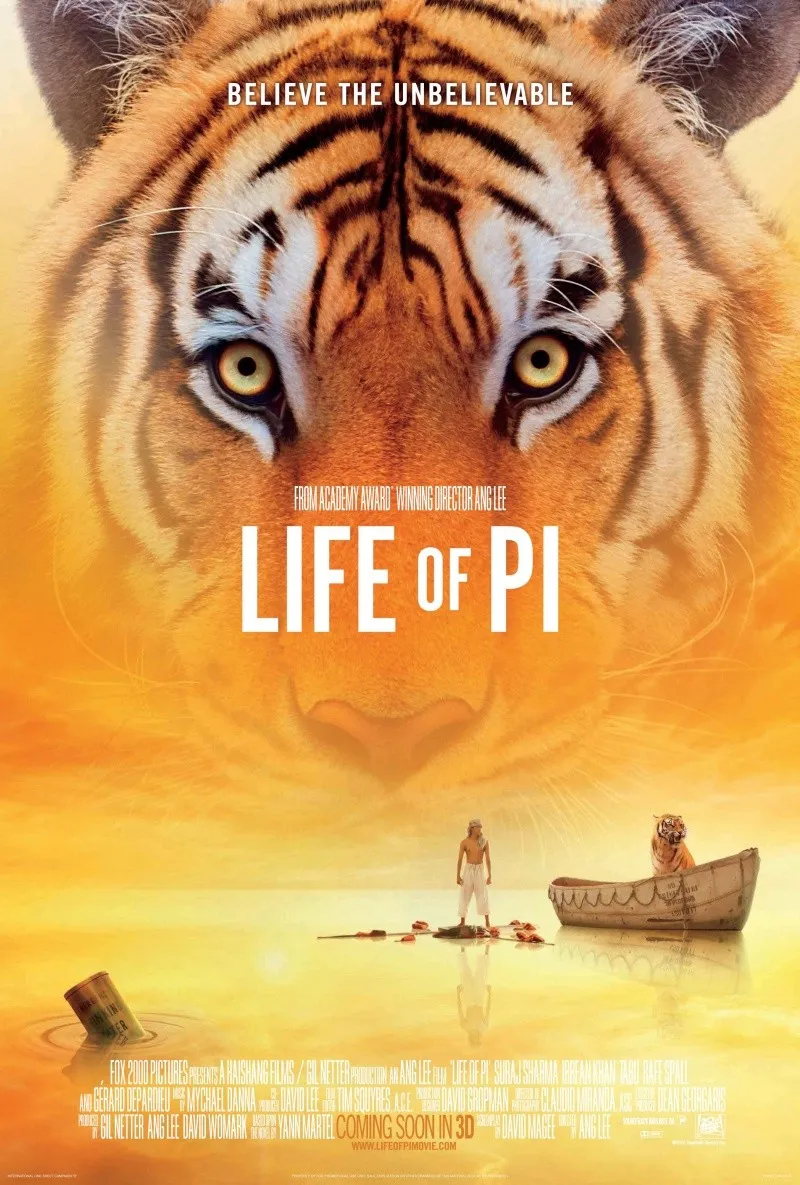
I also wanted to jump on board the Pi wagon, because it is a chance to talk about books made into film. And so for this one, I'm going to cheat, and offer you: The Life of Pi.
I'm cheating because of the title, it evokes a certain 3.1415926 - but in truth, is completely indifferent to Mathematics altogether. The text is far more philosophical than that, as the central character, Pi - has a love of religion and a curious mind for all manner of religious scriptures.
So why Pi? And why isn't the 'Life of' about someone into Mathematics?
Pi, it is explained, is short for 'Piscine' - a French translation would have us believe he was named after a swimming pool! It can also mean fish - and I suppose that's where we get the star sign Pisces. The total, then, is really a way of saying, 'Let me tell you about this story involving this kid'. You can see how the title they went with is far more mystical. Appropriate, given Pi's father tells him: you must pick only one religion.
Does he pick Hinduism, Catholicism or Islam?

The film sets out with the premise that Pi and his family, the owners of a local zoo, would be up and moving across the ocean to a new life - of course, taking the zoo with them. This physical upheaval ended in the upheaval of their boat on the ocean. A storm came, and everything was destroyed - with the exception of a small life boat. Having escaped the drowning cargo ship, Pi is joined by a tiger, Richard Parker and a hyena. His battle then is to survive. The hyena makes quick work eating a zebra who had also stowed away with them, and then an Orangutan. Finally, it is Richard Parker who devours the hyena.
Pi floats on the oceans for weeks on end, which then turns into months, a little bit improbably if you ask me - and, even more improbable when they come upon the carnivorous island in the middle of the ocean! With the realisation of the dangers of the island, Pi finds Richard Parker and makes the decision to leave the relative 'safety' of this acid-emitting island, and continue to float.

Pi continues to have survived on the lifeboat by training Richard Parker - he establishes himself as the dominant one, and they co-exist by having their own sides of the boat. This continues until they eventually find land in Mexico. Upon coming to the shore, Richard Parker leaps from the boat and disappears into the jungle. Extremely hurt, having become so attached the tiger, Pi is left alone. He is eventually found by the authorities, bathed and fed - and then two Japanese interviewers begin their demands: What happened to the cargo ship, and what events took place to get you to Mexico?
The audience, having just been witness to Pi's story, see him re-tell this to the interviewers. They do not look impressed, and they dismiss Pi's story - and as an audience, we start to question the world we were just immersed into. Was it all a make-believe? Had we been duped? Pi tells the story again, instead replacing humans for animals. A far more satisfactory account. Afterall, how could a young man possibly have survived so long, with a tiger in such close proximity - and where, indeed, was that tiger now?

It forces the audience to choose: Do you believe what you just seen, as implausible as it was, or do you choose reason? The question isn't so much about the story, as it makes us consider religion. Afterall, which story would God choose?
The novel was written by a Canadian author, Yann Martel in 2001. The film was released 12 years later in 2013 - it was directed by Ang Lee - for which she won the Academy Award.
Have a look at the trailer below:
This post was in response to the CineTV Twitter Prompt:
https://twitter.com/CineTv_io/status/1503151433356615683
- CineTv_io