
Now I use the freedom of speech advantage of the Hive blockchain - I am going to write about a very sensitive topic.
Something important, something very deep (approximately 3000 words Deep Dive) about the church.
I hope that this post fits to be a "Deep Dive".
I wrote this for many days (almost for a week) in Hungarian (in my own language) (including gathering information), and I translated it to English with DeepL Translator. It may contain grammatical and other errors. Thank you for your understanding.
A community where the majority are homosexuals, yet they are against same-sex cohabitation, marriage, adoption rights, and even gay people in general. This is the Vatican, at least as interpreted by Fréderic Martel.
"The largest gay community in the world"
Image source: https://images-na.ssl-images-amazon.com.

- 'In the Closet of the Vatican' is a fact-finding report on the Catholic Church. According to French public writer-sociologist Fréderic Martel, Catholic priests drink wine and preach water when they frequently and vehemently rush out against gays and their rights expansion, while
There are fewer homosexuals in the Castro, San Francisco's world-famous gay neighbourhood, than within the walls of the Vatican.
"The story of Sodom is also my life story"
Francesco Lepore
Image source: https://0.academia-photos.com.

The author sets the tone for the book by quoting a 2013 telephone conversation between Pope Francis and Francesco Lepore. Lepore, a high official in the Vatican, was fed up with the double life. He left the church and wrote a book about his life as a gay priest.
The original release of his book, in Italian
Image source: https://img.ibs.it.

I am physically and psychologically tired of hypocrisy, double-talk and hiding.
was written in the letter he sent to the Pope the evening before he announced the removal of his cassock in public.
I respect your honesty and friendship
said Francis, when he called Lepore after reading the letter. Martel also looks up to Lepore:
It would have been easier for him to remain silent, enjoy the protection of the Church and continue to live a warm life. But like the mafia, in the Catholic Church, silence is the most important rule.
Martel draws bold parallels, then quotes Al Pacino from the first part of 'The Godfather':
Don't ever take sides against the family.
A few words about Francesco Lepore
Lepore became a boarding student in a seminary at the age of 15. He knew he was gay but was not at peace with himself. As a priest, he wanted to live a virginal life through religion. It worked until he came to Rome at the age of 24. At the University of Santa Croce in the Vatican, he was confronted with the homophobia and extreme conservatism of the Curia, as well as the unashamed openness of many church leaders to homosexual relationships. Lepore himself began to act out his sexual desires. He developed good relationships thanks to his intimate affairs. He began a career in the Vatican. After a few years, his homosexuality became so unashamedly gay that it made the Italian tabloids. The scandal was smoothed over by Stanisław Dziwisz (1939), John Paul II's secretary and chief confidant. Lepore was by this time weighed down by a double life and hypocrisy. After a few years in labour, he left the pulpit to live his life as a gay man, as himself.
A shocking number
Lepore estimates that four-fifths of Vatican priests are gay! Martél treats the figure as fact, without verifying the claim of gay priests leaving the Church from other sources. He considers the stories of the many archbishops, bishops, Anglican clergy and Italian clergy who have lived the gay life, which form the backbone of 'The Embarrassing Secrets of the Vatican', to be sufficient proof: sauna parties with male prostitutes; clerics preying on Arab boys selling their bodies for money in Rome's most seedy neighbourhoods; Catholic leaders living double lives; seminary students who entered the service of God only to indulge their sexual proclivities within the close community of the church.
A multitude of stories
Most scandalous stories are presented by naming the people involved. Also the case of Alfonso López Trujillo (1935-2008).
Alfonso López Trujillo
Image source: https://img-4.linternaute.com.

The Colombian cardinal was a confidant of John Paul II. In 1978, immediately after Wojtyła's election as Pope, he was given the most important ecclesiastical post in Colombia, becoming Archbishop of Medellín. As at the beginning of his career, he openly campaigned for the extreme right in Colombia. A staunch defender of traditional family values, he became president of the powerful Pontifical Council for the Family in 1990. He frequently made sharp outbursts against gays, while having intimate affairs with young seminarians and maintaining a secret Roman apartment to entertain gay prostitutes. Several seminarians also reported Trujillo's abuse to Martel.
His secretary, Alvaro Léon, said that the cardinal, unlike most of his Roman colleagues, could not accept his homosexuality. "He felt his desires were a criminal perversion and wanted to expel them by physical violence. The secretary also gives specific details: Trujillo had a good relationship with the Chilean dictator. Augusto Pinochet had a very keen eye for Chilean priests who were active in social issues. The Archbishop wanted to please the dictator:
When he was in Chile, he would often visit the slums to talk to the priests who were doing social work there, giving the impression of a caring church leader. After the visit, he would pass on the names of the most active ones to the secret police. Many were soon taken to the militia torture chambers or found dead.
Nevertheless, John Paul II included him on his list of potential successors. He did not become Pope, but on his death in 2008, Pope Benedict XVI and Cardinal Sodano jointly celebrated a memorial Mass. Angelo Sodanot (1927), who was Cardinal Secretary of State from 1991 to 2005, quasi Prime Minister of the Vatican, was himself close to Pinochet. He also turned a blind eye to the Chilean government's arrest of priests on charges of political subversion.
Through his statements he became the dictator's guardian angel, consistently trivialising the crimes of the dictatorship
- says Léon.
The book also tells the extraordinary story of the death of Jean Daniélou (1905-1974), who had a heart attack during an orgasm in the arms of a gay prostitute in a Paris brothel.
Jean Daniélou
Imagine source: http://catholicexchange.com.

The reason for his death, according to the Vatican communiqué, is more poetic but less believable: 'The cardinal died in the apostolic effort to meet the living God.'
The name of Cardinal Benedict XVI's Secretary of State Tarcisio Bertone (1934) is also revealed.
Tarcisio Bertone
Image source: https://press.vatican.va.
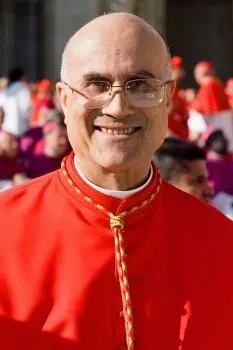
In 2013, the Italian press revealed that the church leader, known for his homophobic outbursts, had become the owner of a well-known gay sauna in a titicoban in downtown Rome. Martel himself visited the 'Europa Multiclub' at via Aureliana 40, one of Rome's most exclusive neighbourhoods, when collecting material for his book.
Fact literature or scandal book?
I personally interviewed 1,500 clergy members in 30 countries. Among them 41 cardinals, 52 bishops, 45 apostolic nuncios and more than 200 priests and seminarians. In this work and in the processing of more than 1,000 scholarly volumes, biographies and articles on the subject, 80 people have helped me
writes Martel, proving that his claims are not based on urban gossip.
Despite this, the German public radio station Deutschlandfunk (DLF) sharply criticises the author in a review.
"Personal stories, however numerous, are not statistical data on which to base serious allegations".
But does the German critic expect the impossible? Obviously, the Vatican does not keep statistics on the proportion of gay Catholic priests.
A similar criticism to that of the DLF is made by the leading German social-cultural weekly, Zeit:
All the speakers in the book confirm Martel's starting point: the vast majority of Vatican priests are homosexual, and the proportion increases as you move up the hierarchy. One suspects that the author deliberately interviewed only those whom he knew in advance would confirm his preconception.
But the DLF and Zeit do not deny that the many interviews and stories make Martél's book a readable read. However, it is precisely the many stories that give rise to another legitimate criticism, namely the jumbled nature of the volume. This is followed by chapters on John Paul II and then, after several detours, for example to Chile, on Bend XVI. So not only is the book not written in chronological order, but the chapters are often not even connected in content.
John Paul II
John Paul II
Image source: https://cdn.britannica.com.

Martel sees the papacy of John Paul II as a zenith: it also changed the nature and prevalence of homosexuality.
After the election of Karol Wojtyła (1920-2005) in 1978
there were few heterosexuals among his confidants, and even fewer celibate gays, a veritable ring of lust surrounded him
- recalls a member of the Curia, without a name.
Yet John Paul II was the Pope who launched a real war on gays, says another priest who was working in the Vatican's foreign office at the time. John Paul II personally led the campaign against sexual protection, which both interviewees say was proposed, directed and fomented by gay clergy.
In this context, Martel also lays down a rule: "The more homophobic a church leader's utterances are, the more likely he is to be homosexual." To support his view, he quotes Pope Francis:
Anyone who expresses extreme views has something to hide.
An example is the outburst of Archbishop Robert Sarah (1945):
Homosexuals are the beasts of the apocalypse, seven-headed and ten-horned monsters sent by Satan to destroy the church.
Sarah, the retired prefect of the Congregation for Divine Worship and the discipline of the Sacraments, compared the LGBT movement to Islamic terrorism in the same 2015 reflection.
The reign of John Paul II saw the emergence of the scandal-hungry tabloid press as we know it today, which prompted the Vatican to adopt a new communication strategy: rumours quickly become a press issue, so it is wisest to ignore accusations of homosexuality among priests, because denying them would only draw media attention. Unless the Church can use the media to serve its purposes. Rumours about the homosexuality of more liberal church leaders are often leaked by gay conservative clergymen in hiding to discredit their opponents.
Benedict XVI
Benedict XVI
Image source: https://upload.wikimedia.org.

A separate chapter is devoted to Benedict XVI (2005-2013). According to Martel, Joseph Ratzinger resigned his earthly position as God's vicar for the first time since the 15th century because he had made himself unacceptable in the Vatican by taking a tough stance against homosexuals and paedophilia. His long-held depression over the pervasiveness of homosexuality and paedophilia throughout his church has turned to depression. Throughout his life, he has fought relentlessly and determinedly against evil, and just as he reached the pinnacle of power, he was forced to acknowledge that he was surrounded by a moral morass.
Do you not have a single valid high priest?
an unnamed church leader recalled on the plane on his way home from a trip to Mexico and Cuba in 2012.
According to Martél's interviews, Ratzinger sees homosexuality as an internal disorder and distinguishes between two types of gay people: those who experience their homosexuality emotionally, culturally, and those who live it out sexually. The latter is considered a sin, a 'weakness of the flesh' and is rejected. Yet it is they who dominate the Vatican. In the decades under John Paul II, they were used to being able to indulge their sexual desires without consequence. The German Pope, who is trying to stop this, is being made impossible by a concerted effort. "I have never seen anything like it. The accusatory articles, the aggressive blog posts, the abusive letters, in every language, from every country in the world, were coming in," recalls a confidant of Ratzinger.
There is also the question of Joseph Ratzinger's sexual orientation. His movements and his dressing like a dresser reinforce the suspicion. Interestingly, in 2007, the Pope was the best dressed man in the 'clothing accessories' category of Esquire, the most trendy men's fashion and lifestyle magazine in the USA.
According to Arnd Bünker, a theology professor at the University of Sankt Gallen in Switzerland
Ratzinger carries more sad passions than any Pope. He is generally good-humoured, but is an enemy of sexual liberation. He considers it a nihilistic deviation and cannot bear to see anyone enjoying sex.
The DLF book reviewer may be close to the truth when he writes that
Ratzinger is a virtuous and abstemious man who has overcome what he considers to be his sinful sexual orientation by renouncing sexual pleasures.
Pope Francis' famous quote
If a man is gay, seeks God and is well-meaning, who am I to judge him?
asked Pope Francis rhetorically to journalists after the 2013 World Catholic Youth Summit in Rio. From then on, the Pope, who has been described as a liberal, was at the latest cast in the role of a great friend of gay people. Yet according to a gay church leader who spoke anonymously to Martel, Francis did not generally speak out on behalf of homosexuals.
He is trying to protect Vatican leaders suspected of homosexuality by this.
Several of Martel's interviewees talk about how the 'gay-friendly Pope' prefers to use the accusation of homosexuality in his power games: if a supporter is suspected of being gay, he will do his best to sweep the matter under the carpet, but if an opponent is accused of being gay, he will help to discredit him. In fact, it is sometimes his confidants who leak the information in the interests of Francis.
Is gay emancipation the main cause of the priest shortage?!
Healthy heterosexuals never willingly chose celibacy as a priestly vocation
says Martel in an interview with DLF about his book. But while homosexuality was socially despised and even criminally persecuted, the church provided a refuge for those attracted to men. A closed, protective community with many like-minded people. With the emancipation of gays, the church lost its appeal to them.
It's not attractive to live a gay life behind the walls of the Vatican if you can do it openly..
While there may be many social processes behind this, other than those mentioned by Martel, the fact is that the priesthood is dwindling. In the author's native France, for example, about 800 priests die every year, but fewer than 100 are ordained.
Catholicism is slowly disappearing
writes Martel.
In 'Don't question it, don't talk about it! - The 'don't discuss it, don't talk about it' rule, which used to make the priesthood attractive to gay people, still applies. Homosexual relationships are tolerated in seminaries as well as in the Vatican. But this does not apply to heterosexual relationships.
No attraction to girls! Anyone caught with a woman is immediately fired - says a German seminarian with a big smile on his face
written in Martél's book. The exception is Africa. On the continent where, due to population growth and conversion, most Catholics will soon be living, celibacy has been de facto abolished. The majority of African Catholic priests live a quasi-married life. They would have no authority in the community if they could not prove that they are practising heterosexuals. Rome is a long way away, so priests even allow themselves to marry their partners in church.
Does homosexuality breed paedophilia?
Obviously, homosexuality and paedophilia are two completely separate things. Yet in the case of the Catholic Church, the two are confused. If a priest has a reputation for being gay, there is often a suspicion of statutory rape.
Globally, the vast majority of violence against minors is perpetrated by men against girls. The explanation is obvious: 90% of men are heterosexual. Martel estimates that 80 per cent of priests are gay, which is why the victims of abuse in the church are mostly boys. The author also has a logical explanation for why priests are more likely than the average person to commit abuse:
The problem is not homosexuality, but its repression and the homophobia that results, to the point where many priests hate themselves and take out their frustration in violence.
Martel considers the cover-up to be as big a problem and as common as the corruption itself. Interviewees often report a whole tangled web of extortion cases. Often the blackmailers are paedophile priests. They threaten their superiors with exposure of their gay double lives if they do not help cover up their cases of abuse.
There is no Vatican gay lobby!
It would be a mistake to talk about a gay lobby in the Vatican
says the much quoted Francesco Lepore.
Lobbying means that a group secretly strives to achieve a goal. It's true that most of those in power in the Vatican are homosexuals, but they don't want to achieve anything for gay people. Cardinals, archbishops and priests protect their secret lives out of shame, fear and perhaps careerism.
Who is the author to judge?
I need to clarify something before I start exposing the immoralities of the high priest. Who am I to judge? I have no wish to lord it over anyone. I don't want to out living church persons. I am trying to describe a system. Cardinals, bishops and priests have the right to keep mistresses, the right to live out their innate or acquired inclinations. Not being a Catholic, it is ultimately of little consequence to me that they break their vows of abstinence or that they act against the ecclesiastical law
writes Martel in the foreword to his book.
I do not about your private life, whether you are a simple man, a small priest or even the Pope himself
Wrote the author.
I am not in the business of exposing anyone's secret homosexuality, but I feel obliged to point out to believers and atheists alike that most Catholic priests drink wine and preach water: they set questionable moral standards, incite against gays while secretly having homosexual relationships, and not infrequently corrupt children.