

He is terribly afraid of dying because he hasn’t yet lived. — Franz Kafka
In the social community of gardeners, I have seen people moving to greener pastures—not literally. Aside from the legal and financial aspects of acquiring land, accessibility and safety are among the main priorities, but one must also consider what is the microclimate and soil type of the property.
Around the world, most people are lucky to have soil ready for gardening. Is it clay-loam or well-drained soil? In this environment, the existence of green thumbs magically manifests in the lush and abundant gardens or farms.
For others, they are blessed to still live on land—no matter what type it is. Gardening and farming over unfavorable environments is not just a feat, but also a reality for millions of people.

Solutions for Droughts
In the arid and semi-arid regions, people use various techniques ranging from permaculture to modern technological methods.
In China, projects such as reforestation thrive through permaculture methods. Weaving grass into the soil to form grids to protect seedlings while also catching nighttime moisture. This is just a few of the greening projects that other countries with worsening climate-related socio-political issues should emulate—a cooler environment mellows strong temperaments.
In Australia, people embrace sand, augment it with layers of compost, and plant with native species alongside crops. The rich organic matter stores the water for longer while also nurturing young trees and shrubs while their growinf roots ready for the sandy soil.
In Africa, India, and the Middle East, they build various systems to capture and reuse rainwater and fossil water ranging from desert swales, artificial lakes, and high-tech irrigation innovations.

Using water for direct human consumption and for local economic growth is not an issue, the real problem are large factories and multi-national companies profiteering and over-harvesting local waters drying up aquifers, lakes, and rivers then blaming climate change for the drought.
In wetter countries that are often visited by typhoons, monsoons, or strong rains, their leaders should address it through massive reforestation and other green-infrastructure mega-projects before severe catastrophes become a norm.
Counting deaths from weather-related events shouldn't be a media frenzy as it is highly preventable with long-term and proactive policies.

Agricultural Reality
"My harvest is not enough to pay debts and provide to my family." This is the common statement you hear when talking to local, small-scale farmers.
Agroforestry is the new answer to food insecurity—the idea I have heard somewhere. It is not a secret that farmers are falling into the trap of poverty since most farmers are monocropping which entails higher risks of plant-diseases, pest-related issues, and weather damages.
The barriers to permaculture of local farmers is in multitude. One is that they are just tenants, most farmers share a piece of a larger land and must cultivate it to consistently offer a third of their harvest to the owner more than twice a year.
Transitioning to permaculture methods means temporarily lesser output that translates to an impermanent loss—that is scary if you have obligations. The people who claim that agroforestry will solve food insecurity often have their own property and can shell out capital easily for faster development.
The debt trap in farming is not just a personal issue, but also the failure of most agricultural policies that just drags farmers down. The agricultural sector does not need high-value crops, but more awareness and national support for localized agroforestry for communal food security.
 |  |
|---|
Permaculture Garden
For over a year, I started my permaculture journey in a somewhat barren orchard. Decades of bad agricultural practices disrupted the soil microbiome and left the soil severely eroded.
On the orchard during sunny days, the ground hardens like rock and cracks, choking crops that were planted during the rainy days. Transitioning to permaculture allowed me to grow year round.
The raised beds are made from layers of tree debris, coconut tree debris, garden soil, rice hull, beach sand, and kitchen scraps. The mud paths were also planted with cover crops such as Mani-mani to replenish depleted soil nutrients.

Around the main garden area, organic barricades have been readied to slow down the undercurrent of floods while also trapping tree debris and sediments to heal the eroded garden soil.
For several months, I was able to sow and transplant 96 fruit tree seedlings with, just 4 more to complete this year's goal! Alongside the fruit trees are nitrogen-fixing trees, bananas, pineapples, and flowers to contribute to the overall healing of the property.
Living mulch such as mung beans protect herbs and strawberries from the scorching sun while also nurturing the soil microbiome. Just this week was my harvest of bean pods, this inspire me to spread more seeds around the orchard to harvest more of it.

During the dry season, the taller trees allow younger crops to grow and the mulch lessens the need for irrigation. In the succeeding years, the orchard will become self-sufficient, productive, and potentially profitable.
Permaculture can be costly at first and laborious, but its benefit exceeds the need for sustenance by also hosting a new ecosystem where life works in symbiosis to help each other thrive longer than a man's lifetime.
How about you, what are your strategies to capture energy and water? Share in the comments down below! :)
PINNED POST
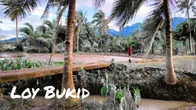 | Clearing the Damage After the Storm Instead of falling into anxiety, I took time to make use of what the storm had given. |
|---|
Explore Communities
 |  |  |  |  |  |  |
|---|
Logos are owned by its respective community and/or its owner/s.
About Me
@oniemaniego is a software developer, but outside work, he experiments in the kitchen, writes poetry and fiction, paints his heart out, or toils under the hot sun.
 | Onie Maniego / Loy Bukid was born in rural Leyte. He often visits his family orchards during the summers and weekends, which greatly influenced his works. |
Donate with Crypto
Bitcoin 34hdQNHHFUodqegi2wwNeNw2p35ewvnaXQ
Ethereum 0xd36126ab2463c3404cca1c97d8f3337917dfd113
© 2022 Onie Maniego and Loy Bukid
Don't forget to vote, comment, and follow me.
Not yet on Hive? Earn while blogging.
Sign up with PeakD | Ecency