
English:
Hello friends of Hive. When we go for walks through parks and avenues, we always enjoy contemplating monuments, facades, gardens, in short, everything that surrounds us. Today I did my daily walk with my husband, who is a lover of the history of my country, Cuba. On our way back home, we passed near a park and wanted to know who the monument in the center of it was dedicated to, verifying the deterioration it presents and the looting it has suffered at the hands of unscrupulous people who have been dedicated to stealing the marble slabs and bronze ornaments.

To our astonishment, the park is named Leonor Pérez, in honor of Leonor Antonia de la Concepción Micaela Pérez Cabrera, who was the mother of the Apostle of our homeland, José Julián Martí Pérez, our National Hero, journalist, and founder of the Cuban Revolutionary Party that organized the War of Independence, where he lost his life in 1895.
The father of our Apostle was Mariano Martí, a native of the Spanish city of Valencia, and the mother was also Spanish, from Santa Cruz de Tenerife, where she was born on December 17, 1828, into a well-to-do family. Leonor and Mariano had eight children, with José Martí being the firstborn and only son. Doña Leonor passed away in Havana on June 19, 1907, at the age of 78 (having survived her son by 12 years) in absolute poverty.
The birthplace of our Apostle is now a museum, located at 314 Leonor Pérez Street, between Egido and Picota Streets, in Old Havana. This museum is indeed well-maintained and visited by many foreign and national tourists.
On the monument to his mother, you can read the letter that José Martí sent her on March 25, 1895, from Montecristi, just as he was about to join the Necessary War, where he expressed his most beautiful and sincere feelings towards his mother, whom he adored as he did his homeland.
This monument dedicated to Doña Leonor Pérez was considered the only one of its kind in the entire continent that honors the mother of José Martí. It features the sculptural ensemble of Doña Leonor by the artist Manuel Rodolfo Toledo, who used 5,200 pounds of bronze donated by the people of Cuba for its construction, according to what I could read in an Ecured article.
The sculpture measures 2.5 m in height x 1.70 m in width and is accompanied by a gray marble pedestal around which there is a high relief that narrates three historical moments in the life and work of the Apostle. From left to right, you can see the forced labor that the adolescent Martí had to perform in the San Lázaro quarries, after having suffered persecution and detention when he was barely 16 years old. The work carried out by Martí upon his return to Cuba is evident, promoting patriotic propaganda in the press and through his speeches from the podium of the Lyceums of Regla and Guanabacoa. To the right of the tomb, allusion is made to his fall in combat at Dos Ríos alongside a compatriot, while on the back, the posthumous tribute to his friend and poet Alfredo Torroella, on January 22, 1879, is remembered; both were associated with the Lyceum of Guanabacoa, where it is considered that the Apostle gave his first political speech in Cuba.
In the sculpture, Doña Leonor appears seated, reading the letter sent to her by her son José Julián from Montecristi on March 25, 1895.

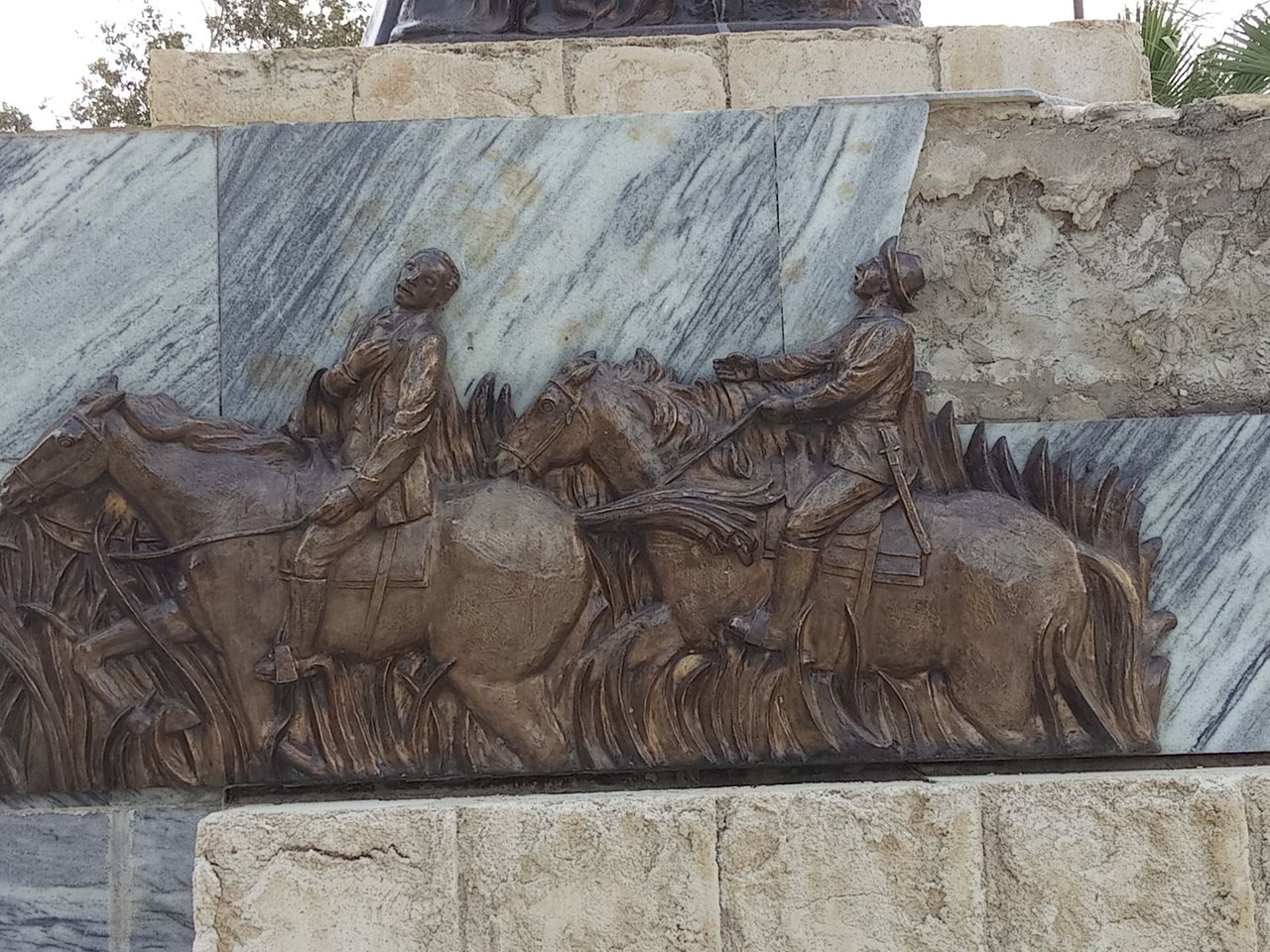


Today, the bronze relief on one of its sides is missing, and most of the marble that the monument had is gone. The bronze that was on the back of the monument has also been stolen.
Currently, there is no one to guard and care for this monument, built with the people's resources. It is a shame to see how a work of art of this magnitude, with such great significance for our history, has been neglected, damaged, and desecrated. It is incredible that the State does not guarantee the care of works and monuments that are the history of our country, that were built with the people's money. It is sad to see that the institutions responsible for keeping our parks clean and well-maintained do not control or do not have personnel to properly guard the works that are for the enjoyment of the people. This has nothing to do with embargoes, with pressures, with disagreements; this has only one name: NEGLIGENCE.
Español:
Hola amigos de Hive. Cuando realizamos nuestras caminatas por parques y avenidas siempre nos gusta contemplar monumentos y fachadas, jardines, en fin todo lo que nos rodea, hoy realicé mi caminata diaria junto a mi esposo, quien es un amante de la historia de mi país, Cuba, de regreso a casa pasamos cerca de un parque y quisimos saber de quién era el monumento que se encuentra en el centro del mismo, comprobando el deterioro que presenta y el saqueo al que ha sido sometido por personas inescrupulosas, que se han dedicado a robar las losas de mármol y los adornos de bronce.
Para nuestro asombro el parque se nombra, Leonor Pérez, en honor a Leonor Antonia de La Concepción Micaela Pérez Cabrera, quien fuera la madre del Apóstol de nuestra patria, José Julián Martí Pérez, nuestro Héroe Nacional, periodista, fundador del Partido Revolucionario Cubano que organizó la guerra de Independencia, donde perdió la vida en el año 1895.
El padre de nuestro Apóstol fue Mariano Martí, natural de la ciudad española de Valencia y la madre también era española, de Santa Cruz de Tenerife donde nació el 17 de diciembre de 1828, en el seno de una familia acomodada. Leonor y Mariano tuvieron ocho hijos, siendo José Martí el primogénito y único varón.
Doña Leonor falleció en La Habana, El 19 de junio de 1907, a la edad de 78 años (después de sobrevir a su hijo12 años) en la más absoluta pobreza.
La casa Natal de nuestro Apóstol hoy es un museo, se encuentra ubicada en la calle Leonor Pérez, número 314, entre las calles Egido y Picota, en La Habana Vieja. Este museo sí se encuentra bien cuidado y a él acuden muchos turistas extranjeros y nacionales.
En el monumento a su madre se puede leer la carta que José Martí le envió el 25 de marzo de 1895 desde Montecristi, casi a punto de sumarse a la Guerra Necesaria, donde expresó sus más bellos y sinceros sentimientos hacia su madre, a la cual adoraba como a su patria.
Este monumento dedicado a Doña Leonor Pérez, es considerado el único de su tipo en todo el continente que rinde honores a la madre de José Martí. En él se encuentra el conjunto escultórico a Doña Leonor del artista Manuel Rodolfo Toledo, quien utilizó para su construcción 5200 libras de bronce donadas por el pueblo de Cuba, según pude leer en un artículo de Ecured.
La escultura mide 2,5 m de altura x 1,70 m de ancho y se acompaña de un pedestal de mármol gris alrededor del cual hay un alto relieve que narra tres momentos históricos de la vida y obra del Apóstol. De izquierda a derecha se observan los trabajos forzados que tuvo que realizar el adolescente Martí en las canteras de San Lázaro, tras haber sufrido persecuciones y detenciones cuando apenas contaba con 16 años. Se evidencia la labor desplegada por Martí de regreso a Cuba, realizando propaganda patriótica en la prensa y desde sus discursos en la tribuna de los Liceos de Regla y Guanabacoa. A la derecha del túmulo se hace alusión a la caída en combate en Dos Ríos junto a un compatriota, mientras en la parte posterior se rememora el homenaje póstumo a su amigo y poeta Alfredo Torroella, el 22 de enero de 1879, ambos eran asociados al Liceo de Guanabacoa, donde se considera que el Apóstol pronunció su primer discurso político en Cuba.
En la escultura aparece Doña Leonor sentada, leyendo la carta que le dirigiera su hijo José Julián, desde Montecristi, el 25 de marzo de 1895.
Hoy no se encuentra el relieve en bronce de uno de sus costados y falta la mayor parte del mármol que tenía el monumento. El bronce que estaba en la parte posterior del monumento también fue sustraído.
En la actualidad no hay quien custodie y cuide de este monumento, realizado con los recursos del pueblo. Es una pena ver cómo se ha dejado descuidar, dañar y profanar una obra de arte de esta magnitud, con un significado tan grande para nuestra historia. Es increíble que el Estado no garantice el cuidado de obras y monumentos que son la historia de nuestro país, que fueron realizadas con el dinero del pueblo. Es triste ver que las instituciones que les corresponde mantener limpios y cuidados nuestros parques no controlen o no tengan personal que custodie correctamente las obras que son para el disfrute del pueblo. Esto no tiene nada que ver con embargo, con presiones, con desacuerdos, esto tiene un solo nombre: NEGLIGENCIA.