
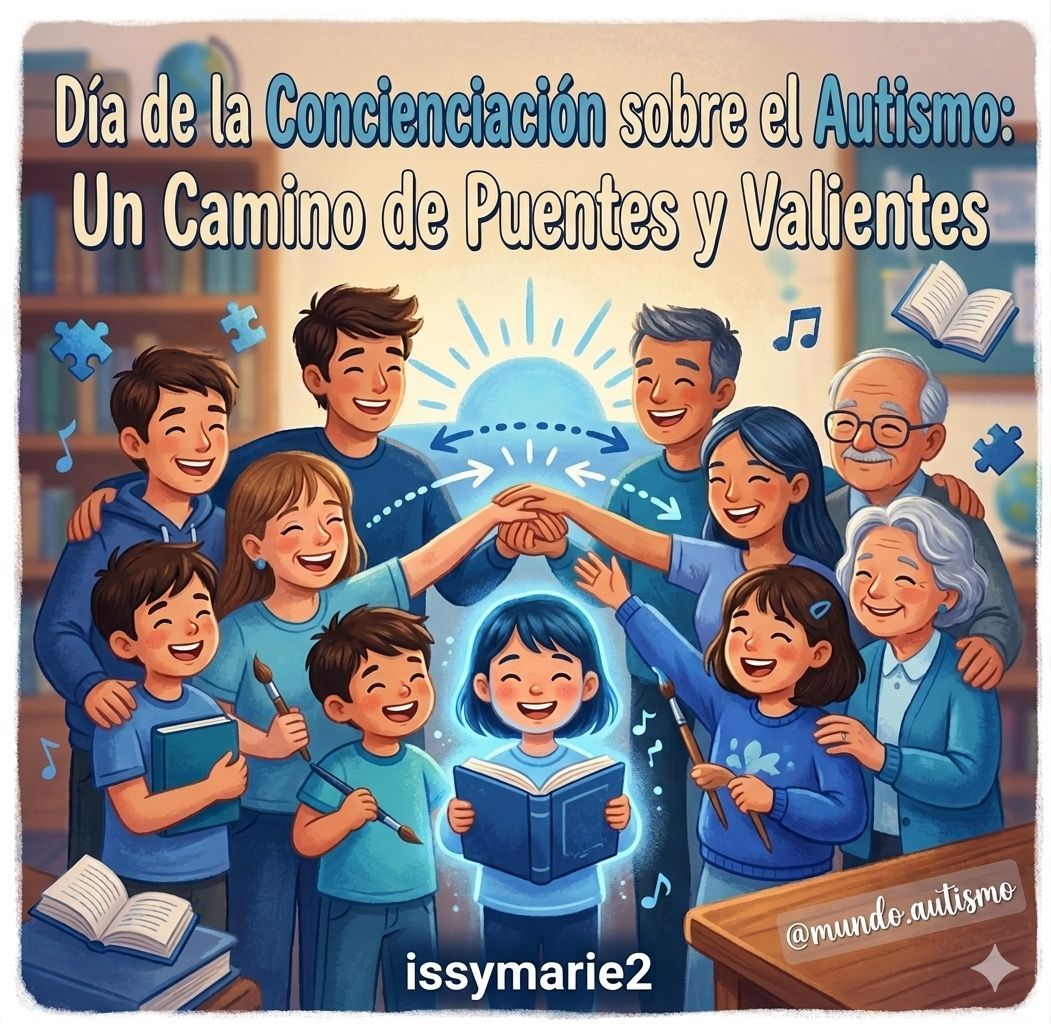
El 2 de abril se conmemora el Día Mundial de Concienciación sobre el Autismo. Una fecha donde se reconoce el camino recorrido por cada familia, su entorno de apoyo y, por supuesto, sus protagonistas: los niños y niñas que, poco a poco, se convierten en adultos.
Esta fecha, instaurada en el año 2007 por la Asamblea de las Naciones Unidas, tiene el propósito de sensibilizar y crear conciencia sobre la condición del Espectro Autista.
¿Por qué sé esto?
Porque, aunque no soy una 'mamá azul', formo parte del grupo de Homeschool en Chile. Allí convivo con muchas familias azules, con sus pequeños, pequeñas y adolescentes. En este grupo nos ayudamos entre todos, porque todos recorremos un camino educativo distinto al convencional. Es un mismo sendero que tiene diferentes atajos, y es ahí donde nuestras direcciones se dividen.
Pero en este camino, donde a veces las calles tienen grietas y hasta falla el alumbrado público, todos llevamos un teléfono que nos mantiene conectados y unidos a la distancia.

Captura de pantalla de mi celular en el grupo de WhatsApp.
Muchas veces he dicho que no conozco el día a día de vivir en una familia con espectro autista, pero sí escucho las voces cansadas de esas madres que buscan un: '¡Vamos, tú puedes!'. A veces no se dan cuenta de que, si una madre ya es poderosa de por sí, una madre azul tiene una energía infinita. No hay kriptonita que la derrumbe. Y si llega a caer —porque es normal, son humanas—, se levanta más fuerte, más valiente y más resiliente. Ellas son el puente entre el aprendizaje y sus hijos; son la voz de las letras en los libros y la guía de sus manos al pintar. Son todo en el mundo de sus tesoros.”
A menudo nos enfocamos solo en la infancia, entregando herramientas para que los niños logren 'encajar en el sistema'. Pero a veces siento que el enfoque social es errado: no se trata de cambiar quiénes son para que 'sean parte de', porque en ese proceso se asfixia la individualidad. ¿Acaso la sociedad busca robots fabricados en serie, todos del mismo lote? La verdadera inclusión no es moldear al niño para el mundo, sino preparar al mundo para recibir la riqueza de su diferencia.
Tras la infancia llega la adolescencia, una etapa de por sí turbulenta. Aquí, los jóvenes con espectro autista a veces enfrentan el mundo con temor. Y es comprensible: si como sociedad o familia hemos vivido la primera etapa desde el miedo y la sobreprotección, terminaremos con adolescentes silenciosos, temerosos de alzar su propia voz. El desafío no es solo que aprendan conceptos, sino que ganen la confianza de saber que su forma de ver la vida es válida y necesaria.
Posterior a la adolescencia llegamos a la adultez, donde la carga emocional, mental y física suele hacerse gigante. Es ahí donde surge mi preocupación —desde la otra vereda, como he dicho antes—, porque es una preocupación natural de madre: ¿Qué mundo les espera cuando dejen de ser "niños"?
¿La sociedad de hoy busca excluir y rechazar? Siento que la integración y la aceptación ocurren solo cuando se cumplen los estándares impuestos pero, ¡vamos!, seamos realistas: ¿Quién los cumple a cabalidad hoy en día? Si a nosotros nos cuesta, ¿con qué derecho le exigimos a una persona con autismo que se anule para encajar en un molde que ya está roto?
Y así como las redes sociales, la televisión, las radios y las revistas promueven con bombos y platillos el Día de la Madre, del Padre o del Niño, ¿por qué no hacen lo mismo con este día? ¿Por qué la concienciación se queda en un lazo azul o en una mención pasajera, en lugar de convertirse en un compromiso real para derribar las barreras laborales y sociales que enfrentarán estos futuros adultos?
Quizás el verdadero desafío de este 2 de abril no sea entender el autismo, sino entender que el mundo es un rompecabezas donde cada pieza, por más distinta que sea su forma, es indispensable para completar la imagen.
“Al final del día, ¿estamos educando para que ellos se adapten al ruido, o para que nosotros aprendamos a valorar su silencio?”
Feliz día de integración para mi, y un bravo absoluto para ustedes, valientes y poderosas familias azules de

English
World Autism Awareness Day is observed on 2 April. It is a day to recognise the journey undertaken by each family, their support network and, of course, the people at the heart of it all: the children who, little by little, are growing into adults.
This day, established in 2007 by the United Nations General Assembly, aims to raise awareness and understanding of autism spectrum disorder.
Why do I know this?
Because, although I am not a ‘blue mum’, I am part of the Homeschool group in Chile. There, I spend time with many blue families, with their little ones and teenagers. In this group, we all help one another, because we are all following an educational path that differs from the conventional one. It is the same path that has different shortcuts, and that is where our directions diverge.
But on this path, where the roads are sometimes cracked and even the streetlights fail, we all carry a phone that keeps us connected and united across the distance.
Captura de pantalla de mi celular en el grupo de WhatsApp.
I have often said that I don’t know what daily life is like in a family with a child on the autism spectrum, but I do hear the weary voices of those mothers seeking a: ‘Come on, you can do it!’. Sometimes they don’t realise that, if a mother is already powerful in her own right, a blue mother has infinite energy. There is no kryptonite to bring her down. And if she does fall — because it’s normal, they’re human — she gets back up stronger, braver and more resilient. They are the bridge between learning and their children; they are the voice of the words in the books and the guide for their hands as they paint. They are everything in the world of their little treasures.”
We often focus solely on childhood, providing tools so that children can ‘fit into the system’. But sometimes I feel that the social approach is misguided: it’s not about changing who they are so that they ‘belong’, because in that process individuality is stifled. Does society really want mass-produced robots, all from the same batch? True inclusion is not about moulding the child to fit the world, but preparing the world to embrace the richness of their difference.
After childhood comes adolescence, a turbulent stage in itself. Here, young people on the autism spectrum sometimes face the world with fear. And it is understandable: if, as a society or family, we have approached the first stage with fear and overprotection, we will end up with silent teenagers, afraid to raise their own voices. The challenge is not just for them to learn concepts, but to gain the confidence to know that their way of seeing life is valid and necessary.
After adolescence comes adulthood, where the emotional, mental and physical burden often becomes overwhelming. That is where my concern arises — from the other side, as I have said before — because it is a natural mother’s concern: What kind of world awaits them when they are no longer ‘children’?
Does today’s society seek to exclude and reject? I feel that inclusion and acceptance only happen when imposed standards are met, but come on, let’s be realistic: who actually meets them fully these days? If we struggle with it, what right do we have to demand that a person with autism suppress themselves to fit into a mould that is already broken?
And just as social media, television, radio and magazines promote Mother’s Day, Father’s Day or Children’s Day with great fanfare, why don’t they do the same for this day? Why does awareness stop at a blue ribbon or a passing mention, rather than becoming a real commitment to breaking down the workplace and social barriers these future adults will face?
Perhaps the real challenge of this 2nd April is not to understand autism, but to understand that the world is a jigsaw puzzle where every piece, however different its shape, is essential to completing the picture.
“At the end of the day, are we educating them to adapt to the noise, or are we learning to value their silence?”
Happy Inclusion Day to me, and a huge round of applause to you, brave and powerful blue families of

Créditos / Credits:
Las imágenes usadas fueron creadas en Gemini AI.
El texto fue traducido en DeepL versión free.