
Hello all, I've finally gotten a little over a full year of Solar Stats to share. I think it's interesting to see the monthly stats and compare.
Of course everyone's location and electric usage will very, but it's still nice to see various reports from others for comparison. This allows others to see some real-world usage for their own projects and planning. Here in Florida, I see a slight reduction in production from November-Feb, but fairly consistent throughout the year with all the sunshine we get here.

We are pretty big electricity users compared to average I suppose. We both work from home and run my wife's quilting and embroidery business from here which means extra large equipment pulling power, in addition to a pool filter/pump, and of course charging my electric vehicle (Chevy Blazer EV, more on that in another post following soon). So when looking at the consumption, keep in mind that these consumption and usage numbers also include all of my vehicle and transportation costs. (To more equal comparison, try adding all your vehicle gas, oil changes, brake pad replacements, etc. to your house electric bill).
Some key stats (some shown in the graph).
Annual Solar production 17.5 MWh which is about $2,300 in annual savings from our Electric Bill. I can't even describe how nice it was the few months we produced more than we used!
Average Solar offset of all usage for the year = 64% (I would love another dozen panels to get that to 100%).
CO2 reduction = 12.5 tons.
Equivalent to 210 trees planted.
I had to finance my installation. My payments are $245 per month, which means the solar system (and backup capability) cost me about $640 dollars net this year. For us the primary objective was the battery backup capability vs. buying a propane tank and whole house generator. A small price to pay for the power outage protections we've received. Just the one long 4 day outage last year paid for itself from our perspective. The ongoing savings and eventual profit? it may generate just a bonus.
Outages: (But not for me! lol)
As the pic shows, we had 34 "outages" last year. The worst was 3 day outage during the hurricane last October. More recent was a 4 and a half hour outage from local transformer blowup in storm, and multiple other short disruptions.

I work from home, often on large conference calls where I may be presenting to dozens or even hundreds of people. Erratic connectivity and drops during important calls are highly disruptive.
This is why I love Solar vs the other backups. The Automatic Transfer Switch (ATS) in this system handles the power shifts in an outstanding fashion. I wasn't even aware that these outages were happening (except the big one of course), because the switchover and switchback was so smooth. If it weren't for the email notifications and display in the console, I would not have even known about them.
This is much better experience for me than the propane backup generator was. The old style generator would take at least 10 seconds to kick on, and I would lose internet, router would reboot, etc. when power went out, then it would cut out again when power came back and again reboot the router, etc. This would get really irritating when the power coming back on, but not stable, doing multiple flips. The way the Solar is configured and works, it just keeps providing smooth, conditioned power the whole time, we seldom even notice the lights flicker.
Here's a pic of the battery backup portion of the system and ATS box with the new trellis cover plants starting to grow.

System Specs:
Tech Details:
System Size = 13.44 kW DC
Panels = QTron M-G2+420 (32 Panels, 420 Watts each)
Inverters = IQ8M-72-2 (240V)
AC rated power output = 10.56 kWh AC
Estimated First Year Production
17,914 kWh
Battery Backup = Enphase 20.16 kWh system (4 IQ Battery 5P)
Battery capacity = 20.2 kWh
Operating power = 7.68 kW
I see the initial First Year Power Production estimates were almost exactly on the mark. Just imagine the increase if we could replace the whole roof with Tesla panels or some other type of Solar roofing. I was hoping to add another dozen panels this year before the 30% tax incentives went away, but other unexpected expenses forced a delay, so maybe next year or the year after when some of the new improved technology comes out that may actually double output.

Here is a pic of the panels from drome just after install from previous post.

Stability and Issues:
Virtually none. The system has been hands off and maintenance free (other than washing heavy pollen off the panels once last year) for the last year and a half of usage.
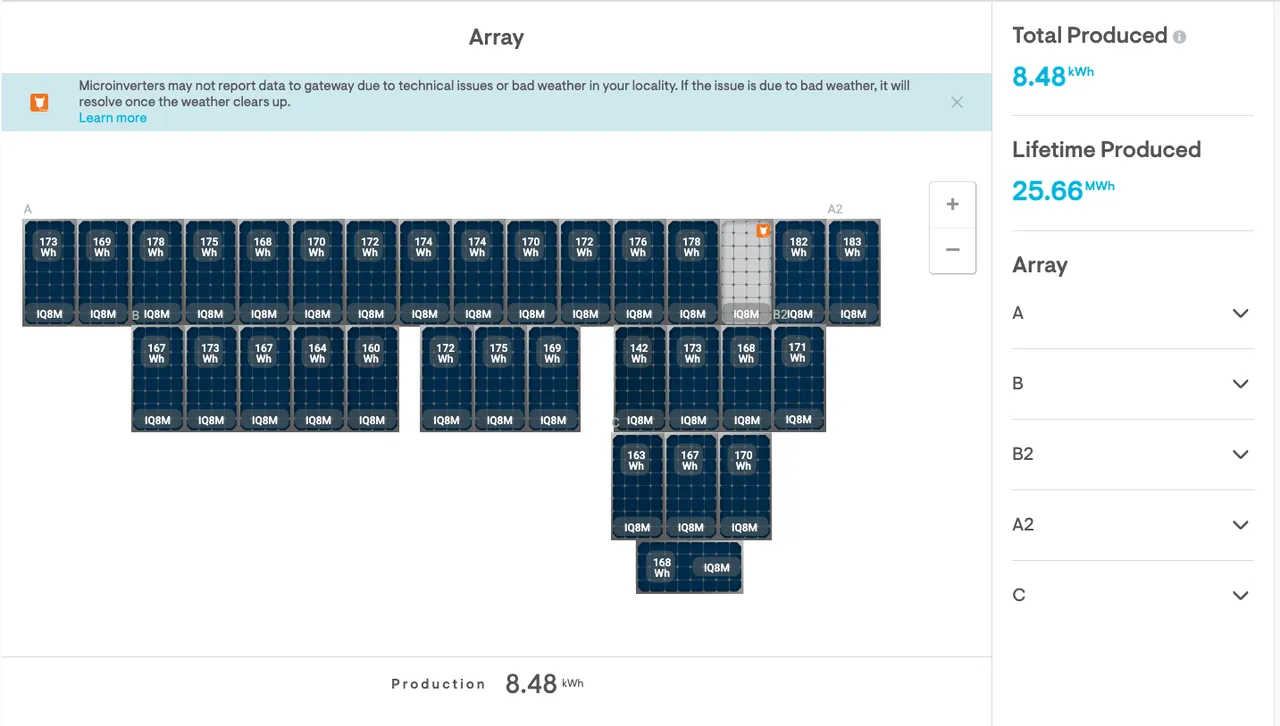
I am starting to see sporadic errors from one of the micro-inverters in the Array.
I just love the visibility this system gives, and it highlights one of the reasons I prefer micro-inverters for each panel vs. a single inverter for them all. In this model even if one of the panels is covered by clouds, shade, or other, the rest keep working and providing power. I'm not sure if it's maybe a loose connector or what, but this one panel has given errors a few times that then seem to fix itself. Will keep a watch on it, they are still under warranty.
How long to break even or turn profit?
I hear this question a lot. Keep in mind that for us like many others, the primary motivation was not direct cost savings, but having reliable backup power to address the frequent short and often extended outages we have here from hurricanes and tropical storms.
That said, It looks like we've so far produced about $3.3K in direct Solar Savings in just over a year. That works out to about 18 years to fully pay for the system if only looking at direct cost (Entire system was about $60K). However, that will be offset by the other savings and start paying back much sooner, and result in even higher savings as Electric utility costs go up (we had yet another big increase this year), and don't forget the annual vehicle gas and oil savings that I like to bundle in here as well (how much do you spend on annual vehicle costs? This will get reduced even lower when we add some additional panels. The bulk of our system cost was in the expensive backup batteries. I don't plan to add any more batteries to our system, but do plan to buy the adapater to allow me to power house from the vehicle. Once implemented, it will be basically the same as adding another 2-3 batteries to my system, except that I could drive to charge up if needed and bring the power back to recharge the house batteries or power the house.
So far, still very happy with the investment, and anxious to add those extra panels and see the numbers shift even further.