
Source
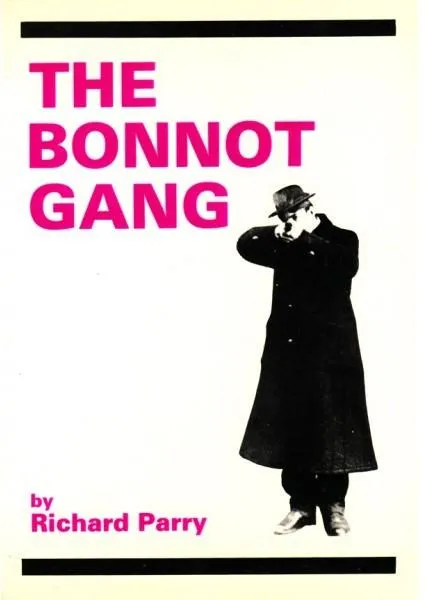
The Story Of The French Illegalists by Richard Parry
After Libertad's death at the end of 1908 there were three factions competing for control of l'anarchie according to police reports: one based on an alliance of the Mahé sisters and the DeBlasius brothers, one around Léon Israel and friends, and the 'Go Barefoot' brigade.
The arguments were calmed however by giving the editorship to a fourth party — Armand, a thirty-six year-old Parisian who had progressed from the Salvation Army, through Tolstoyanism, to individualist anarchism, having read Max Stirner the previous year.
By the time of Victor Kibalchich's arrival in Paris, Lorulot had taken over the editorship of l'anarchie from Maurice Duflou, who had returned to the basement to supervize the running of the print shop.
Mauricius was still handling the bulk of the Causeries Populaires, although Rirette sometimes gave talks on subjects such as 'the Psychology of Love', 'the Role of Women amongst Anarchists' and 'Can One Love?', the sort of topics generally left to women speakers.
Traditional masculine and feminine roles still exerted a pervasive influence, regardless of the anarchist belief in free love.
Rirette had just returned from a trip to Italy with Mauricius after getting meningitis in Rome; back at the Causeries Populaires she re-encountered Victor and they realized that their initial hostility was based on mutual attraction.
He had originally found work as a draughtsman in a machine-tool shop in Belleville, and after finishing his ten-hour shift would go to the Ste Geneviève Library on the Left Bank and try and read politics.
However he soon found himself too exhausted by work to do anything in the few 'free' hours left to him, so he quit and rented a little garret in rue Tournefort, near the Library, behind the place du Panthéon.
Here he tried to support himself by teaching French to the numerous Russian exiles and students, amongst whom he discovered a seventeen year-old Baron's son who enjoyed smoking hashish and inhaling ether, and who was prepared to pay Victor two hundred francs a month.
But this stroke of good luck soon came to an end.
Victor and Rirette began to spend time together strolling and chatting together in the Luxembourg Gardens; sometimes they would go to the woods of St Cloud, or talk of music and poetry as the sun set over the River Seine.
Rirette and her two girls moved in with Victor.
One day in the Luxembourg Gardens, Victor introduced Rirette to a shy young anarchist called René Valet.
She found him of an extreme sensibility and rather sad, something like Poil de Garotte, the poor ginger-haired kid who suffered at the hands of his family in Jules Renard's semi-autobiographical novel of the same name.
René was from a 'good' middle class home, but still faced the problem of military service; he lived there until his call-up papers came then left for Belgium, where he became briefly acquainted with Octave Garnier.
Back in Paris he collaborated on Le Libertaire and became secretary of the anarchist 'Revolutionary Youth'.
He lived near Denfert-Rochereau, not far from Victor's place, and had set up a small locksmith's workshop there.
He and Victor became good friends and 'discussed everything together'.
Occasionally they would attend anarchist soirées in the rue Montagne Ste Geneviève where there was music, singing and recitals in poetry and prose.
René was often bursting to stand up and recite some of the many passages of prose and poetry that he knew by heart, but felt too inhibited even amongst comrades.
Finally, however, his day came and he recited some of Jehan Rictus' verse with such feeling that he had the same stunning effect on his audience as had the author when he first stood up in a Left Bank café and made a name for himself overnight.
The last line of the poem ran:
"Quand c'est qu'on s'ra vengés?" — "When will we be avenged?" —
the profound emotional intensity which showed itself on these occasions was destined to find other outlets.
On his arrival in Paris at the end of August 1909, Victor made contact with the anarchist-individualist group at ·the rue de la Barre, and immediately began writing for l'anarchie.
Under his old pseudonym of Le Rétif he had written an article or letter in virtually every issue from September onwards.
Almost at once he found himself at odds with the editor, Lorulot, who felt that Kibalchich's rhetoric was excessive and too inflammatory.
Kibalchich glamorized the death of Fischer, one of the four Haymarket martyrs, whose last words were reputedly:
"Today is the most beautiful day of my life".
Le Rétif's rhetorical question concerning the anarchist martyrs was "Aren't they better and more lived than the pacific theoreticians?".
In fact the men were themselves propagandists who had had nothing to do with the bomb-throwing for which they were made scapegoats and judicially murdered by the State.
In reasoned opposition to Kibalchich, Lorulot felt that even the most brave and fierce were obliged to compromise if they didn't wish to be immediately suppressed by the power of the State.
Such a message didn't sell papers, however, and Le Rétif's bravado was more to the young anarchists' tastes.
In February 1910 Victor, now turned twenty, got his first front page article entitled 'Anarchists and Social Change': he was clearly destined for greater things.
Meanwhile, social ferment, if not social change, was in evidence on the streets of Paris.
This series of posts will insure that these anarchists' works live on in living memory.
If only a few.
Don't lose hope now, dear reader.
We've made it this far.
At some point the ride gets easier.
Rule by force has had it's day.
When everybody sees the iron fist in the velvet glove we win.
We just have to survive its death throes.
There is a reason these facts are not in the modern curriculums.
Setting rewards to burn only burns the author portion of the payout.
The crowd isn't silenced.
Please cheer loudly, if that is your thing.