
Hello to all community!
Are you already on vacation or are the vacations very close?
As you have read in previous posts I am in Calabria with Maria, and we are having a great time.
In fact, I'll tell you I'm even more productive than usual: the sea has an invigorating and relaxing effect!
Today I am telling you about a "surgical" operation of "osteo synthesis" performed by my friend on a hair straightener.
First let's take a look at the problem that arose in the straightener:

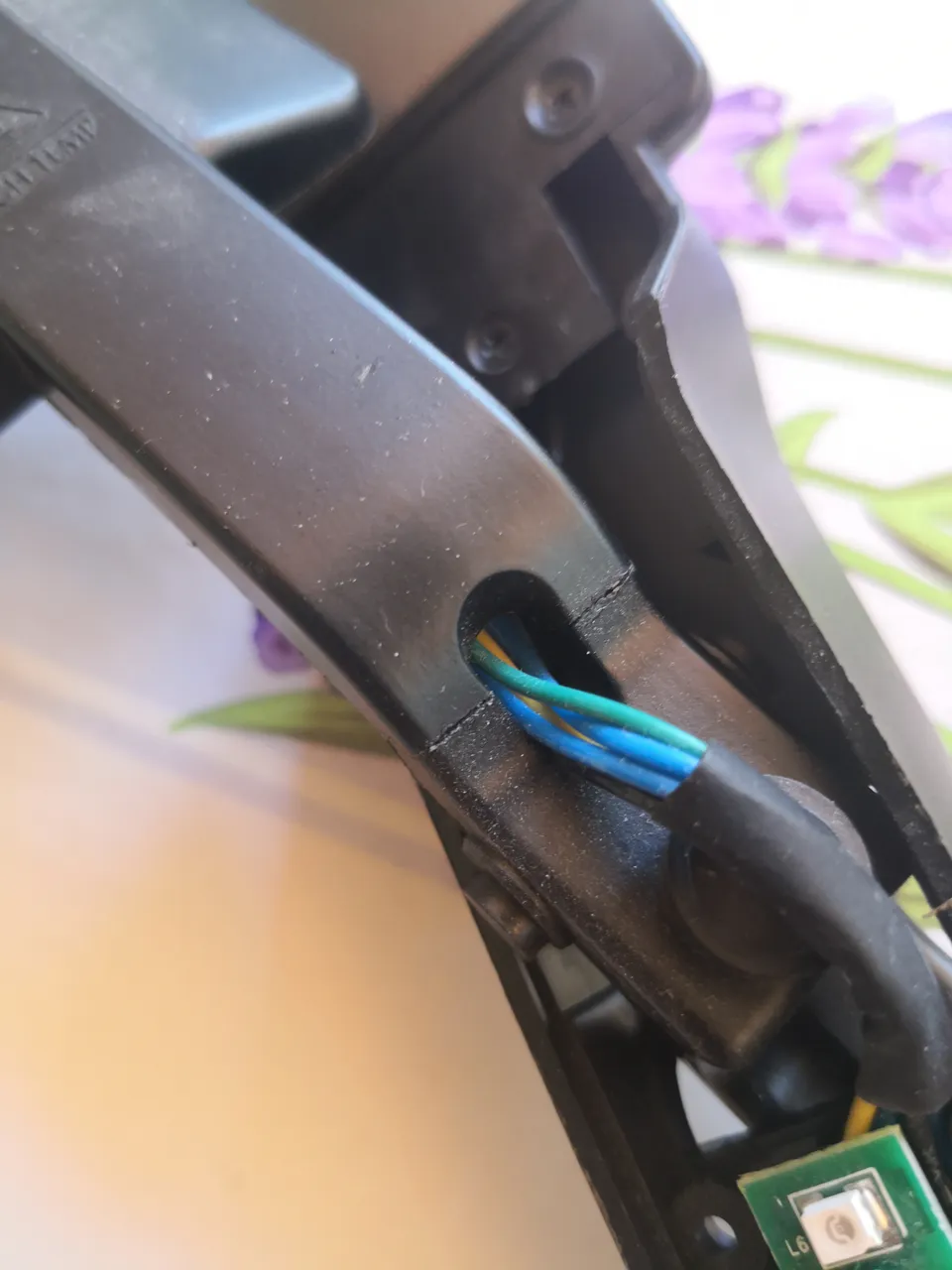
As you can see from the whitish lines near the bundle of blue strands, the part that puts pressure on the other straightener broke off.
For this reason I wrote that my friend will turn into an orthopedic surgeon for a few minutes....
In fact, he has to rebuild those two "knees" on pain of disposing of it, much to his wife's dismay....
Are you also ready and sitting by my friend's side like I did?
Good, let's get going!
First, let me show you the fractures in the plastic and the tool we used to fix them:
The two photographs above, clearly show the fracture points. Right now you can't see completely broken because my friend has already disassembled the plate and glued the 2 parts together to have the stumps locked for further work.

In the picture above you see what is the tool we will use for the fixings.
How does it work?
Simple, you insert the staples into the end of the brass electrodes and press the button on the gun.
The paper clip becomes glowing and "drowns" in the melted plastic.
Once the plastic cools, the paper clip remains in the melt and is independently removed from the gun.


These the various processes, in the end the plate with "osteo synthesis" results in this way:

The excess parts of the staples, you just need to bend them a little that they come off without any problem.
If one wants, to finish the job one can run a cutter over them to remove the loose pvc beads.
Finished the job and reassembled, the hair straightener turns out perfectly fine:

NOTE:
My friend has two really great hands, though this time I felt like giving him some advice in case the handle breaks again.
I told him to insert two screws (one on each side, of course) to provide more rigidity to the whole system.
Clearly, to insert 2 screws in the position in the drawing will require pre-drilling.

That's all for today too, see you at the next DIY intervention!
Happy active vacations to you all!