


Hola querido hiver.
Uno de los monumentos principales de mi ciudad, Zaragoza, es el llamado Palacio de la Aljafería. Su origen es del siglo XI y se construyó como lugar de recreo del monarca musulmán Al-Muqtadir. Él le dio el sobrenombre de Palacio de la Alegría que terminó derivando en Aljafería.
Con el paso de los siglos el edificio ha pasado por diferentes usos y ampliaciones hasta su estado actual. Estas piedras han visto pasar desde los mismísimos Reyes Católicos hasta las tropas de Napoleón. Cada uno se encargó de dejar sus huellas en lugar, unas con mejor intención que otras, pero todas han aterrizado en lo que ahora contemplan nuestros ojos y te voy a enseñar en esta publicación.


En la portada puedes ver el foso defensivo que rodea el palacio y destacan las torres almenadas que le dan su característica silueta de castillo medieval. Se accede por una puerta de herradura bastante discreta para la monumentalidad del edificio, situada en la parte central de las torres y frente al puente sobre el foso.
Cruzado el umbral llegamos al Patio de San Martín. Desde él se puede acceder a diversas estancias: a la derecha, la capilla del mismo santo y a la Torre del Trovador; a la izquierda a la sede de las Cortes de Aragón (el poder legislativo de la región); y al frente al palacio musulmán.
Acceder a este último es como entrar en un pequeño paraíso en la Tierra. Supongo que esa era la idea de Al-Muqtadir. Lo consiguió, vaya que sí lo consiguió. Si conoces la Alhambra de Granada es una versión reducida pero igual de impactante. Se percibe el frescor de las plantas y del agua que corre por esos canales. Su rumor es lo único que acompaña a los visitantes.


Columnas en las que reposan arcos lobulados y yeserías con formas vegetales y letras arabescas. Vamos hasta el fondo, que nos aguarda una sorpresa: el oratorio privado del monarca. Ahora vive mejores tiempos que cuando los soldados del ejército francés lo usaron como cocina hace algo más de doscientos años. A pesar de la restauración el hollín se resiste a abandonar este bello lugar.


La delicadeza del material con el que se adornaban las paredes era equivalente a la sensibilidad de estos artistas de la filigrana. Imagina cómo estaría relleno todos eso que aquí ves liso. Añádele colores. ¿No te decía que esto es un paraíso?


Abandonamos la zona musulmana y la estética cambia por completo: del yeso a la madera y de las formas geométricas e inertes a los animales y plantas.


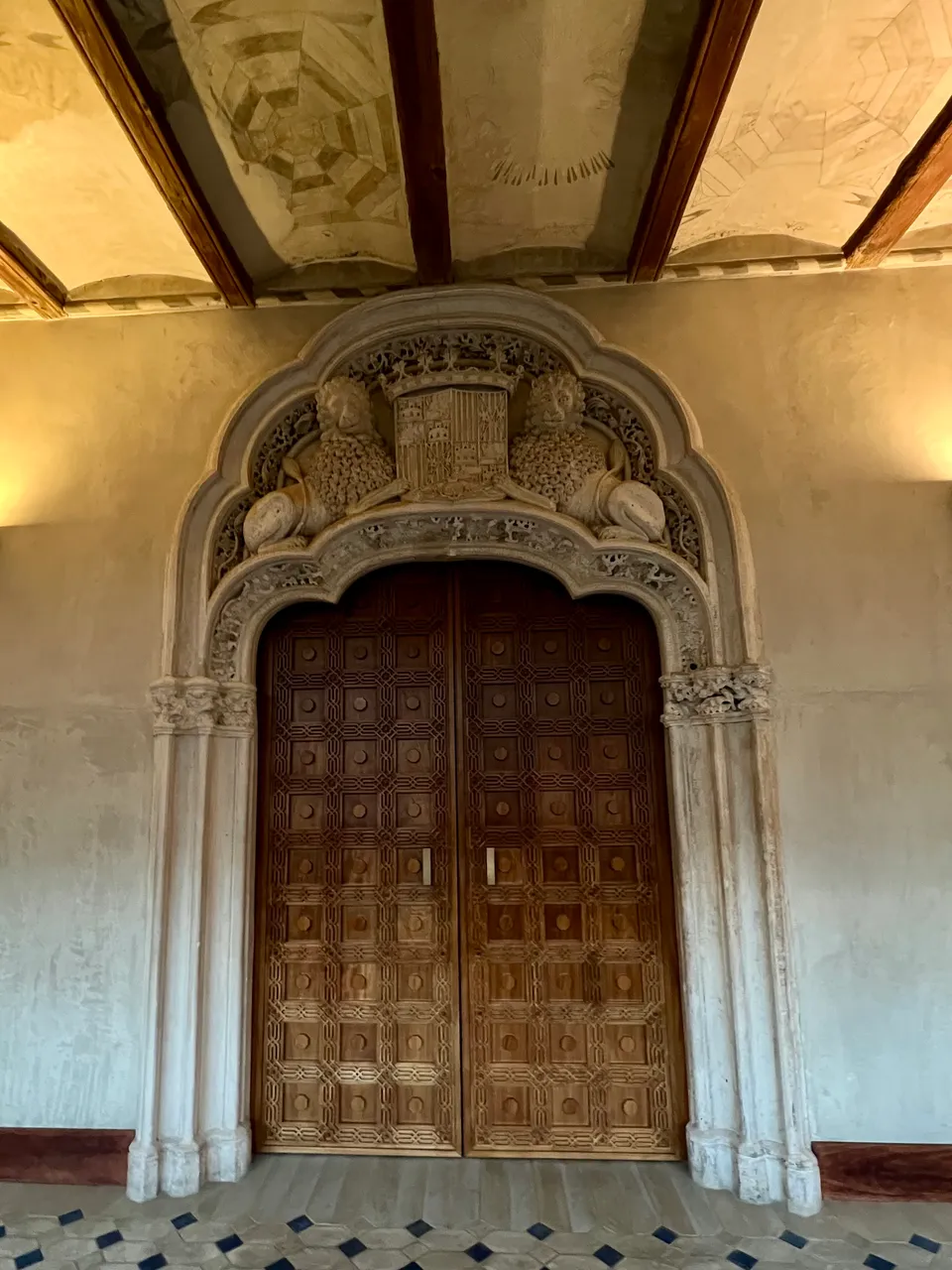
En esta parte hubo dos palacios cristianos. El medieval tras la reconquista y el de los Reyes Católicos. Este último es sencillo de identificar porque el lema y símbolos de estos monarcas aparecen por todas partes, en especial en los techos.


Entre todas las estancias esta es sin duda la más impresionante. Por algo es el Salón del Trono. Su artesonado de madera policromada y dorada se despliega sobre la galería, el friso y el salón.

Cuando salimos de allí y accedemos a la galería que hace las veces de corredor, es una delicia contemplar el palacio musulmán desde la parte superior.

Aquí pillé a dos hivers in fraganti, hehe. Guardaré su anonimato por esta vez, aunque si quieres averiguar quiénes son ya he escrito sobre ellos antes... Te tocará investigar...


Por nuestra parte vamos terminando la visita. Bajamos la escalera imperial que alguna vez pisaron Fernando e Isabel, Isabel y Fernando.


Terminamos la visita por el jardín desde el lado contrario al inicial. Desde aquí se pasa por el edificio de las Cortes, que se puede ver cuando los políticos no están repartiéndose el botín negociando y parlamentando.
Si quieres más detalles sobre este monumento, aquí te dejo el enlace a su página oficial.
Hasta la próxima publicación. Mientras tanto, ¡cuídate!

Herramientas: Cámara iPhone 13 Pro, editor de fotos Mac.
Si te gusta lo que publico, únete a mi Fanbase pinchando aquí

©️Copyright 2024 Paloma Peña Pérez. Todos los derechos reservados.

Hi, dear hiver.
One of the main monuments of my city, Zaragoza, is the so-called Aljafería Palace. It dates back to the 11th century and was built as a place of recreation for the Muslim monarch Al-Muqtadir. He gave it the nickname of Palacio de la Alegría (Palace of Joy), which eventually became Aljafería.
Over the centuries, the building has undergone various uses and extensions until it reached its current state. These stones have seen the passage of the Catholic Monarchs themselves as well as Napoleon's troops. Each one has left their mark on the place, some with better intentions than others, but all of them have landed in what our eyes now contemplate and I am going to show you in this publication.
On the front you can see the defensive moat that surrounds the palace and the crenellated towers that give it its characteristic silhouette of a medieval castle. Access is through a horseshoe gateway that is rather discreet for the monumentality of the building, located in the central part of the towers and opposite the bridge over the moat.
Once you cross the threshold, you come to the Patio de San Martín. From here you can access various rooms: to the right, the chapel of the same saint and the Troubadour's Tower; to the left, the seat of the Cortes de Aragón (the region's legislative power); and to the front, the Muslim palace.
Entering the latter is like entering a small paradise on Earth. I guess that was Al-Muqtadir's idea. He succeeded, he certainly did. If you know the Alhambra in Granada, it is a smaller version but just as impressive. You can feel the freshness of the plants and the water running through those canals. Their murmur is the only thing that accompanies visitors.
Columns on which rest lobed arches and plasterwork with vegetal forms and arabesque lettering. We go to the bottom, where a surprise awaits us: the monarch's private oratory. It is in better times now than when the soldiers of the French army used it as a kitchen a little over 200 years ago. Despite the restoration, the soot refuses to leave this beautiful place.
The delicacy of the material with which the walls were adorned was equal to the sensitivity of these filigree artists. Imagine how all that plain stuffing you see here would be filled in, add colours to it. Didn't I tell you that this is paradise?
We leave the Muslim area and the aesthetics change completely: from plaster to wood and from geometric and inert shapes to animals and plants.
There were two Christian palaces in this part. The medieval one after the Reconquest and the one of the Catholic Monarchs. The latter is easy to identify because the motto and symbols of these monarchs appear everywhere, especially on the ceilings.
Of all the rooms, this is undoubtedly the most impressive. It is the Throne Room for a reason. Its coffered ceiling in polychrome and gilded wood spreads out over the gallery, the frieze and the hall.
When we leave and enter the gallery that serves as a corridor, it is a delight to contemplate the Muslim palace from the top.
Here I caught two hivers in fraganti, hehe. I'll keep their anonymity for this one, though if you want to find out who they are I've written about them before... It'll be up to you to investigate...
As for us, we are finishing our visit. We descend the imperial staircase once trodden by Ferdinand and Isabella, Isabella and Ferdinand.
We finish the visit through the garden from the opposite side to the initial one. From here you pass by the Cortes building, which can be seen when the politicians are not sharing the spoils negotiating and parliamenting.
If you want more details about this monument, here is the link to its official website.
Until the next post. In the meantime, take care!
Tools: iPhone 13 Pro camera, Mac photo editor.
Translated with DeepL
If you like my content, join my Fanbase clicking here

©️Copyright 2024 Paloma Peña Pérez. All rights reserved.
