

At last, it has gotten warmer in Varanasi:

It's not only about a shift of 4 degrees from +9 at night, but it's also about buildings (in narrow cold lanes) being slowly warmed by the afternoon sun. +9 at night isn't nice when you have no heating in the hotel, no proper clothes and no blankets. But it's over now. We are going to have a period of super comfortable temperatures before the heat comes (perhaps, in March). I should really use this opportunity, especially because I have the time frame now - having a ticket for a flight to Georgia (country) for the middle of March.
Having all this in mind, I keep going out with my 1-kg black friend... (saying this I mean a Nikon DSLR, lol)... and photographing this wonderful city.
Already showed the ghats in the afternoon and at night, but there is another part of the old city: the lanes... Can't say they are beautiful but they impress a traveler, this is for sure: a stone labyrinth rich with street art, colorful shrines, animals, and scenes of everyday life. Here, I'll share some shots from that maze.

Varanasi is an absolute dog city, lol. A shock for a cat lover, like me? :D Nope. Surprisingly, Varanasi dogs are the most peaceful creatures. I noticed that in 2014 when I came here for the first time, and I confirm it now.

These dogs live in a parallel reality - if one barks, it means it is irritated by another dog or a cow, not you, not any other human. Once, I saw how several of them were barking and circling around a passing bull (all in the lane where two motorcycles can barely pass each other). Probably, they have a claim against this particular bull.
The reason why these dogs aren't aggressive against people may be that they have no owners and no land to guard, and they are cared for by strangers. Also, I guess the dog population of old Varanasi just evolved into a more peaceful breed - people normally aren't kind to mean dogs.

But don't idealize, though, they are treated like in a shelter - these are stray dogs, they are numerous, and nobody will cure one with medications if it is dying on the street.
There are also owned dogs and house dogs as well. But they are a minority here.

Kids are another tribe of the lanes, lol. Mostly, they don't rush to say hello to you as it happens in small cities in Rajasthan - Varanasi children are used to foreigners. But still, some communication is regular.

I was asked, "photo, photo!" And look how happy they were :)

Another tribe in the lanes:

Evil dwarf clowns - monkeys! :D

These tailed guys are also supported by strangers; and, when it's possible, they steal anything from humans and each other either.

This baby monkey robbed a mate and rushed away with loot - a sort of fruit. Guess what has happened next? The creature accidentally dropped the loot to the roadside and thus lost it... :D

This is actually the main lane of the central part of the old Varanasi, the widest one, called Bangali Tola.

Amazingly peaceful from the point of traffic, although passing motorcycles every time try to kill you, lol - I mean it feels very dangerous every time.
There is much street art in the lanes.

And not always devoted to religious topics.
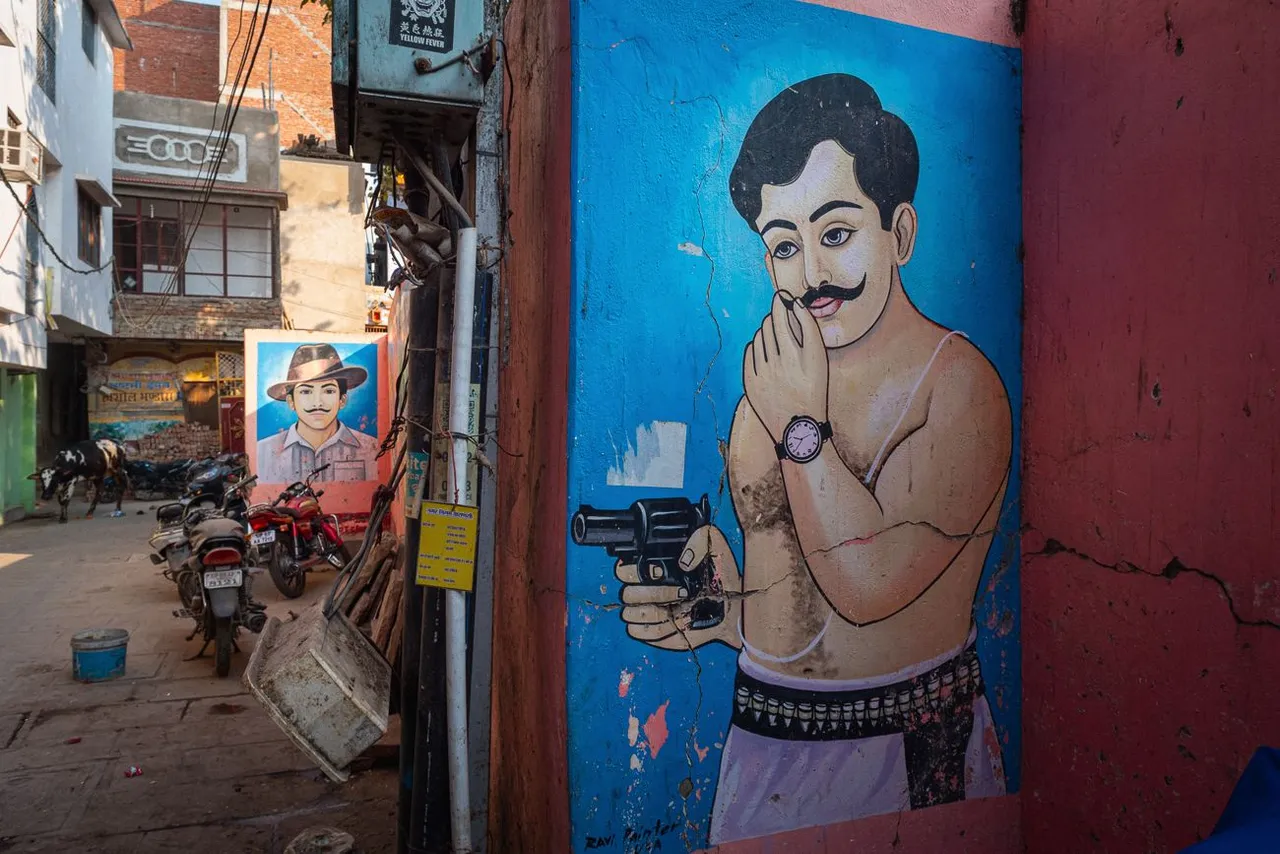
Loved this, Bollywood-themed ones.

And here is a remnant of the pandemic time:

A 24mm is very wide on a full frame, so you often have too much to control in the frame, and it also breaks geometry and distorts faces. You often are too far from the object, and need to literally stick the camera into the face of a stranger you are photographing, lol.

A crop
A difficult focal length compared to 35 and 50mm.

But it gives more space for creativity, and stands out from more usual lenses and mobile devices. In narrow lanes, it's just the best choice. Going to keep walking with my 24mm, more posts about Varanasi are coming, stay tuned! 😎
The photos were taken with a Nikkor 24mm f/2.8D on a full-frame DSLR Nikon D750 in January, 2026 in Varanasi, Uttar Pradesh, India.