
The 1920s in New York City were indeed "Roaring". The Garment District in the heart of the city was beneficiary to all that energy. Art Deco-inspired buildings featured showrooms on the ground floor. On the upper floors workers sewed clothes that would be sent not only to the showrooms, but all over the world.
My mother was a seamstress. She worked on one of those upper floors.

This is a picture of the factory in which my mother worked. The picture was part of her personal photo collection.

In later years, when I was growing up, my mother never complained about the work. The factories had been unionized under the International Lady Garment Workers Union, so conditions weren't bad. She was young and single. She got to see the newest fashions before they hit the stores. And Manhattan was her playground.
Rally of thousands during the 1933 Dressmakers' Strike in New York, August 27, 1933

Image Credit: Kheel Center Used under CC 2.0 license
This strike was a turning point in the union's history. The right to organize was codified in NIRA (National Industrial Recovery Act). The union capitalized on this and within a year its membership had grown from about 40,000 to 200,000.
Waldorf Astoria Lobby

Image credit: Alan Light. CC 2.0 license. The original Waldorf Astoria was torn down in 1929 to make way for the Empire State Building. In 1931, the new Waldorf Astoria was constructed with strong Art Deco influence.

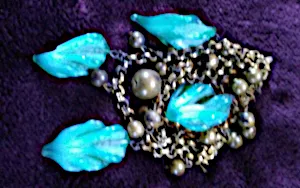
My mother had mementos from that time in her life, pictures of her in the Waldorf Astoria, pieces of fabric that were exotic and beautiful. And she had this strange bauble. I've never been certain about its intended purpose. Was it to be sewn on a dress? Turned into a broach? Attached to a hat, or shoe? It was just something my mother held onto, as though one day she would find a use for it. That day never came, until now.

New York City was awash in Art Deco...architecture, clothing, jewellery. This bauble shows the definite Art Deco influence. I'm not sure what the green glass (?) ornaments are intended to be. They look like highly stylized leaves. Or maybe they are hands. The brass beads are woven together with thread which has, remarkably, held up all these years. There is one corner that seems to have torn and then been repaired.

You can see from the back flap that the bauble is supposed to be attached to something, probably by threads. Or, perhaps, more metal beads were to be added. I don't know. It's just a relic that reminds me of my mother and the stories she told about a happy time in her life.

Evening in Paris

In 1929 a perfume called Evening in Paris was imported into the United States by the Bourjois company. This perfume became so popular that it was formulated and packaged in a number of forms, including face powders, rouge compacts and talc. The bottle pictured above is the classic cobalt blue, Art Deco style bottle in which Evening in Paris talc was sold.
Advertisement in Paris for Bourjois Products

Image credit: Unknown author. 1923. Public domain
I believe my mother also had the face powder featured in the ad, although I'm not sure. The scent comes back to me and it seems familiar.
My mother used to keep the talc bottle on her bedroom dresser, next to a hairbrush inlaid with mother of pearl. In my recollection, she never used the hairbrush, the face powder or the talc. These were part of the furniture, decorations. The hairbrush and face powder were lost over the years, but this cobalt blue bottle is still filled with talc today.

A few days ago I was surfing different blogs and came across 
This was great fun. I'll bet most people have some relics hanging around in their closets. It would be interesting to hear the stories behind those.

Art Deco Border design was adapted from a Pixaby picture by AnnaliseArt
