
There are four tribes of corbiculate bees, the Euglossini tribe which includes the so-called "orchid bees", the Bombini tribe which includes the bumblebees, the Meliponini tribe which includes the stingless bees, and the Apini tribe which includes the honeybees. They are called corbiculate bees because they have corbiculae or pollen baskets on their hind legs.
Existen cuatro tribus de abejas corbiculadas, la tribu Euglossini que incluye a las llamadas "abejas de las orquídeas", la tribu Bombini que incluye a los abejorros, la tribu Meliponini que incluye a las abejas sin aguijón, y la tribu Apini que incluye a las abejas melíferas. Se llaman abejas corbiculadas porque tienen corbículas o canastas de pollen en sus patas traseras.

The bees of the Euglossini tribe (commonly known as "orchid bees") differ significantly from their social relatives in morphology and behavior, including their exceptionally long tongues and bright iridescent coloration. Most striking about these bees is that the morphology of the males is uniquely modified to collect aromatic compounds from certain orchids and other plants.
Las abejas de la tribu Euglossini (comúnmente conocidas como "abejas de las orquídeas") difieren significativamente de sus parientes sociales en cuanto a morfología y comportamiento, incluyendo sus lenguas excepcionalmente largas y su brillante coloración iridiscente. Lo más sorprendente de estas abejas es que la morfología de los machos está modificada de forma única para recoger compuestos aromáticos de ciertas orquídeas y otras plantas.
The modifications include brushes or tufts on some of their legs that they use to remove the aromatic compounds, for example, from the labellum or middle petal that is distinguished among the other orchid petals by being larger. They also have, on other legs, comb-like structures that allow them to transfer aromatic compounds from some legs to others where they are absorbed through an opening in a spongy storage chamber.

Las modificaciones incluyen cepillos o mechones en algunas de sus patas que utilizan para remover los compuestos aromáticos, por ejemplo, del labelo o pétalo medio que se distingue entre los otros pétalos de las orquídeas por ser más grande. También tienen, en otras patas, estructuras en forma de peine que les permiten transferir los compuestos aromáticos de unas patas a otras donde se absorben a través de una abertura en una cámara de almacenamiento esponjosa.
In general, adult males of the tribe Euglossini, in addition to being adapted to collect pollen by their corbiculae, are able to collect and store aromatic substances. This plays an important role in pollination biology, because many orchids and other flowering plants have adapted to pollination by males of the tribe Euglossini.
En general, los machos adultos de la tribu Euglossini, además de estar adaptados para recolectar polen por sus corbículas, son capaces de recolectar y almacenar sustancias aromáticas. Esto juega un papel importante en la biología de la polinización, ya que muchas orquídeas y otras plantas con flores se han adaptado a la polinización por parte de los machos de la tribu Euglossini.

The collection of fragrance or aromatic compounds is done in the following way. The bee alights on a fragrant surface, for example an orchid flower, and examines it with its antennae. Then, its labial glands secrete self-produced lipids that are mixed with the fragrance by means of the tufts on its forelegs. For this, the bee brushes the fragrant surface with its legs. It then takes off and flies off, during which it brushes the mixture of lipids and fragrance onto its hind legs. The mixture of substances, which is now on the hind legs, is raked by the comb-like structure to the slit or opening of the container on its legs containing spongy tissue.
La recolección de la fragancia o compuestos aromáticos la realizan de la siguiente manera. La abeja se posa en una superficie perfumada, por ejemplo una flor de orquídea, y la examina con las antenas. Luego, sus glándulas labiales segregan lípidos de producción propia que se mezclan con la fragancia por medio de los mechones en sus patas delanteras. Para esto, la abeja cepilla la superficie perfumada con sus patas. A continuación, despega y emprende un vuelo, durante el cual cepilla hacia sus patas traseras la mezcla de lípidos y fragancia. La mezcla de sustancias, que ahora se encuentra en las patas traseras, es rastrillada por la estructura parecida a un peine hasta la hendidura o abertura del contenedor en sus patas que contiene tejido esponjoso.

The fate of the mixture of aromatic substances is unknown and the exact function of these stored aromatic compounds is a matter of debate, although some evidence suggests a role in mating behavior and sexual selection.
El destino de la mezcla de sustancias aromáticas es desconocido y la función exacta de esos compuestos aromáticos almacenados es objeto de debate, aunque algunas pruebas sugieren un papel en el comportamiento de apareamiento y la selección sexual.
In the Euglossini tribe is the genus Euglossa, the photographs I show are of a species of that genus. The bee is visually similar to the dilemma species. Something remarkable in that genus is their flight speed, they are bees that fly very fast and can also stop in the air and perform maneuvers to stay stable. The photographs I captured in a natural environment, were while the bee was staying in one place in the air.
En la tribu Euglossini se encuentra el género Euglossa, las fotografías que muestro son de una especie de ese género. La abeja es visualmente similar a la especie dilemma. Algo notable en ese género es su velocidad de vuelo, son abejas que vuelan muy rápido y además pueden detenerse en el aire y ejecutar maniobras para mantenerse estables. Las fotografías que capturé en un entorno natural, fueron mientras la abeja se mantenía en un mismo lugar en el aire.

These bees, for example in a forest, forage for diverse resources, which can be found anywhere, from the floor to the top of the trees, that is, they fly at all vertical levels of the forest. When flying for food, these bees can find higher air speeds at the top of trees or in open terrain. These bees may fly at high speeds in the natural environment for a number of reasons: to cover long distances while foraging over large areas, transit quickly through exposed habitats, escape from aerial predators, or simply to progress forward in the face of a strong headwind. They can fly at speeds of 3 to 6 meters per second.
Estas abejas, por ejemplo en un bosque, buscan diversos recursos, que pueden encontrarse en cualquier lugar, desde el suelo hasta la parte superior de los árboles, es decir, vuelan en todos los niveles verticales del bosque. Cuando vuelan buscando alimento, estas abejas pueden encontrar velocidades del aire más altas en la parte superior de los árboles o en un terreno abierto. Estas abejas pueden volar a gran velocidad en el entorno natural por varias razones: para cubrir largas distancias mientras buscan alimentos en grandes áreas, para transitar rápidamente por hábitats expuestos, para escapar de depredadores aéreos o simplemente para avanzar ante un fuerte viento en contra. Pueden volar a velocidades de entre 3 y 6 metros por segundo.
At high air speeds, which can cause the bee to lose stability in flight, they can maintain stable flight by extending their hind legs.
A altas velocidades del aire, que pueden hacer que la abeja pierda estabilidad en su vuelo, pueden mantener su vuelo estable a través de la extensión de sus patas traseras.

While I was capturing the photographs, I was thinking of a way to catch one to see it up close with more detail, what occurred to me was that, as the flowers are trumpet-shaped and the bee has to travel a short distance inside the flower, as soon as it entered I would close the entrance with my fingers. That's what I did, then I removed the flower from the plant and placed it inside a plastic container which I closed. The bee came out of the flower, walked and flew into the container; it also tried to get out by biting with its mandibles into slits in the container. I show the photographs below.
Mientras capturaba las fotografías, pensaba en alguna manera para atrapar alguna y así verla de cerca con mayor detalle, lo que se me ocurrió fue, que como las flores tienen forma de trompeta y la abeja tiene que recorrer un corto trayecto dentro de la flor, tan pronto entrara cerraría la entrada con los dedos. Eso hice, después removí la flor de la planta y la coloqué dentro de un recipiente de plástico que cerré. La abeja salió de la flor, caminó y voló dentro del recipiente; también intento salir mordiendo con sus mandíbulas hendiduras en el recipiente. A continuación, muestro las fotografías.


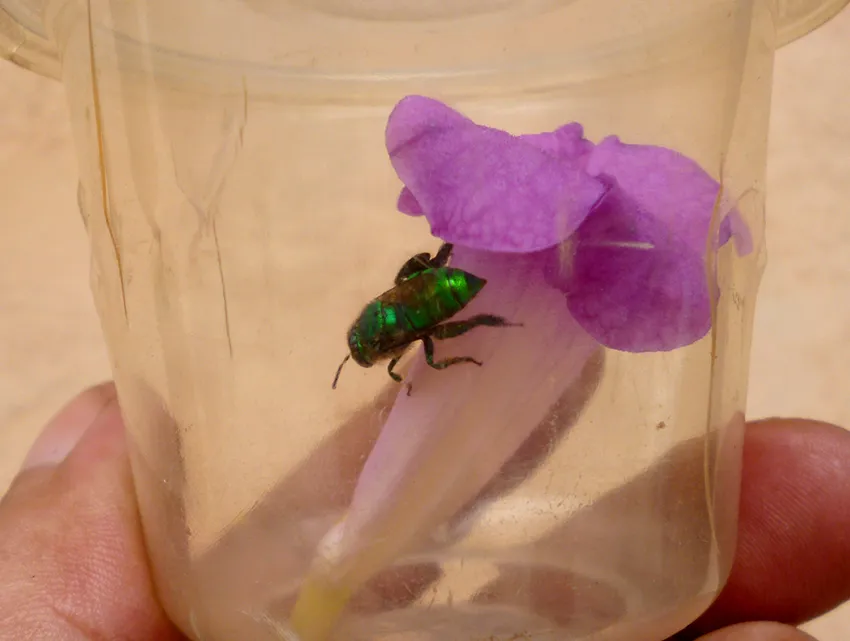


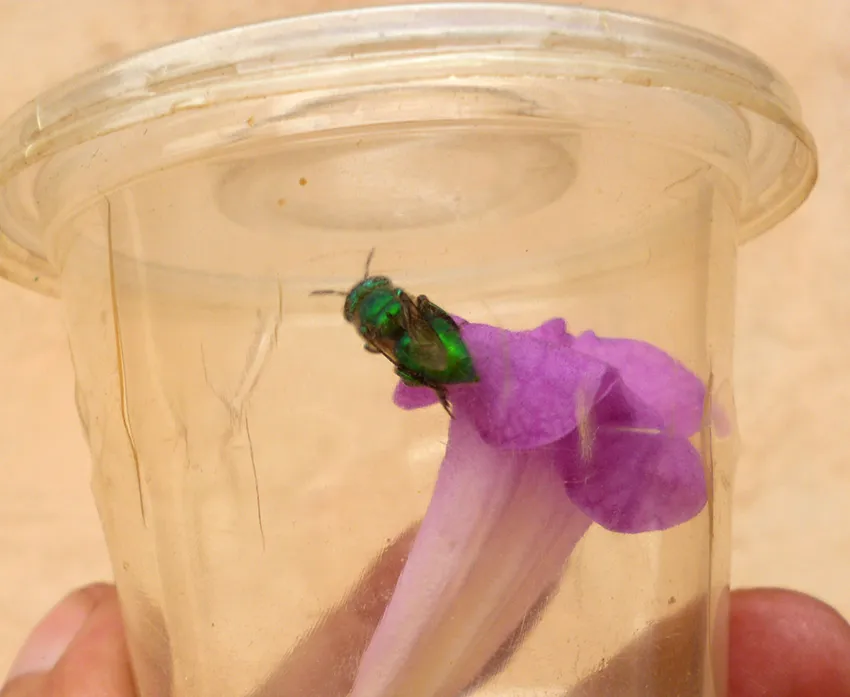


The actions of the bees in the natural environment and inside the container I captured on video and can be watched in the following.
Las acciones de las abejas en el entorno natural y dentro del recipiente, las capturé en video y se pueden ver en el siguiente.

Imágenes capturadas con cámara digital Panasonic DMC-FH4.
