

Image designe by me with canva
¡Hola amigos! Hoy les traigo un artículo interesante del cuál tal vez no hayan oído hablar, aunque otros sí, se trata de los pies de loto, una tradición muy antigua en la que deformaban los pies de las niñas chinas para reducirles el tamaño ¿de qué forma? y ¿para qué propósito? Sigue leyendo y descubrirás las respuestas.
Hello friends! Today I bring you an interesting article which you may not have heard of, although others have, it's about lotus feet, a very old tradition in which Chinese girls' feet were deformed to reduce their size, in what way and for what purpose? Read on and you will find out the answers.

Aunque el nombre no suena para nada mal, de hecho más bien tiene un nombre precioso, se trata de una tradición bastante dolorosa que consistía en vendar los pies de las niñas chinas hasta deformarlos por completo, con el objetivo de disminuir el tamaño en la mayor medida posible y dejarlos con la apariencia de un botón de loto.
Although the name doesn't sound bad at all, in fact it has a beautiful name, it's a rather painful tradition that consisted of bandaging the feet of Chinese girls until they were completely deformed, with the aim of reducing the size as much as possible and leaving them with the appearance of a lotus button.


Esta tradición se inicio en el siglo X, se dice que surgió a partir de que cierto emperador le pidiera a su concubina que atara sus pies en forma de luna creciente y que danzara para él en puntas de pie, a todos les resultó tan elegante la danza de la concubina que pronto todas las mujeres empezaron a imitarla.
This tradition began in the tenth century, it's said that it arose after a certain emperor asked his concubine to tie her feet in the shape of a crescent moon and dance for him on her tiptoes, everyone found the concubine's dance so elegant that soon all the women began to imitate it.
Pero su origen también pudo haberlo influenciado el surgimiento de un cuento de hadas (una versión de cenicienta) este cuento se llama Yeh Xian, y fue escrito en el año 850, en esta versión la protagonista pierde su calzado, el cual, luego de pasar por las manos de varias personas, llega hasta un rey, el cuál queda admirado con el pequeño tamaño y decide buscar a su dueña para casarse con ella, de esta forma deducimos que el ideal de belleza de los pies pequeños existía desde hace muchísimos años.
But its origin could also have been influenced by the emergence of a fairy tale (a version of Cinderella) this story is called Yeh Xian, and was written in the year 850, in this version the protagonist loses her shoes, which, after passing through the hands of several people, reaches a king, who is admired with the small size and decides to look for its owner to marry her, thus we deduce that the ideal of beauty of small feet existed for many years.

En un principio esta costumbre era exclusiva de la alta sociedad, ya que solo las mujeres ricas podían darse el lujo de prácticamente inutilizar sus pies, debido a que contaban con servidumbre que hiciera el trabajo por ellas, no obstante la costumbre posteriormente se popularizó en todos los estratos sociales, y para los hombre era señal de prestigio ya que con esto le demostraban a las demás personas que podían mantener a su esposa.
At the beginning this custom was exclusive of the high society, since only the rich women could afford the luxury of practically disable their feet, because they had servants to do the work for them, however the custom later became popular in all social strata, and for men it was a sign of prestige because with this they showed other people that they could support his wife.

¿Cómo era el proceso de vendaje?
How was the bandaging process?
La edad ideal para vendar los pies de las niñas era después de cumplir los 2 años, pero antes de los 6, se realizaba normalmente durante el invierno porque se creía que durante esa época había menos sensibilidad, y por lo tanto el proceso era menos doloroso.
The ideal age for bandaging girls' feet was after the age of 2, but before the age of 6, it was usually done during the winter because it was believed that during that time there was less sensitivity, and therefore the process was less painful.

En primer lugar remojaban los pies de la niña en una solución tibia de hierbas y sangre animal. Posteriormente les cortaban las uñas, masajeaban los pies por un largo rato, y por ultimo procedían a envolver cada pie usando vendas de algodón de 3 metros de largo por 5 centímetros de ancho. Estas vendas eran previamente sumergidas en la misma solución de hierbas y sangre.
First they soaked the girl's feet in a warm solution of herbs and animal blood. Then they cut the nails, massaged the feet for a long time, and finally proceeded to wrap each foot using cotton bandages 3 meters long by 5 centimeters wide. These bandages were previously dipped in the same solution of herbs and blood.

El proceso era bastante doloroso porque mientras envolvía los pies, la persona encargada de hacer esto, doblaba los dedos del pie de la niña con mucha fuerza y hacía lo mismo con el arco, todos los días hasta romperlo por completo. Las vendas se ajustaban cada vez más y se cosían para que las niñas no intentaran zafarlas.
The process was quite painful because while wrapping the feet, the person in charge of doing this, bent the girl's toes with great force and did the same with the arch, every day until it was completely broken. The bandages were pulled tighter and tighter and stitched so that the girls would not try to pull them off.

Usualmente quien se encargaba de este proceso era la abuela de la niña o cualquier mujer que no fuese su madre, ya que ésta no solía soportar los quejidos y llantos de su hija. Era un proceso tan agresivo para la salud del pie que a veces las niñas contraían infecciones y se les caían algunos dedos, algo que se consideraba beneficioso pues los pies quedaban aún más pequeños.
Usually who was in charge of this process was the girl's grandmother or any woman who was not her mother, since she could not stand the whining and crying of her daughter. It was such an aggressive process for the health of the foot that sometimes the girls got infections and some of their toes fell off, something that was considered beneficial because the feet became even smaller.

La longitud ideal de los pies de loto eran de 11 centímetros o menos a la cuál llamaban «Loto dorado» posteriormente existían los pies de 13 cm «Loto de plata» y en el último escalafón estaban los pies de 15 cm o más «Loto de hierro» (estos últimos eran los menos deseables)
The ideal length of the lotus feet was 11 centimeters or less, which was called "Golden Lotus", then there were the feet of 13 cm "Silver Lotus" and in the last step were the feet of 15 cm or more "Iron Lotus" (the latter were the least desirable).

Calzado para los pies de loto
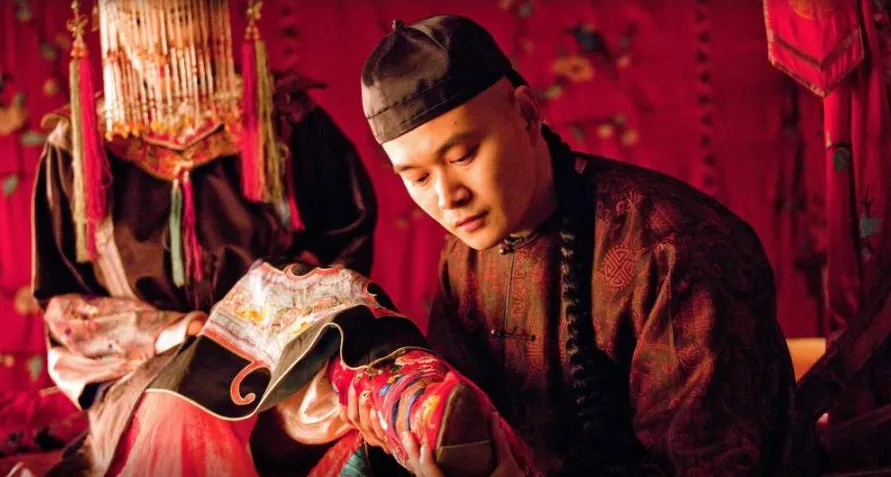
Conforme las niñas iban creciendo y sus pies se desfiguraban, obviamente ya no podían usar un calzado común y corriente, sino uno especial, bellamente adornado y que les brindara un soporte adecuado para poder caminar con ellos, aunque estas mujeres no podían permanecer demasiado tiempo paradas y mucho menos caminar normalmente.
As the girls grew older and their feet became disfigured, they obviously could no longer wear ordinary footwear, but rather special, beautifully ornamented footwear that would provide adequate support for them to walk in, although these women could not stand for too long, let alone walk normally.


Propósitos
Purposes
A pesar de que las mujeres que vendaban los pies de sus hijas lo hacían por una razón estética ya que creían que de esta forma se veían hermosas, y de hecho muchos hombres así lo creían, los pies de loto también tenían una connotación erótica pues, algunos hombres creían que el hecho de caminar en puntillas fortalecía los músculos de la vagina y por lo tanto esto derivaba en una relación sexual más placentera para el hombre, de hecho los manuales sexuales de la dinastía Qing contenían 48 formas diferentes de jugar con este tipor de pies.
Although women who bandaged their daughters' feet did it for an aesthetic reason as they believed that this way they looked beautiful, and in fact many men believed so, lotus feet also had an erotic connotation because some men believed that walking on tiptoe strengthened the muscles of the vagina and therefore this resulted in a more pleasurable sexual intercourse for men, in fact the sex manuals of the Qing dynasty contained 48 different ways to play with this type of feet.
Hemos llegado al final de este artículo, amigos, espero que les haya gustado, que hayan aprendido algo nuevo, muchas gracias por dedicarme su tiempo.
We have reached the end of this article, friends, I hope you liked it, that you have learned something new, thank you very much for dedicating your time to me.

Image designe by me with canva
A continuación les dejaré las fuentes en las cuales encontré información de apoyo para la realización de este artículo.
Below are the sources from which I found the information to support the preparation of this article.
Curiosidades.com
La moda en la historia