

Hi, everyone, how are you? 😊I want to show you some collages I made. They cover different themes, but they all have one thing in common: they were all created with care and are meant to inspire reflection or further exploration if you like the idea of using art to complement a story. 😌

📀golden lady📀
I was inspired by 📀Gustav Klimt📀,and for those who aren't familiar with him, I'll give you a brief overview. He is said to have been a master of modernism; he became known for his “Golden Age,” using gold and silver leaf, oil, and tempera on canvas to create dense, luminous textures. He worked with tools such as fine brushes for meticulous details, palette knives for textures, and a cardboard viewfinder to frame landscapes.
📀These are examples of the works

📀Adele Bloch-Bauer I

📀the kiss
It was really interesting to use Klimt's works as an example, since I liked how the collage turned out. It took me almost two hours to find magazine clippings to make this, and it was worth it. 😉

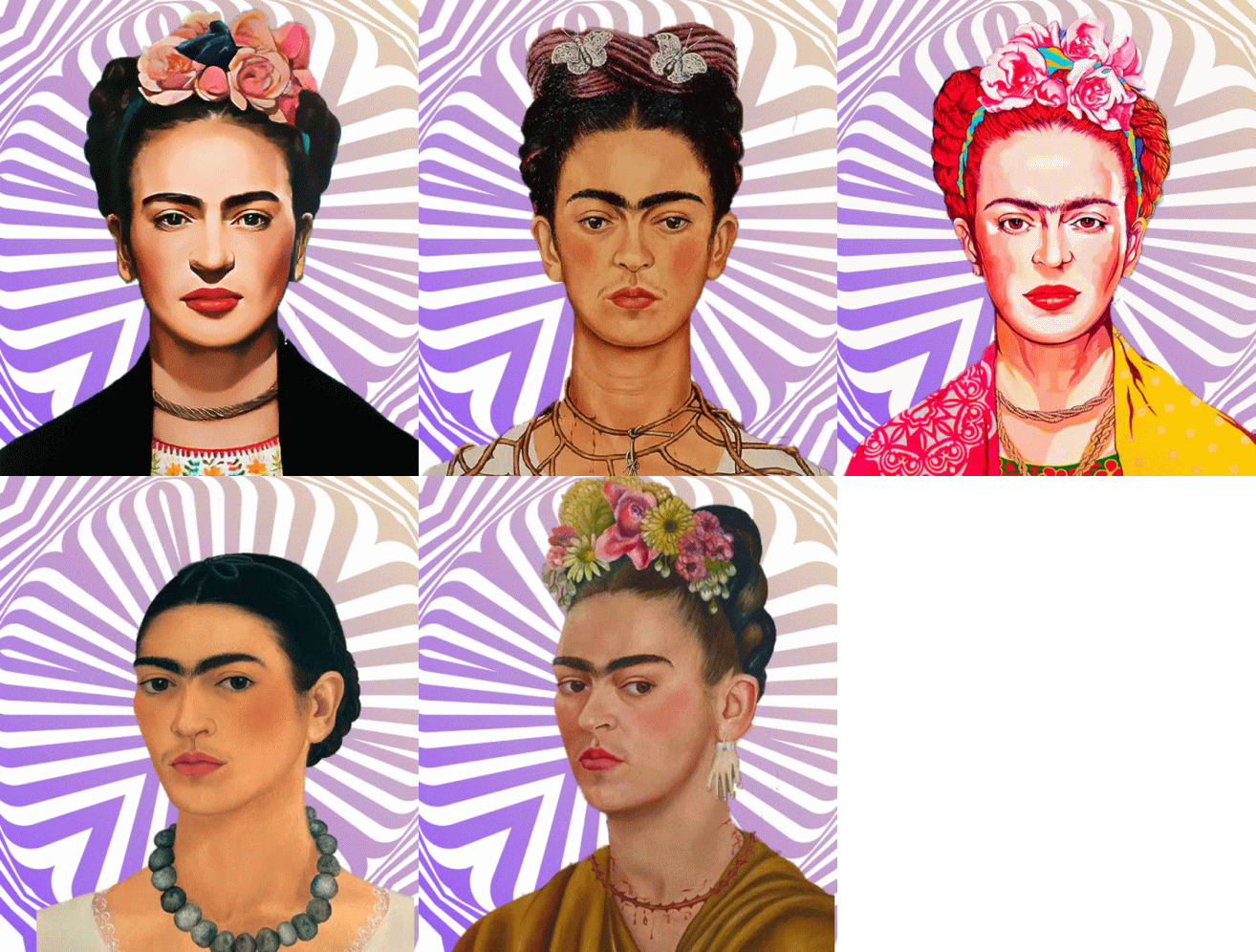
Now it’s Mexico’s turn, featuring one of its most famous female artists 🦋 Frida Kahlo💖
Kahlo was known for her intense self-portraits, rich in symbolism and conveying both physical and emotional pain, as well as a strong sense of Mexican identity. She used vibrant colors, elements of nature, and a folk aesthetic to capture her autobiographical reality, using art to overcome the pain of her accident and her tumultuous relationship with Diego Rivera.💚
I had some unused encyclopedias and a color print of Kahlo. And I thought, it would be really interesting to create something to add to my blog.🦋
I had to do some research, and to give the collage more character, I cut the images into pieces—some with irregular edges—and placed Frida in the center, just like the self-portraits she used to make.💖


⛳️early 19th century (1800-1820)🎻
A lot has happened, such as
🎻this era can be viewed in two ways.
⛳️1. To tell the story of the changes that shaped the world into what we know today
🐴the spread of the ideas
🤛 the French Revolution,
🌻the Napoleonic era,
💗and the onset of industrialization
🎻2. To romanticize the era and use it as a trendy hook in fashion, movies, TV shows, romantic relationships, articles, etc. ( Pride and Prejudice - Bridgerton)
This time I went with the second commercial concept to see how it would turn out, and I liked the result too.
Another time I'll do something a bit more crude and, so to speak, a bit more natural—without romanticizing it


💙sea and color
Here I was just thinking about
💙The Caribbean Sea
💙Venezuela
💙And Colombia
They form a coastal zone with La Guajira as the meeting point. In other words:
💙The region is vital to both countries because of its resources,
💙including fishing
💙tourism
💙new gas discoveries
💙as well as serving as a bridge for trade
💙and cooperation, with significant transportation and logistics activity
The two countries are like brothers, and the truth is that I found great inspiration in their colors to create this collage
By the way, I also wanted to mention that the structures that look like houses on stilts in Venezuela are known as 💙“palafitos,”💙 which are traditional dwellings built on wooden stilts (made from mangrove wood) directly over the water or on flood-prone land, commonly found on Lake Maracaibo and in the Orinoco Delta. These ancestral structures, central to indigenous culture, stand out for their fresh, sustainable design and their use as functional homes, restaurants, or cultural heritage sites.


⏳The Future in the 1960s💡
This really got me thinking. With so much reliance on technology, sometimes you have to wonder what else they can invent—or, failing that, what else can be modified to make things work even better.
the color palette and what I found in old encyclopedias—I was only able to save the images. This is what I came up with
In the 1960s and 1970s, there were many predictions that came true and others that didn’t quite. People also had very fanciful ideas about what the future would be like.
💡I'm going to share with you one of the studies I came across online
💡A Cashless Economy
In December 1969, the BBC science program “The World of Tomorrow” predicted that there would be no cash in the future and proposed new job opportunities for all banking workers. We know that cash still exists, but at the time, the program suggested that people would use a magnetic card with a private number to make transactions through a modem-style system. It also predicted that paper receipts would be a thing of the past.


💞Reflection and Books💕
This was the simplest one, and all I could think about was the reflection that goes hand in hand with problem-solving.
And I feel like you can almost hear the music, just like in a romantic comedy movie.
With its cliché of finding love unexpectedly, facing obstacles along the way, and ending with a happy ending.
💞I think this would be a good example
❤️Mujer bonita (Pretty Woman, 1990): Una comedia romántica icónica sobre un empresario y una trabajadora sexual


Thank you for reading this far. Blessings. 😊