

ESPAÑOL (clica aquí!)
Hace sólo unos días no dejó el Dr. Claus Knapp Boetticher. Me enteré por uno de sus hijos que me lo comunicó personalmente una tarde de domingo. Ese día no pude acompañar a la familia debido a mis propias obligaciones familiares; espero reparar, de alguna forma mi ausencia, dejando por escrito mi recuerdo de una de las personas más brillantes que he conocido.
Acompañan al texto dos videos, que son una parte muy importante de esta publicación y para esta comunidad.
En éstos videos nos encontraremos al Dr. Claus Knapp Boetticher explicando como, junto al Dr. Widukind Lenz, descubrieron la causa de la muerte y de las terribles malformaciones presentes en miles de bebés, en numerosos países, durante los años 60,s. La causa fue un medicamento, la talidomida y, sin ninguna duda, su descubrimiento salvó miles y miles de vidas.
Just a few days ago, Dr. Claus Knapp Boetticher passed away. I found out from one of his sons, who told me personally one Sunday afternoon. That day, I was unable to accompany the family due to my own family obligations; I hope to make up for my absence in some way by writing down my memories of one of the most brilliant people I have ever known.
Accompanying the text are two videos, which are a very important part of this publication and for this community.
In these videos, we see Dr. Claus Knapp Boetticher explaining how, together with Dr. Widukind Lenz, they discovered the cause of death and terrible malformations in thousands of babies in numerous countries during the 1960s. The cause was a drug, thalidomide, and without a doubt, their discovery saved thousands and thousands of lives.

ESPAÑOL (clica aquí!)
En una entrevista publicada en isanidad al Dr. Claus Knapp Boetticher se le pregunta sobre lo injusto de que el trabajo de investigación llevado junto a Lenz no fuera reconocido con el Premio Nobel en medicina. La respuesta, ya nos da una aproximación a la gran humanidad y modestia que atesoraba Claus:
Con 31 años, en 1959 usted y su colega Lenz descubrieron el origen de las malformaciones que empezaron a ver en recién nacidos, y con medios escasos. ¿Usted es consciente de la trascendencia que tuvieron sus investigaciones y de la enorme labor que hizo? No es exagerado decir que, con la perspectiva que da el tiempo, tendrían que haberles reconocido su trabajo con el Premio Nobel de Medicina.
No es una labor meritoria, yo he hecho en otras especialidades cosas que tenían muchísimo más trabajo, muchísima más intencionalidad y dificultad, e igual que también se salvan muchas vidas, pero no son tan escandalosas. Entonces, pues bueno, yo no considero que esto sea nada especial, es cumplir con lo que tenemos que cumplir.
Los 2 vídeos, por tanto, son el testimonio de una labor que aunque no logró un merecido reconocimiento como el Nobel, puso coto a una gran tragedia. De verdad que merece dedicarles un tiempo.
In an interview published on isanidad, Dr. Claus Knapp Boetticher was asked about the injustice of his research with Lenz not being recognized with the Nobel Prize in Medicine. His response already gives us a glimpse into Claus's great humanity and modesty:
In 1959, at the age of 31, you and your colleague Lenz discovered the origin of the malformations you began to see in newborns, and with limited resources. Are you aware of the significance of your research and the enormous work you did? It is no exaggeration to say that, with the perspective that time gives, your work should have been recognized with the Nobel Prize in Medicine.
It's not a commendable achievement. I've done things in other specialties that involved much more work, much more intention and difficulty, and just as many lives are saved, but they're not as sensational. So, well, I don't consider this to be anything special, it's just doing what we have to do.
The two videos, therefore, bear witness to work that, although it did not receive the recognition it deserved, such as the Nobel Prize, put an end to a great tragedy. It is truly worth taking the time to watch them.

ESPAÑOL (clica aquí!)
En estos dos vídeos, con muy pocas visualizaciones a pesar del paso del tiempo y de su contenido, se haya una estupenda síntesis de la vida de Claus, contada por el mismo. Una vida y obra que va más allá de la talidomida.
También aparecen sus opiniones personales sobre temas diversos como las farmacéuticas o los políticos, dos temas que llegó a conocer muy bien. También reflejan, estas grabaciones, su buen talante, su buen humor y su modestia.
La vida pública de Claus se puede encontrar en internet y en los dos videos que presento hoy por que trataré de dar una visión, la mía, más personal.
These two videos, which have received very few views despite the passage of time and their content, provide a wonderful summary of Claus's life, told by himself. A life and work that goes beyond thalidomide. They also feature his personal opinions on various topics such as pharmaceutical companies and politicians, two subjects he came to know very well. These recordings also reflect his good nature, good humor, and modesty.
Claus's public life can be found on the internet and in the two videos I am presenting today, because I will try to give a more personal view, my own.

ESPAÑOL (clica aquí!)
No recuerdo exactamente como fue nuestro primer encuentro. Claus, persona habladora y que solía pararse a charlar con los vecinos que se encontraba por la calle, un día me cazó. Normalmente huyo de este tipo de situaciones, ni soy hablador, ni me gusta que personas desconocidas me asalten por la calle… Sin embargo, ese día no salí corriendo, ni tampoco puse mala cara. Algo raro ocurrió esa mañana.
Desde ese primer momento he tenido la oportunidad de hablar en numerosas ocasiones con Claus de temas que nos interesaban a los dos, como la des-humanización de la medicina. En más de una ocasión me decía: las palabras también curan.
Nunca he tenido muy claro por qué Claus me permitió ser una parte, una parte muy pequeña, de su vida. En ocasiones he pensado que fue por interés. A Claus, le busqué durante años los libros de segunda manos que necesitaba. Aunque con seguridad, creo que no fue sólo al buscador de libros lo que vio en mi.
De esta relación conservo una carpeta con alguna documentación que Claus creyó que debía de conservar o al menos leer: fotocopias de artículos de periódicos, artículos científicos y algún libro que hablan de su lado más personal.
Siempre se mostró muy orgulloso de sus hijos, y entre las imágenes que hoy comparto se encuentra la fotografía de una entrevista a un hijo suyo publicada en una revista de esas de gran nombre. Puedo recordar el día que con alegría me compartió esa entrevista fotocopiada.
Tampoco se olvidaba de su esposa en nuestras conversaciones, una mujer sueca, aunque siempre me pareció muy "española", que parece que tuvo bstante paciencia con Claus. O eso entendí de nuestras conversaciones.
No salir corriendo ese primer día en el que se me acercó Claus ha fue toda una suerte para mi. Hay un momento en la historia de la medicina y de la ciencia en la que todo cambió. Lo explica muy bien Laborit (otro libre pensador como Claus) en su Autobiografía. Hubo un momento, posterior a la finalización de la II GM, en el que la ciencia todavía no estuvo secuestrada totalmente por la gran industria, y en el todavía hubo un pequeño espacio para la libre investigación.
Investigadores y científicos que fueron los últimos eslabones de una cadena de pensadores que, en España, tuvieron apellidos como Cajal, Marañón, Mira y López, Tosquelles… etc., por nombrar pensadores de izquierda y derecha que compartieron un denominador común: su humanismo y su rigor científico.
I don't remember exactly how we first met. Claus, a talkative person who used to stop and chat with neighbors he met on the street, caught me one day. I usually avoid these kinds of situations; I'm not talkative, and I don't like strangers accosting me on the street... However, that day I didn't run away, nor did I frown. Something strange happened that morning.
From that first moment, I had the opportunity to talk to Claus on numerous occasions about topics that interested us both, such as the dehumanization of medicine. On more than one occasion, he would say to me: words also heal.
I have never been quite sure why Claus allowed me to be a very small part of his life. Sometimes I have thought it was out of interest. For years, I searched for the second-hand books Claus needed. Although I am sure that it was not just the book finder that he saw in me.
From this relationship I have kept a folder with some documentation that Claus thought I should keep or at least read: photocopies of newspaper articles, scientific articles and some books that talk about his more personal side.
He was always very proud of his children, and among the images I am sharing today is a photograph of an interview with one of his sons published in a well-known magazine. I can remember the day he happily shared that photocopied interview with me.
He also did not forget his wife in our conversations, a Swedish woman, although she always seemed very "Spanish" to me, who seems to have had a lot of patience with Claus. Or so I understood from our conversations.
Not running away on that first day when Claus approached me was very fortunate for me. There is a moment in the history of medicine and science when everything changed. Laborit (another free thinker like Claus) explains it very well in his Autobiography. There was a moment, after the end of World War II, when science had not yet been completely hijacked by big industry, and there was still a small space for free research.
Researchers and scientists who were the last links in a chain of thinkers, who in Spain had surnames such as Cajal, Marañón, Mira y López, Tosquelles… etc., to name thinkers from the left and right who shared a common denominator: their humanism and their scientific rigor
ESPAÑOL (clica aquí!)
Mi encuentro con Claus ha sido un gran privilegio … porque, además de buena persona, representaba a uno de eslabones finales de una cadena… la del humanismo en medicina y psicoterapia.
No es extraño, por tanto, que se preocupara de dejar a sus hijos, como parte de su herencia, una colección completa de la Biblioteca Clásica Gredos; presentada por la editorial RBA como: Las 100 obras maestras del mundo clásico de Homero a Marco Aurelio.
En alguna ocasión me preguntó si sus hijos entenderían por qué les dejaba esta colección. A lo que yo le contestaba que seguro que sí.
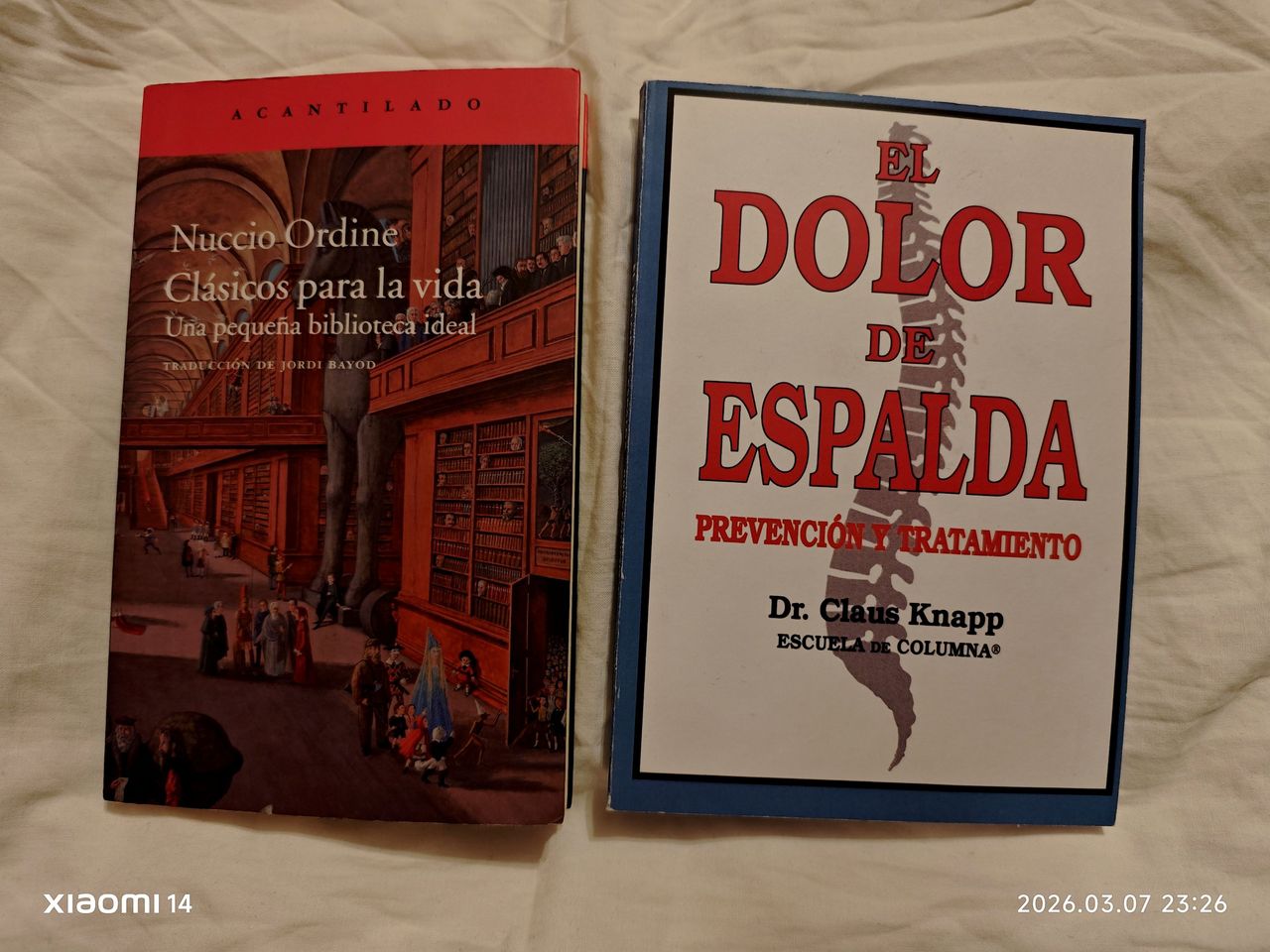
Entre la colección de imágenes de esta publicación hay dos libros, uno de su autoría y otro que nos remite a la lectura de los clásicos.
Uno de los mejores libros que he leído en los últimos años me lo regaló Claus: Clásicos para la vida de Nuccio Ordine.
Un libro, que siendo breve, plantea desde los clásicos de Occidente, cuestiones que me parecen fundamentales en la actualidad:
¿Qué es una vida buena?
¿Qué es la justicia?
¿Qué significa ser humano?
El día en el que los europeos (y Occidente por extensión) nos pongamos a pensar y en asamblea (como hacían los griegos de Atenas) a compartir y discutir nuestros puntos de vista sobre estas cuestiones… quizás sea posible otra Europa.
My encounter with Claus was a great privilege... because, in addition to being a good person, he represented one of the final links in a chain... that of humanism in medicine and psychotherapy.
It is not surprising, therefore, that he was concerned with leaving his sons, as part of their inheritance, a complete collection of the Gredos Classical Library, presented by the RBA publishing house as: The 100 masterpieces of the classical world from Homer to Marcus Aurelius.
On one occasion, he asked me if his sons would understand why he was leaving them this collection. To which I replied that I was sure they would.
Among the collection of images in this publication are two books, one of which he wrote himself and the other which refers us to the classics.
One of the best books I have read in recent years was given to me by Claus: Classics for Life by Nuccio Ordine.
A book which, although brief, raises questions from the Western classics that I consider fundamental today:
What is a good life?
What is justice?
What does it mean to be human?
The day when Europeans (and the West by extension) start to think and gather together (as the Greeks of Athens did) to share and discuss our views on these issues... perhaps another Europe will be possible.
 Dedication / dedicatoria Dedication / dedicatoria |  Claus drawn by himself /Claus dibujado por el mismo Claus drawn by himself /Claus dibujado por el mismo |
|---|
ESPAÑOL (clica aquí!)
El otro libro que aparece en las imágenes, titulado “Dolor de espalda”, ha sido motivo de algún desencuentro con Claus.
En esas páginas se recoge un método que alivia los dolores de espalda y sana patologías que, en teoría, deberían pasar por quirófano. Claus creía que las operaciones de espalda tenía que inevitablemente desaparecer. Yo pensaba que estas intervenciones no desaparecerían… por qué motivo los cirujanos, la medicina oficial, iba a reconocer que sobre este tema son unos absolutos ignorantes.
La contestación, muy optimista, de Claus solía ser que los expedientes médicos demostraban que el quirófano no era necesario. Mi respuesta, la de un pesimista, solía ser que el mercado y la verdad, no suelen llevarse bien.
The other book that appears in the images, entitled “Back Pain,” has been the source of some disagreement with Claus.
These pages describe a method that relieves back pain and heals conditions that, in theory, would require surgery. Claus believed that back surgery would inevitably disappear. I thought that these procedures would not disappear... why would surgeons, official medicine, admit that they are completely ignorant on this subject?
Claus's very optimistic response was usually that medical records showed that surgery was not necessary. My response, as a pessimist, was usually that the market and the truth do not usually go hand in hand.

ESPAÑOL (clica aquí!)
Aquí finalizo mi presentación en Hive de una gran persona con dos apuntes. El primero, es que llegó a conocerme bastante bien… en una dedicatoria me llamaba “el amigo de lo difícil”. El segundo apunte es sobre la repercusión que ha tenido la marcha de Claus en los medios… nada o casi nada. Otro reflejo del mundo en el que vivimos.
Un abrazo muy grande a toda la familia y amigos del Dr. Claus Knapp Boetticher.
Here I conclude my presentation on Hive of a great person with two notes. The first is that he got to know me quite well... in a dedication he called me “the friend of the difficult.” The second note is about the impact Claus's departure has had in the media... nothing or almost nothing. Another reflection of the world we live in.
A big hug to all the family and friends of Dr. Claus Knapp Boetticher.

Thank you for joining me here.
Gracias por acompañarme hasta aquí.

Banner edited with Canva pro and cropped with ezgif.com.
Banner editado con Canva pro y recortado con ezgif.com.
Avatar created with IA Ideogram.
Avatar creado con IA Ideogram.

Translated from my native language Spanish with DeepL (free version).
Traducido de mi lengua materna, el español, con DeepL (versión gratuita).
Cover based on photographs owned by me, edited with GIMP.
Portada a partir de forografías de mi propiedad, editada con GIMP.
All photographs are my own.
Todas las fotografías son de mi propiedad.