
Biafra, officially the Republic of Biafra, was a state in West Africa that existed from May 1967 to January 1970. It was made up of the states in the Eastern Region of Nigeria.
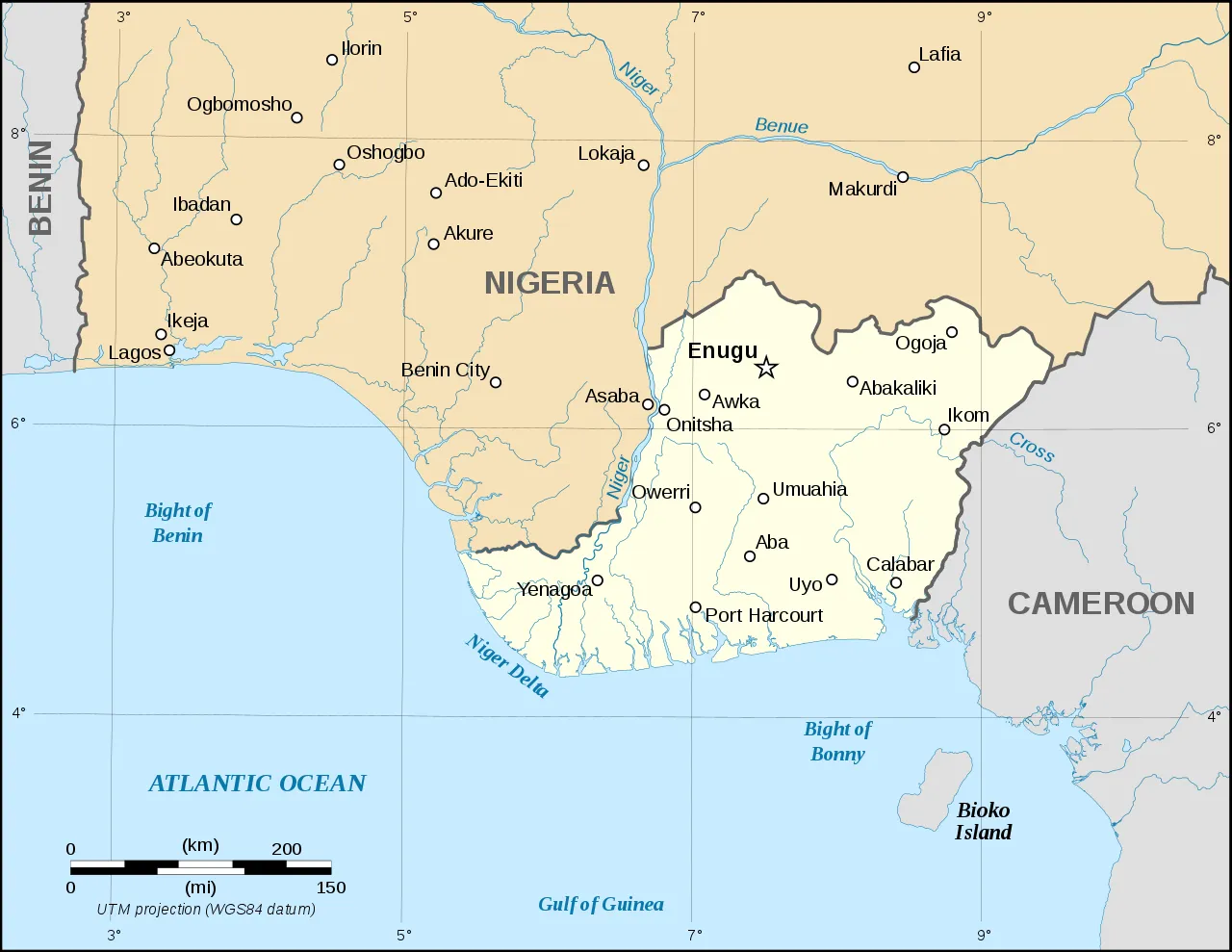
Republic of Biafra
1967–1970
Flag of Biafra
Flag
Coat of arms of Biafra
Coat of arms
Motto: "Peace, Unity, and Freedom."
Anthem: "Land of the Rising Sun"
Red: Republic of Biafra
Biafra's declaration of independence from Nigeria resulted in civil war between Biafra and Nigeria. Biafra was formally recognised by Gabon, Haiti, Ivory Coast, Tanzania, and Zambia. Other nations, which did not give official recognition but provided support and assistance to Biafra, included Israel, France, Spain, Portugal, Norway, Rhodesia, South Africa, and Vatican City.[a] Biafra received aid from non-state actors, including Joint Church Aid, Holy Ghost Fathers of Ireland,[2] and under their direction Caritas International,[3] and U.S. Catholic Relief Services.[4] Médecins Sans Frontières (Doctors Without Borders) also originated in response to the suffering.
Its inhabitants were mostly Igbo, who led the independence movement due to economic, ethnic, cultural and religious tensions among the various peoples of Nigeria. Other ethnic groups included the Efik, Ibibio, Annang, Ejagham, Eket, Ibeno, and the Ijaw.
After two-and-a-half years of war, during which almost two million Biafran civilians (3⁄4 of them small children) died from starvation caused by the total blockade of the region by the Nigerian government,[5] Biafran forces under Nigeria's motto of "No-victor, No-vanquished" surrendered to the Nigerian Federal Military Government (FMG). The surrender was facilitated by the Biafran Vice President and Chief of General Staff, Major General Philip Effiong, who assumed leadership of the Republic of Biafra after the original President, Colonel Chukwuemeka Odumegwu Ojukwu, fled to Ivory Coast.[6] After the surrender of Biafra, some Igbos who had fled the conflict returned to their properties but were unable to claim them back from new occupants. This became law in the Abandoned Properties Act (28 September 1979).[7] It was purported that at the start of the civil war, Igbos withdrew their funds from Nigerian banks and converted it to the Biafran currency. After the war, bank accounts owned by Biafrans were seized and a Nigerian panel resolved to give every Igbo person with an account only 20 pounds.[8] Federal projects in Biafra were also greatly reduced compared to other parts of Nigeria.[9] In an Intersociety study it was found that Nigerian security forces also extorted approximately $100 million per year from illegal roadblocks and other methods from Igboland - a cultural sub-region of Biafra in what is now southern Nigeria, causing greater mistrust of the Igbo citizenry towards the Nigerian security forces.[10]
History and etymology
Map of Africa (Abraham Ortelius, 1584)

Map of West Africa (Rigobert Bonne (Royal Cartographer of France)

West_Africa_1839_Mitchell_map_-_Kong.jpg)

Map of West Africa (1839); Biafra is shown in the region of "Lower Guinea"
Early modern maps of Africa from the 15th to the 19th centuries, drawn from accounts written by explorers and travellers, show references to Biafra, Biafara,[11][12] and Biafares.[13] In his personal writings from his travels, a Rev. Charles W. Thomas defined the locations of islands in the Bight of Biafra as "between the parallels of longitude 5° and 9° East and latitude 4° North and 2° South".[14] People in the region have described Biafra as the land directly adjacent to the Bight of Biafra and also an indigenous state, existing before European colonialism created such entities as Nigeria.[15]
**Events leading to war
**
Main article: Nigerian Civil War
In 1960, Nigeria became independent of the United Kingdom. As with many other new African states, the borders of the country did not reflect earlier ethnic, cultural, religious, or political boundaries. Thus, the northern region of the country has a Muslim majority, being primarily made up of territory of the indigenous Sokoto Caliphate. The southern population is predominantly Christian, being primarily made up of territory of the indigenous Yoruba and Biafra kingdoms in the West and East respectively. Following independence, Nigeria was demarcated primarily along ethnic lines: Hausa and Fulani majority in the north, Yoruba majority in the West, and Igbo majority in the East.[16]
Ethnic tension had simmered in Nigeria during discussions of independence, but in the mid-twentieth century, ethnic and religious riots began to occur. In 1945 an ethnic riot[17] flared up in Jos in which Hausa-Fulani people targeted Igbo people and left many dead and wounded. Police and Army units from Kaduna had to be brought in to restore order. A newspaper article describes the event:
At Jos in 1945, a sudden and savage attack by Northerners took the Easterners completely by surprise, and before the situation could be brought under control, the bodies of Eastern women, men, and children littered the streets and their property worth thousands of pounds reduced to shambles[17]
Three hundred Igbo people died in the Jos riot.[9] In 1953 a similar riot occurred in Kano. A decade later in 1964 and during the Western political crisis[18] divided the Western Region as Ladoke Akintola clashed with Obafemi Awolowo. Widespread reports of fraud tarnished the election's legitimacy. Westerners especially resented the political domination of the Northern People's Congress, many of whose candidates ran unopposed in the election. Violence spread throughout the country and some began to flee the North and West, some to Dahomey. The apparent domination of the political system by the North, and the chaos breaking out across the country, motivated elements within the military to consider decisive action. The federal government, dominated by Northern Nigeria, allowed the crisis to unfold with the intention of declaring a state of emergency and placing the Western Region under martial law. This administration of the Nigerian federal government was widely perceived to be corrupt.[19] In January 1966, the situation reached a breaking point. A military coup occurred during which a mixed but predominantly Igbo group of army officers assassinated 30 political leaders, including Nigeria's Prime Minister, Sir Abubakar Tafawa Balewa, and the Northern premier, Sir Ahmadu Bello. The four most senior officers of Northern origin were also killed. Nnamdi Azikiwe, the President, of Igbo extraction, and the favored Western Region politician Obafemi Awolowo were not killed. The commander of the army, General Aguiyi Ironsi seized power to maintain order.[20][21][22]
In July 1966 northern officers and army units staged a counter-coup. Muslim officers named a General from a small ethnic group (the Angas) in central Nigeria, General Yakubu "Jack" Gowon, as the head of the Federal Military Government (FMG). The two coups deepened Nigeria's ethnic tensions. In September 1966, approximately 30,000 Igbo were killed in the north, and some Northerners were killed in backlashes in eastern cities.[23]
In January 1967, the military leaders Gowon, Chukwuemeka Ojukwu and senior police officials of each region met in Aburi, Ghana and agreed on a less centralized union of regions. The Northerners were at odds with this agreement that was known as the Aburi Accords; Obafemi Awolowo, the leader of the Western Region warned that if the Eastern Region seceded, the Western Region would also, which persuaded the northerners.[23]
Now, therefore, I, Lieutenant-Colonel Chukwuemeka Odumegwu Ojukwu, Military Governor of Eastern Nigeria, by virtue of the authority, and pursuant to the principles, recited above, do hereby solemnly proclaim that the territory and region known as and called Eastern Nigeria together with her continental shelf and territorial waters shall henceforth be an independent sovereign state of the name and title of "The Republic of Biafra".
Chukwuemeka Odumegwu Ojukwu[24]
After returning to Nigeria, the federal government reneged on the agreement and unilaterally declared the creation of several new states including some that gerrymandered the Igbos in Biafra. On 26 May the Eastern Region voted to secede from Nigeria. Four days later, Ojukwu unilaterally declared the independence of the Republic of Biafra, citing the Easterners killed in the post-coup violence as reasons for the declaration of independence.[16][23][25] It is believed this was one of the major factors that sparked the war.[26] The large amount of oil in the region also created conflict, as oil was already becoming a major component of the Nigerian economy.[27] Biafra was ill-equipped for war, with fewer army personnel and less equipment than the Nigerian military, but had advantages over the Nigerian state as they were fighting in their homeland and had the support of most Biafrans.[28]
The FMG attacked Biafra on 6 July 1967. Nigeria's initial efforts were unsuccessful; the Biafrans successfully launched their own offensive, occupying areas in the mid-Western Region in August 1967. By October 1967, the FMG had regained the land after intense fighting.[23][29] In September 1968, the federal army planned what Gowon described as the "final offensive". Initially, the final offensive was neutralised by Biafran troops. In the latter stages, a Southern FMG offensive managed to break through the fierce resistance.[23]
Copied***