
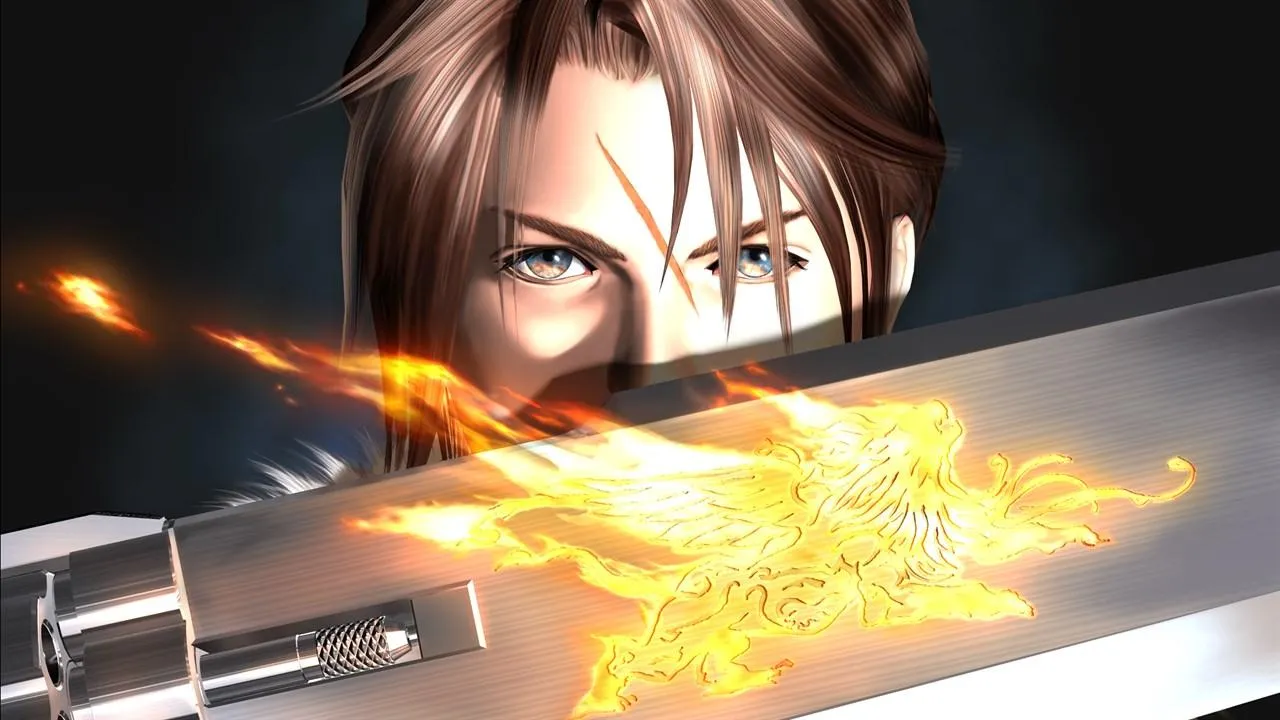
One of my favorite YouTube channels Resonant Arc started a series in which they analyze Final Fantasy VIII in great detail. In the first part they played the game from the start until the end of Dollet Mission. This part of the analysis was mostly about the games creators.

If you have time I advice you to watch the video, I learned many new things from each minute of this analysis. Most of which I won't touch upon in my response.
They talk a bit about the history of Final Fantasy and how the team wanted to do something different with FFVIII. The series creator, Hironobu Sakaguchi has been training Yoshinori Kitase to pass the torch to him eventually. Every Final Fantasy up to VII was created with Sakaguchi's vision, (even when he didn't take a part in the development.) With VIII, the team had the creative freedom to do what they want for the first time, and they wanted to do something completely different.
As a creative person, I can see where they come from. Even Resonant Arc's Mike said: "You can only make the same thing so many times." Different isn't always good in brands, but in art, you can't make something amazing without trying to be different.
Style over Substance?
One thing that stood to me is how Testuya Nomura was the Director of the opening FMV. I didn't know this, but I felt it. Final Fantasy VIII's opening had the same vibe as Kingdom Hearts series.
Final Fantasy VIII's might be the most hype opening of any Final Fantasy I played, (maybe second only to Final Fantasy VII but that one didn't have "Liberi Fatali" playing in the background.)
The style of Nomura, (and Kitase) is heavily stylistic. The writing, or should I say presentation style of Kitase's team, (Nomura included) focuses too much on emotion. If they can make you feel this hyped, that happy or sad at this and that moment, they succeeded. The story is written to compliment these feelings.
That's completely valid approach, and Mike agrees with the video. This approach however comes with a weak point: The story/writing does not make sense sometimes!
When the story's logic is a secondary to the feelings it moves into the player, weak dialogue and plot-holes start piling up. A good writer can do both but that's a compromise that might decrease the impact of either the logic or the feelings of the scene.
Sakaguchi was that type of person who would make the compromise. Nomura on the other hand never compromises the style in favor of logic! (To a lesser extent, Kitase too, going by the games I played directed by him.)

That's why Mike felt that the opening is a "style over substance" he goes in detail about the lines in that opening (See the analysis video above: 1:12:50 to 1:19:00.) I agree that the dialogue itself doesn't make sense, it's intentionally very weak.
The way it's presented makes it look cool, and I think that is the whole point! Anything could be written there to have that effect! I think that's the main problem, but in my opinion, that's the main feature!
Despite that dialogue being very weak, first time players will think it's cool because they don't have the context yet and the animation will make anything seem cool. Those who replay the game AFTER finishing it, will relieve the feelings they get while in the last section of the game. That's also part of the "feeling over logic" style of Kitase's team.
Art is a Compromise
I think I just want to say: There's an audience for that kind of style! The development team know this!
I don't want to say that there isn't a better way to do this! There's a reason why I kept repeating "weak dialgue" through this post, because while I see why they did that, and there's an audience for it. I'm sure they could've done it better, or they could've compromised to reach a better solution.
Opening the game in Dollet's Mission instead of at the school, would be a good example of a compromise that gives much better result. They could even frame it in a way that shows the rivalry between Squall and Seifer better than the opening we got.
Making an art for consumers is always about compromises: How much exposition you could provide without getting boring? How much control to give your characters over the story before it goes out of control? How much to give the story before the characters feel out-of-character? How much you let the theme control the story or the characters deviate from the theme? How much you can get away with, without breaking the audience suspension of disbelief?
That in my opinion, is what makes writing fascinating!