

Hello dear friends! Today I want to share my thoughts on this chapter, which is like a retrospective, and it was fantastic because it sets the context before the Lisbon disaster.

The curious thing is that the name says it all if you stop to think for a moment. “Fiat Lux” — “Let there be light.” A biblical title for one of the darkest moments in Shay Patrick Cormac's life. A perfect contrast, because this chapter doesn’t illuminate anything… at least not for those who still believe that good and evil are so clearly separated. Here, instead, is where you realize you’ve been playing in the dark for hours without even knowing it.

The sequence begins with a heavy weight, almost as if the game wants you to feel the same burden Shay carries. You come from betrayals, doubts, from having seen your world crumble because of an order you believed was just. The Assassins, your family, turn out not to be so incorruptible. And Shay, who always had more questions than answers, here finally begins to see—or accept—that something is very wrong with this mission of hunting artifacts “for the good of humanity.”

In this chapter, you get to follow the trail of the Templars, or rather, cross paths with them at a point where the two sides are no longer so clearly defined. This is where the game pushes you to observe, unfiltered, Shay’s moral conflict. He’s not just a renegade assassin… he’s someone who is discovering, piece by piece, that what he was taught may not have been the whole truth.

The mission leads you into a sequence where tension is felt even in the silences. Everything feels muted, colder. The narrative pace drops suddenly—not to bore you, but to force you to be completely present: listening, watching, doubting alongside Shay. It isn’t long before you encounter key figures who shift the protagonist’s path, almost without him realizing it. The conversation, the revelation, the idea that the Assassins might be about to cause a disaster they don’t even understand… all of it hits like a blow.

And then, almost without warning, the chapter becomes a point of no return. From here on, Shay makes decisions that aren’t impulsive or angry—they’re born from fear and a sense of responsibility. He knows what he saw in Lisbon, he knows what a mishandled artifact is capable of, and what torments him is that his own brothers want to repeat history without heeding any warning. That’s the spark that ignites Fiat Lux: not a great battle or a collapsing building, but something much more human—the painful certainty that following the same path will only lead to another catastrophe.
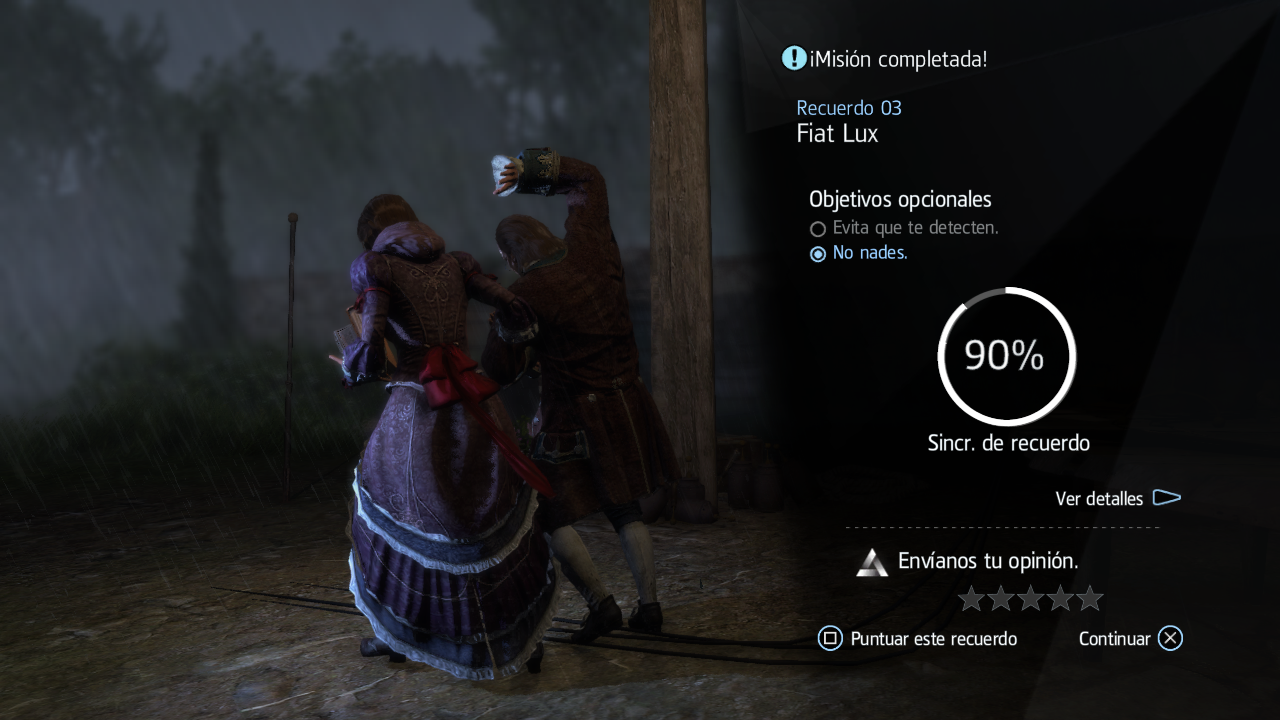
The plot of the chapter takes shape around that moral breaking point. There’s espionage, yes. There’s tension. There are painful decisions. But above all, there’s a different perspective: that of Shay beginning to open his eyes, even if it means being left alone. And that’s reflected in how you progress, in how you observe your former allies from a new angle, in that uncomfortable silence that accompanies every step.
When the episode ends, you’re left with this strange feeling of knowing you’re no longer controlling the same character you were at the beginning of the game. Something changed in him, and in you as the player. Fiat Lux is that kind of chapter—it doesn’t need explosions to shine. Its strength lies in what it reveals, not in what it destroys. It’s the exact moment where the story stops being black and white, and you know that, from here on out, you’ll be walking through much deeper shadows.