
First of all: Yes, it is a sensitive topic. We tend to have a bite reflex as soon as our beloved games are chased through the press as bogeymen or talked to death by the local regulars' table. Although they have fought for a respectable reputation in our society over the last 20 years, there are still veteran "experts" or hasty politicians who secretly see our hobby as a potential danger.
At least the debate has shifted in a different direction in the last few decades: While the violence potential of so-called "killer games" was discussed up until the early 2000s, the focus today is on the risk of addiction that games could presumably cause. Whereby even many passionate gamers see the growing problem.

The wild 80s
For a long time, gambling addicts were dismissed as isolated cases. The elderly among us, who have been involved with games since the early 1980s, still remember the hype surrounding arcade machines such as Space Invaders (1978) or Pac-Man (1980). These should pull as many coins as possible out of the player's pocket and persuade him to play one round after the other based on playful qualities alone. Quite a few arcade visitors have certainly carried home an empty wallet.
Space Invaders

A whispering "Don't play so much!" was probably the maximum that most of us have heard from our parents in childhood - or possibly from our steadfast partner in adulthood. However, such behavior usually did not lead to long-term damage.
Escape to a "better" world
Let's be honest: classic role-playing games like Wizardry (from 1981) or Final Fantasy (from 1987) only hinted at the potential danger of addiction in epic game worlds. In any case, hardly anyone would have considered it as a serious escape from reality in which one would like to spend all of his time - in contrast to modern online titles.
Whether life simulations like Second Life (2003) or MMORPGs à la World of Warcraft (since 2004): Online games have the power to completely cast a spell over a person and to more or less suppress their real life - just like us it was already mentioned in our report on games that changed the world.
World of Warcraft
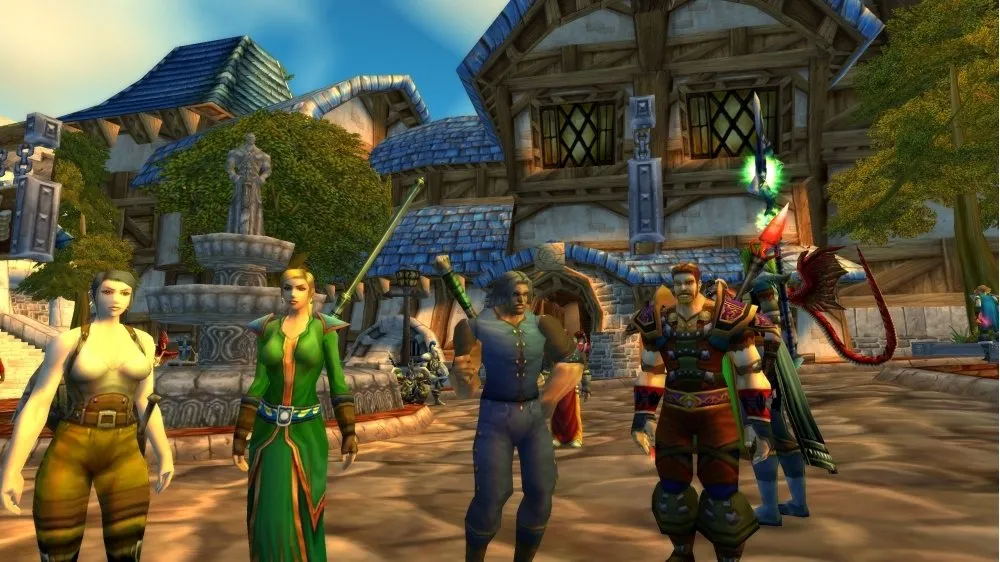
Blizzard's mega-seller is widely known as a synonym for the risks of computer game addiction, whereupon two questions arise: Is World of Warcraft wrongly chosen as a blatant scapegoat simply because of its success? And if not, what does Blizzard do differently than other developers to increase or even optimize the search effect?
The fact is that the Americans are among the undisputed masters in two fundamentally different disciplines: in balancing game elements as perfectly as possible and in designing game worlds with a love of detail that live from collecting and hamstering objects.
The first-mentioned virtue particularly benefited the real-time strategy game series Starcraft (from 1998) and the multiplayer shooter Overwatch (2016). The latter, on the other hand, is a key selling point for the Diablo action role-playing game series (from 1996) and World of Warcraft.
Diablo 3

The principle is actually quite simple: you are kept happy by regularly receiving new goodies such as fresh weapons or better armor. The gaps are decisive and must be well balanced: If they are too short, the player gains "power" too early and the game is quickly exhausted. If they are too long, he will lose patience due to a lack of noticeable progress and would rather play something different.
The trick is to fix the player through early successes and to carefully increase the waiting times until the next lucrative object. This is why in many online role-playing games you reach one level after the other very quickly, especially at the beginning, while it takes longer and longer afterwards. Or you can do it like Nintendo with Animal Crossing (from 2001) and link some events to certain times of the day or even seasons to which the player has to refer to collect all the insects or fish.
The game as a life's work
I would like to emphasize that this design philosophy is fundamentally not reprehensible and good enough for legitimate gaming pleasure. However, it is problematic as soon as it is deliberately abused to create an addiction and the player cannot really explain in the end why he has invested so many hours, days or months. In such cases, only a succinct "It's just addictive ..." comes out - which brings us to the middle of the topic.
Unfortunately, the combination of collecting and meeting other online gamers can lead to a dangerous conclusion: why should I face reality when all I need is in my favorite game?
From there it is not far to compulsion that secretly turns fun into work. After all, you have to look after your characters, work diligently through missions and farm experience points in order to be able to keep up with your online buddies. In other words: If you really want to play an MMORPG "seriously", you "have" to invest a lot of time - and that is of course missing in other areas of life.
When games make you sick
The World Health Organization (WHO for short) made it clear two years ago how seriously the topic is taken today: It named the so-called "Gaming Disorder" as an independent clinical picture. It should be postponed that one of the largest psychiatric associations worldwide - the American Psychiatric Association - considers the classification to be problematic.
In their opinion, there are not enough clearly meaningful studies. However, they take the concerns seriously and would like to carry out further investigations.
Another counter-argument comes from the games industry itself: They find the term "gaming disorder" stigmatizing and fears that they will put millions of gamers under general suspicion. At first glance, this is reminiscent of the tiresome killer game debate, in which one had to defend oneself against the allegations against the alleged violence of first-person shooter fans. However, there is one very important difference: while at that time players from politicians to the tabloids were classified as dangerous perpetrators because they were seen as potential gunmen, the addiction debate is about a victim role.
From addiction to debt trap
It's bad enough when someone loses their job thanks to excessive gambling and suddenly has to face poverty. In addition, more and more games appear that directly cause a big minus on the account. What is meant are primarily Free2Play creations, the name of which could hardly be more cynical.
Clash of Clans

What at first glance looks like a gift for the player turns out to be one of the most perfidious methods manufacturers use to maximize their profits. First of all, anyone can download a Free2Play game for free, for example on their smartphone or tablet. Then the already mentioned mechanisms of online role-playing games take effect again, which is why even newcomers quickly celebrate success and are stimulated accordingly.
The progress becomes deliberately slower the longer you play, in order to trigger impatience. So there is an in-game currency, for example the jewels of the still very popular Clash of Clans (2012). They look nice and shiny and really valuable, even though they are made up of bits and bytes just like the rest of the game. With their help, lengthy processes such as the construction of a new building can be accelerated.
In fact, such jewels can be earned directly in the game, for example by completing tasks or by exchanging medals, which in turn can be won against other players in the clan war leagues. You just need a lot of patience for all of this and you have to invest a lot of time in the game, which is why you can alternatively buy the jewels for real money and thus buy a massive advantage.
Danger to children
For a study, the Forsa Institute surveyed 1,000 children and young people between the ages of 12 and 17, of whom over 72 percent regularly consumed games. Slightly more than 15 percent of them would show "risky or pathological play behavior", which would ultimately affect at least one in ten children.
And another 15 percent of these said they were downright unhappy without the opportunity to play.
The money spent averaged around 92 euros per child within six months and resulted in a whopping thousand for some young people. In this context, the study mentioned the notorious loot boxes, which six percent of those who played regularly would have afforded. That is the equivalent of over 180,000 children and young people - in Germany alone! And certainly not everyone has bought just one box ...
Help, not judge
In the end, the question arises: what can we do?
First of all, we have to make it clear that the industry is right in one respect: we live in a democracy, we have freedom of expression, and everyone can do what they want, as long as they don't harm anyone else. Point. In this respect, politics with regard to adults should not introduce any regulations or change laws and instead improve the protection of children and young people, if the just made amendment to the Youth Protection Act is not sufficient.
Second Life

On the other hand, if you know an adult who you are worried about due to a possible gambling addiction: Take the whole thing seriously, talk to him about it and offer your help. As with alcohol, drugs and the so on, there are therapeutic options that everyone can take advantage of.
