

The photos 📸 are my entry to the #monomad contest from 

Greetings, friends of the Black and White community.
Today I'm here to tell you about my brief stint with infrared photography. This type of photography captures images that are below the visible spectrum of light. It is not possible to observe them with the human eye, but camera sensors and some special films are able to capture them. This can be achieved by putting a filter on the lens that blocks all visible light and lets only infrared light through, leaving the camera in a long exposure. Another option is to modify the camera by removing the low-pass filter, whose function is precisely to block infrared waves.
These photos were taken with a modified camera and a 720 nm filter, which is quite conventional. The foliage, by reflecting the infrared light, generally appears with white tones, while the sky and water absorb it, so they are usually dark. This gives the photograph a totally different look from the reality we observe. Maybe that's why I wasn't completely hooked. The final result completely denaturalizes the landscape, moving us to a surreal and very different place.
However, in black and white the result is quite interesting. Although still somewhat strange, it has the ability to transport you from the warm Caribbean to the snowy flakes of the cold regions of the planet.
Check out the photos and I'll read them in the comments. If you are interested in having me bring you more of this branch of photography, I'll dust off the equipment and get to work.
Greetings. I hope you like this little IR photography series!


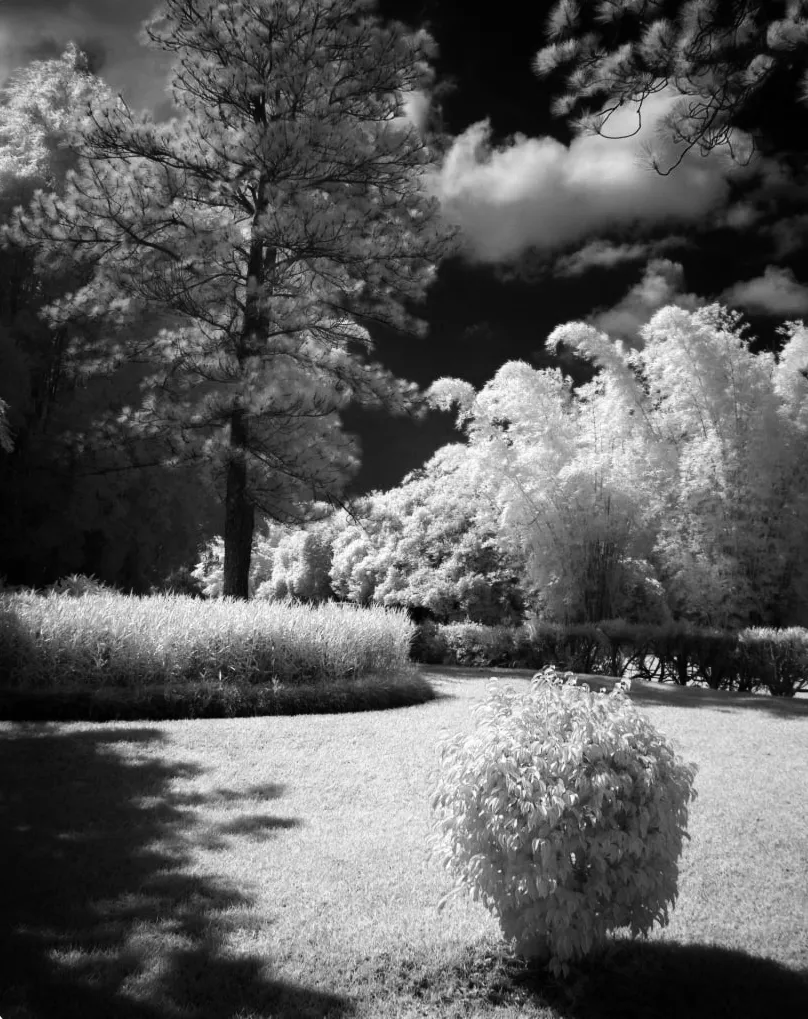


Estos son los resultados. ¡Espero que les gusten!
[Español]
Saludos, amigos de la comunidad Blanco y Negro.
Hoy vengo a hablarles de mi breve paso por la fotografía infrarroja. Este tipo de fotografía captura imágenes que están por debajo del espectro visible de la luz. No es posible observarlas con el ojo humano, pero los sensores de las cámaras y algunas películas especiales logran captarlas. Se puede conseguir poniendo un filtro en el lente que bloquee toda la luz visible y deje pasar solo la infrarroja, dejando la cámara en una larga exposición. Otra opción es modificar la cámara, quitándole el filtro de paso bajo, cuya función es precisamente bloquear las ondas infrarrojas.
Estas fotos fueron hechas con una cámara modificada y un filtro de 720 nm, que es bastante convencional. El follaje, al reflejar la luz infrarroja, generalmente aparece con tonos blancos, mientras que el cielo y el agua la absorben, por lo que suelen salir oscuros. Esto le da a la fotografía un aspecto totalmente distinto a la realidad que observamos. Tal vez por eso no me enganchó del todo. El resultado final desnaturaliza por completo el paisaje, trasladándonos a un lugar surrealista y muy diferente.
Sin embargo, en blanco y negro el resultado es bastante interesante. Aunque sigue siendo algo extraño, tiene la capacidad de transportarte desde el cálido Caribe hacia los nevados copos de las regiones frías del planeta.
Observen las fotos y los leo en los comentarios. Si les interesa que les traiga más de esta rama de la fotografía, desempolvaré los equipos y pondré manos a la obra.
Saludos. ¡Espero que les guste esta pequeña serie de fotografía IR!
"All photos were taken by me 

Technical data:
Nicon camera: D7500
Nicon lens: 50mm f1.4 p-ais; 105mm f2.5 p-ais; 16-80 f2.8-4 G; 35mm f1.8 G
Translated by Deepl free version.