
The day was cloudy for the most part ...

... with only a couple of short outbursts of sun. One of them happened when this opening photograph was taken, at the high watermark of this little trip, when I reached the small city called Pazin.

Pazin it's a small city with some great medieval stuff in it, situated right in the center of Istra, the peninsula at whose southern end I live. This was the most northern point I reached today, after visiting Pazin, it was all about driving back home.

And now, after this short introduction to the final destination ...

... it's time to start from the beginning, with this shot taken at the outskirts of Pula. Pula is the biggest city on the peninsula. And the nearest one to my small seaside town. Only a quick, ten kilometers long drive and I was there.

I had to buy some stuff in one of the city's shopping malls. With that done ...

... I drove to another suburban neighborhood, on the opposite side of the city.
There I visited a small but well-equipped PC shop and took a couple of photographs. Most of the buildings in that area looked like the ones in this photograph, but ...

... not far from them, just across some large recreation field, there was this old villa that looked like something out of fairy tales. As you can clearly see in these shots, the sky was clear - the weather was sunny.

After photographing this recently trimmed tree that grew near the facade of one of the tall condos ...

... and the magpie nest on the top of an older tree that was tall almost as the surrounding buildings ...

... it was time to drive out of the city. But instead of going south, towards my hometown ...

... I decided to turn north and have some fun while driving around.

The sky was still partially blue when I reached this old church by the road, about forty kilometers from Pula ...

... but the weather was slowly getting gray and cloudy.

Church of St. Mary of the Holy Mount was first built in the 12th century.

But its shape and size were changed on quite a few occasion during the following few centuries.

Its current look was defined in the year 1666 ...

... when the porch was added.

That porch was a great addition. It has many sculptures ...

... and the sculptures make this place memorable.

All those saints ...

... and angels ...

... made of stone ...

... look alive enough ...

... to bring a breath of petrified life in this melancholic place ...

... surrounded by woods.

After a bit of walking around the church ...

... with my eyes glued to the hypnotic patterns made of brown leaves fallen from the surrounding oaks ...

... I found this small floral anomaly - a daisy.

I reached the area behind the building, where I took this very different portrait of the old church, and then ...

... passed by the lateral facade ...

... on my way back to the porch.

Some sculptures there ...

... are part of the front facade.

All the elements of this old church look pretty cool ...

... so I photographed each one separately ...

... detail after detail.

It is believed that all the sculptures on the facade ...

... and on the pillars ...

... along with the angel & saint-shaped caryatids ...

... were made by the same unknown sculptor, probably a local artisan.

These massive stones are a recent addition.

The monoliths are here since the year 2000. This is a war and post-war memorial for the victims of world war two and for those who lost their lives on the peninsula in the turbulent few years after that war.

While the church was changing through centuries ...

... the nearby bell tower stayed the same and is now the best-preserved Romanesque tower in Istra.

After taking this last portrait of the entire church ...

... I entered the car and drove away.

This photograph was taken while driving, about ten kilometers further ...

... on the road to Pazin.

At this point, the day was gray and cloudy.

Here I'm driving through the city, while in the following photograph ...

... I just parked the car near this stylish, elaborate garbage can. Originally it was an old, fancy public faucet, but now is quite obviously used to host a wide assortment of garbage. The stone wall behind it ...

... is part of the robust medieval stronghold, the Pazin castle.
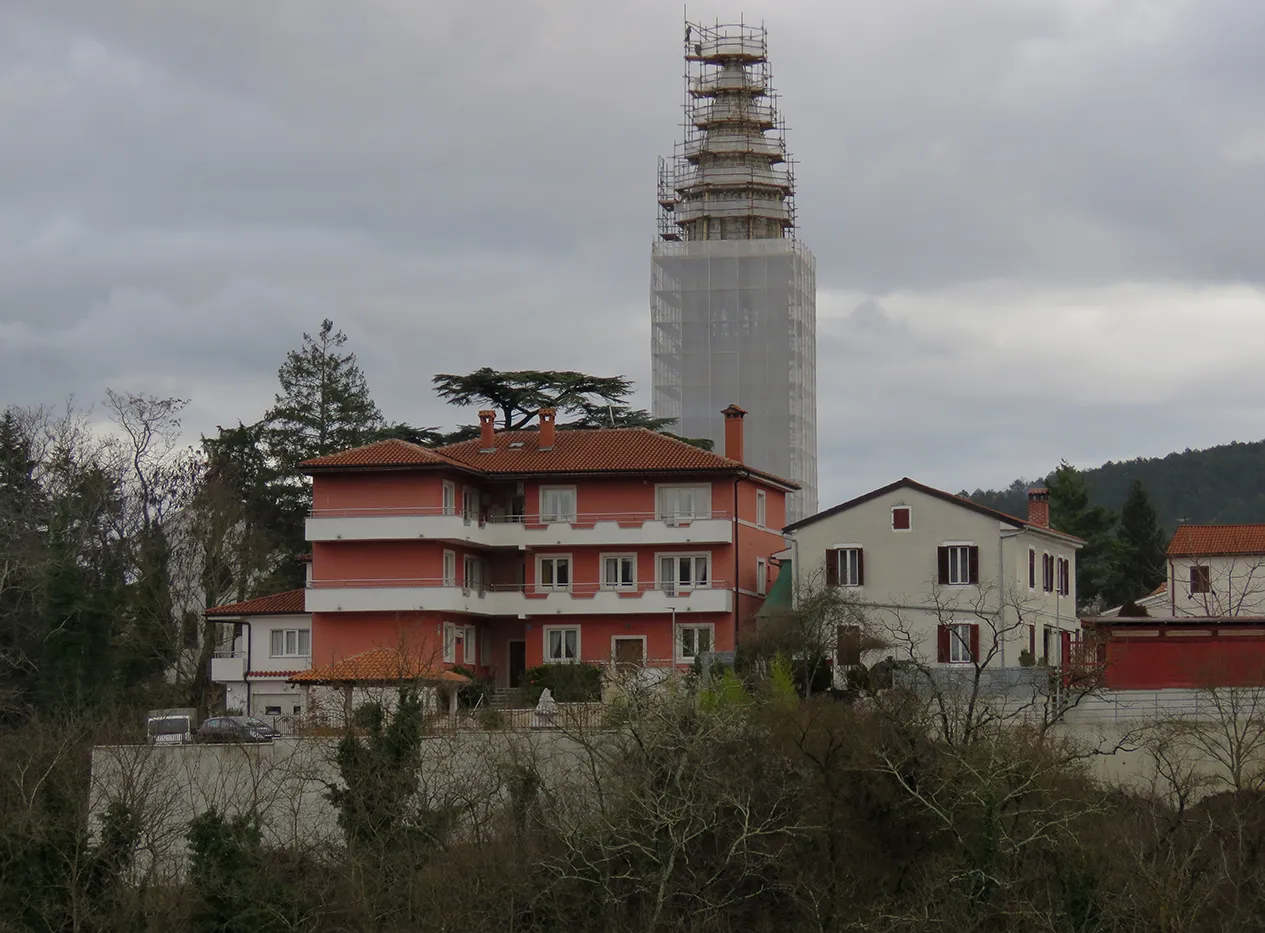
Here you can take a look at another part of the old town ...

... with the bell tower of the parish Church of St. Nicholas as the main attraction. These days the tower is being restored, so you can't see how it really looks.

That's why I included this old photograph taken in 2010. The church is first mentioned in the year 1266. Some major changes occurred in the year 1441.
From 1659 to 1764, quite a few baroque elements were added, and the church got its current look. A look that you won't see in this post. I photographed only the tower today. The 45 meters tall bell tower was built in 1705.

Pazin it's a pretty peculiar small city.

The city with a hole in its center.

The oldest part of the city was built around the deep canyon with a large, intricate cave system formed by the mostly underground river called Pazinchitza.

These are the remains of an ancient building at the edge of the precipice.

It's not far from the castle, so it's probably part of the same medieval complex, but I can't say for sure. The canyon is pretty deep and spectacular.

The entrance to the underground abyss is situated under the 198 high vertical rock. The explored part of that cave system is 270 meters long and includes an underground lake.

The Pazin castle is in written sources first mentioned in the year 983. On 7 June 983 precisely, as Castrum Pisinum, in a document issued by Otto II, Holy Roman Emperor, confirming the possession of the castle to the bishop of Porech. Porech is a town situated on the Adriatic coast, about 30 kilometers west of Pazin.

The current look of the building ...

... was defined in the period from 1537 to 1540.

Among various ancient details photographed while walking around the thick walls ...

... I found also this contemporary little bottle, once filled with liquor.

This is some cool old house near the castle.

Here you can see the same house from a different angle.
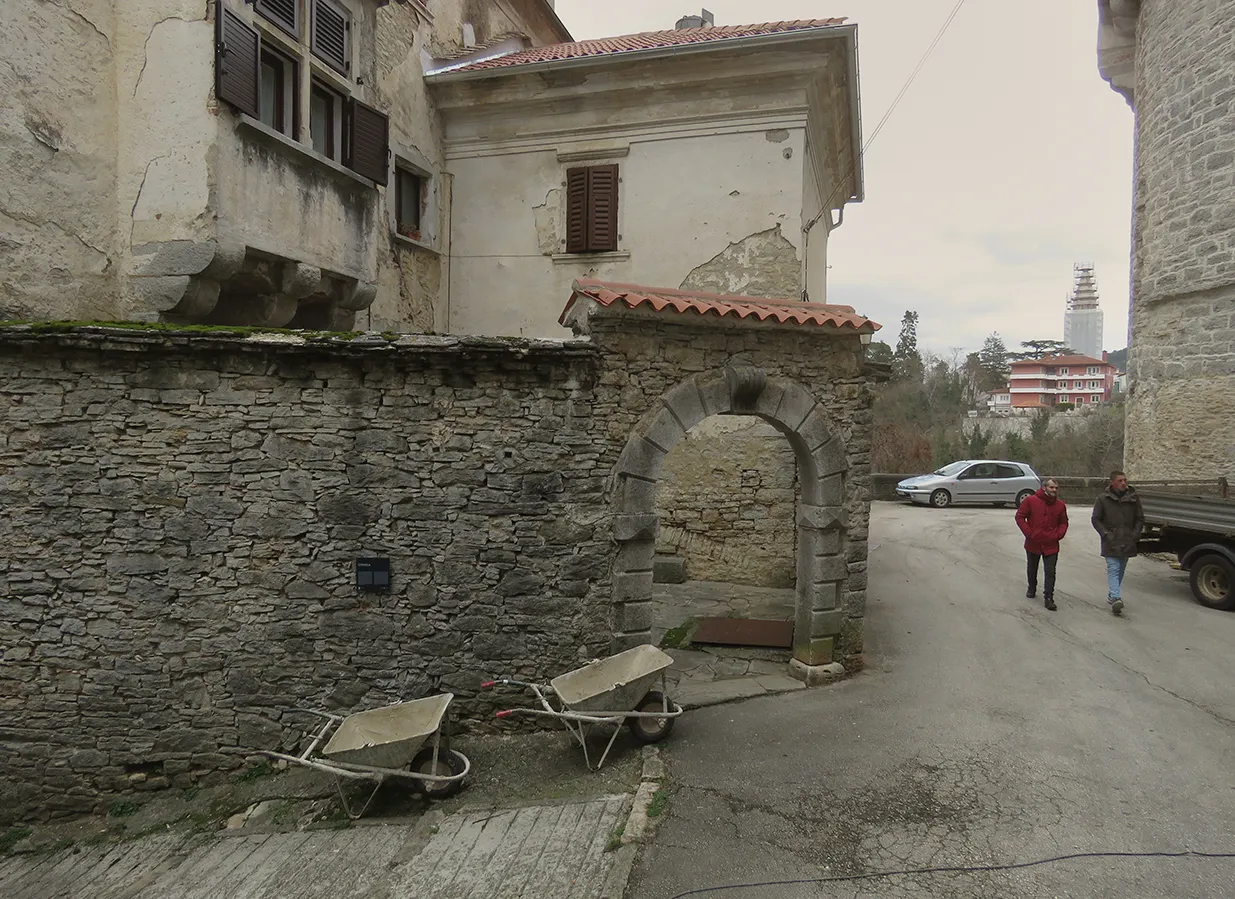
While photographing the house, I noticed two wheelbarrows by its wall.

They looked pretty cool so I took a couple of photographs, and then ...

... a bit further, in one of the neighboring yards, I caught two workers in action.

At one point, while I was rambling around the old buildings under the cloudy sky ...

... the weather suddenly changed.

The unexpected outburst of sun ...

... repainted the city in a very different way.

I was watching the same old things ...

... amazed by their look ...

... in the new light.

These joyful, sunny interludes are usually very short, and this one wasn't an exception.

I was shooting very fast ...

... zooming in and out in all directions ...

... to catch as much as I can before things turn gray again.

When I left Pazin ...

... the weather was cloudy again.

I shot this police van while driving, on the stretch of road just outside the town called Svetvinchenat, about forty kilometers from home.

While passing through the town called Vodnjan, about twenty kilometers from Medulin, my hometown, I photographed a nicely painted oldtimer with some problems under the hood.

Here I'm on the large roundabout at the entrance of Pula.

I was driving behind a boat for a kilometer or two.

In this closing photograph, I'm on the road that leads from the city of Pula straight to my hometown. Soon I was home, ready to transfer the photographs from the camera to the PC and start working on this post.
AS ALWAYS HERE ON HIVE, THE PHOTOGRAPHS ARE MY WORK.