
Hello Guys ... How are you today?

Previously, I apologize, if this post is not related to flower petals, but this explanation includes plants that do not have petals.
However, if you think about it, this plant has been adopted into the realm of ornamental plants even though it has just been included in an ornamental plant, the history of this plant has become an ornamental plant along with every forest taro plant. However, because the forest taro plant has a variety of colors and patterns, this plant automatically disappears in the eyes of its devotees.

In our area, some people still maintain it as an ornamental plant that is planted in the backyard, usually it grows on the banks of seeping water drainage, and thanks to its character, it can be anticipated by itself. So that the yard of the house is not flooded with running water.
Her name
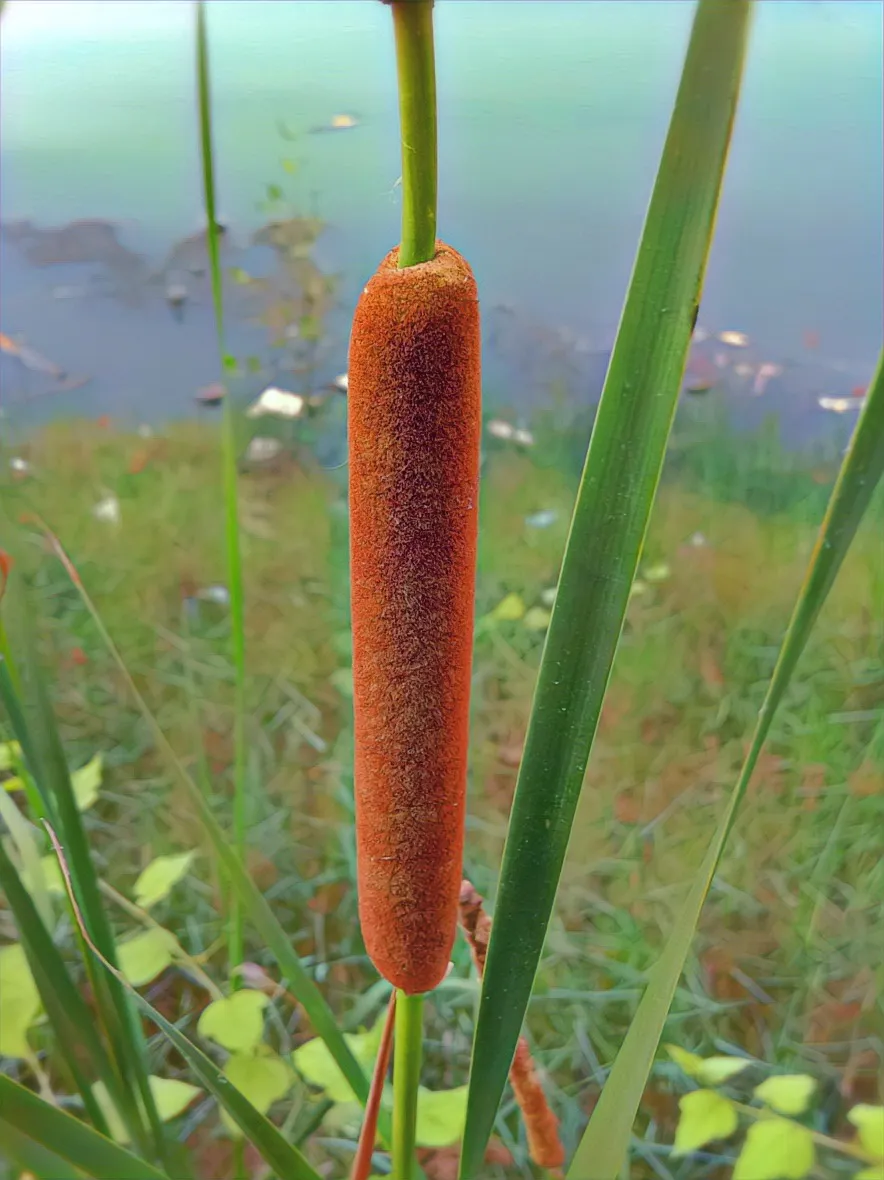
Each object must have a designation, so that it is easy for someone to recognize it. Sometimes people give the name according to the character of the object itself. Here he is known as the Cat's Tail Plant, this is in line with the flowers or the middle part of the plant that resembles a cat's tail or some people call it Kerosene torch fire plant, this name also very in accordance with its characteristics if the middle is dipped in kerosene and then burned it will light up like a torch as a lamp in the dark.

While experts give a general term that is rather complicated to memorize, except for the intellectual community who often mentions it, this general term is often heard in the expert board in the form of Typha Orientalis, even experts describe it regularly as you see below.
| Kingdom | Plantae |
|---|---|
| Ordo | Poales |
| Family | Typhaceae |
| Genus | Typha |
| Species | Orientalis |
That's what intellectuals call it like Typha Orientalis of course these people also have their own reasons for giving names even though they are in Latin or other common languages which are often referred to by world experts and even local experts.

Has tremendous benefits for society
Even though it grows in locations that are difficult for humans to reach, such as growing in every brackish water marsh, or in the puddles of the wilderness, in essence this plant is very sturdy and strong in every way, be it for itself, or in the containment of a dangerous object and also a material comes from him. This plant is often used in a rather harsh location in anticipation of something.
In our area in particular, very much is found of this plant, as mentioned above, it will be seen growing near the mangrove trees, although it grows with a rather far distance, but this plant is always there where there are mangrove trees.

Its presence in our area can add assets to traditional leaf hat craftsmen, leaf mats, and the centerpiece can become a cotton pad to make pillows.
The leaf stems are hard and tall, very good if processed into crafts such as leaf hats (sekey hats for fishermen and farmers) and the stem material can also be used as a base material for mats. However, the stems of the leaves must first be processed with some simple techniques and then they can be used as the ingredients mentioned above.

How to process is to take as much or as needed in an object. Then the leaf stems are warmed in boiling water, when the leaf stems are slightly damp, they are removed and dried in the sun until completely dry.
The dried leaf stems are then smoothed with special bamboo that has been shaped like a knife, then rubbed hard with the previous bamboo until there is no rough surface and materials for making mats and materials for hats can be used.
Well here the purpose of a craftsman is to be able to carry out his duties regularly, and the skill of making mats and hats must have a special ability to shape or make leaves into a beautiful work, so that fishermen and farmers will always get head protection from the sun in the form of a heat cap from the hot sun.
Then what about the stem that grows in the middle? Or should we say its brown petals that resemble a cat's tail? Processed into the basic ingredients of kapok pillows or mattresses.
So, the technical explanation of the processing will be conveyed in the next meeting, including how to make mats or hats.
| Post title | Cat's tail plant that has many benefits |
|---|---|
| Photo source | Hibiscus tiliaceus |
| Photografer | @𝘀𝗼𝗲𝗵𝗮𝗱𝗮 |
| Photo taking location | Lhokseumawe, Aceh |
| Source of writing | Own idea |
| Camera photo | Smartphone type Vivo Y12 |
𝓨𝓸𝓾 𝓬𝓪𝓷 𝓼𝓮𝓮 𝓶𝓮 𝓱𝓮𝓻𝓮
𝔗𝔴𝔢𝔱𝔱𝔢𝔯 𝔉𝔞𝔠𝔢𝔟𝔬𝔬𝔨 𝔏𝔦𝔫𝔨𝔢𝔡𝔩𝔫
