
If you prefer the English version, click on the following link 👉 HERE
El sonido es inconfundible. No es el clic etéreo y plástico de mi teclado retroiluminado, ese que me ha servido de puente con el mundo digital durante años. El sonido de la Perkins Brailler es un golpe seco, mecánico, casi ancestral. Es un "clac" que vibra en la mesa y se siente en los huesos.
Hace dos semanas, ese sonido volvió a mi vida. No regresó como un hobby, sino como una necesidad; es más que un recuerdo, es como un refugio.
El niño de siete años
Para entender por qué hoy mis dedos buscan con torpeza y esperanza el relieve del papel, debo viajar a mis siete años. Me veo en aquel colegio para invidentes al que entré cuando apenas tenía cinco. Allí, mientras otros niños aprendían a trazar círculos con lápices de colores, yo aprendía la arquitectura de los seis puntos.

La celda Braille era mi universo. Recuerdo la sensación del papel grueso, la resistencia que ofrecían las teclas de la máquina y la voz de la maestra diciéndome que mis manos eran mis ojos. A esa edad, la práctica no era un esfuerzo, era un juego de descubrimiento. Aprendí a leer constelaciones de puntos que formaban palabras, y esas palabras formaban mundos.
Sin embargo, la vida —y la tecnología— nos van alejando de lo táctil. Mi teclado de PC, ese híbrido brailler-vidente que brilla en la oscuridad, me hizo creer que el relieve ya no era tan vital. Me volví cómodo en la luz que aún me quedaba.
El aviso de la penumbra
Pero el cuerpo tiene su propio lenguaje y el tiempo, como bien decimos, pasa factura. En las últimas semanas, unos "episodios" —así los llamo para no darles un nombre más aterrador— me han alertado. La visión, esa ventana que se ha ido entornando poco a poco, parece querer cerrarse un poco más.

Sentí miedo. Es humano sentirlo. Pero tras el miedo, vino un instinto de supervivencia: la necesidad de retomar lo que soy.
Saqué la vieja Perkins. Estaba allí, pesada y firme, esperando. Al tocarla, sentí que saludaba a un viejo maestro que no veía en décadas.
El reencuentro con el relieve
Dicen que la práctica hace al maestro, pero yo prefiero decir que la práctica reconstruye al hombre.
Volver a leer Braille después de años de desuso es un ejercicio de humildad. Mis yemas, acostumbradas a la superficie lisa de las pantallas táctiles, han perdido esa "agudeza" de la infancia. La primera tarde, los puntos se sentían borrosos, como si el papel (Opalina 130gr.) me hablara en susurros que yo ya no podía entender.
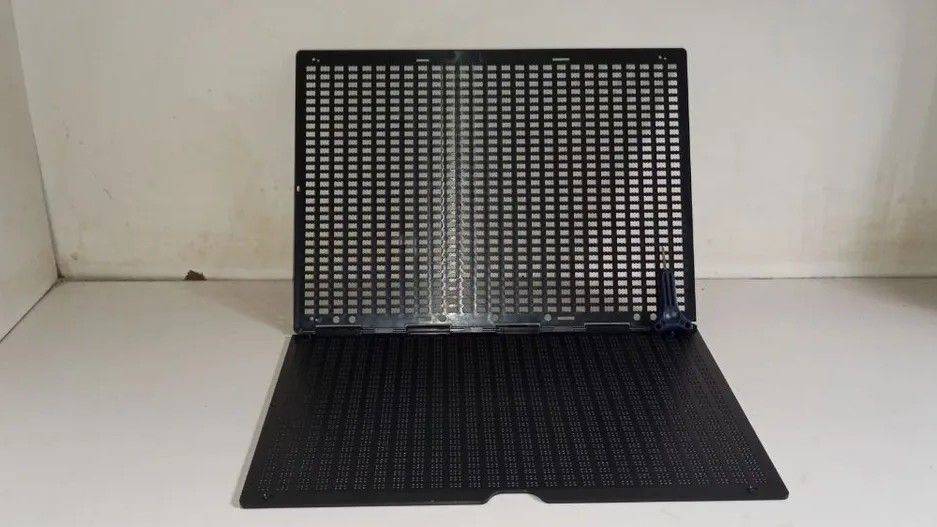
Escribí mi nombre. Clac, clac, clac. Sentí el relieve de la 'A', la 'M', la 'I'.... Pasé el dedo. Allí estaba. No era una imagen en una pantalla que podía desvanecerse si fallaba la luz o la batería. Era una marca física, una herida hermosa en el papel que mis dedos reconocían.
He dedicado estas dos semanas a practicar a diario. Media hora, una hora. Mis dedos están despertando de un largo letargo. A veces me frustro porque voy lento, pero luego recuerdo que no tengo prisa; estoy aprendiendo a caminar de nuevo antes de que oscurezca del todo.
El talento de la resiliencia
Participo en esta iniciativa de 
Practico Braille porque me niego a quedar en silencio si la luz se apaga. Practico porque la maestría que busco no es la de un erudito, sino la de alguien que sabe que, mientras haya tacto, habrá lectura; y mientras haya lectura, habrá libertad, eso se lo he transmitido a Matthew, mi hijo.

Hoy, mi Perkins Braille, mi regleta y mi punzón, no es solo una máquina de escribir, son el salvavidas que me mantendrá a flote. Y cada punto que logro identificar bajo mi piel es una pequeña victoria contra el olvido. Porque al final del día, la práctica no solo nos hace maestros... nos hace valientes.
𝗘𝗻𝗰𝘂𝗲𝗻𝘁𝗿𝗼 𝗱𝗲 𝗧𝗮𝗹𝗲𝗻𝘁𝗼𝘀: «La practica»

Portada de la convocatoria.
Dedicado a todos aquellos escribas que contribuyen, día a día, a hacer de nuestro planeta, un mundo mejor.


The sound is unmistakable. It's not the ethereal, plastic click of my backlit keyboard, the one that has served as my bridge to the digital world for years. The sound of the Perkins Brailler is a dry, mechanical, almost primal click. It's a "clack" that vibrates in the table and resonates in my bones.
Two weeks ago, that sound returned to my life. It didn't come back as a hobby, but as a necessity; it's more than a memory, it's like a refuge.
The Seven-Year-Old Boy
To understand why today my fingers clumsily and hopefully search for the raised dots on the paper, I must travel back to when I was seven. I see myself in that school for the blind that I entered when I was barely five. There, while other children learned to draw circles with colored pencils, I learned the architecture of the six dots.
The Braille cell was my universe. I remember the feel of the thick paper, the resistance of the typewriter keys, and the teacher's voice telling me that my hands were my eyes. At that age, practice wasn't a chore, it was a game of discovery. I learned to read constellations of dots that formed words, and those words formed worlds.
However, life—and technology—are distancing us from the tactile. My PC keyboard, that Braille-sighted hybrid that glows in the dark, made me believe that relief was no longer so vital. I became comfortable in the light that remained.
The warning of the twilight
But the body has its own language, and time, as we say, takes its toll. In recent weeks, some "episodes"—that's what I call them to avoid a more terrifying name—have alerted me. My vision, that window that has been gradually closing, seems to want to close a little more.
I felt fear. It's human to feel it. But after the fear came a survival instinct: the need to reclaim who I am. I took out the old Perkins Brailler. It was there, heavy and sturdy, waiting. Touching it, I felt like I was greeting an old master I hadn't seen in decades.
The Reencounter with Relief
They say practice makes perfect, but I prefer to say that practice rebuilds the man.
Returning to reading Braille after years of disuse is an exercise in humility. My fingertips, accustomed to the smooth surface of touchscreens, have lost that childhood "sharpness." The first afternoon, the dots felt blurry, as if the paper (130gsm Opaline) were whispering to me in sounds I could no longer understand.
I wrote my name. Click, click, click. I felt the relief of the 'A', the 'M', the 'I'... I ran my finger over it. There it was. It wasn't an image on a screen that could vanish if the power or battery failed. It was a physical mark, a beautiful indentation in the paper that my fingers recognized.
I've dedicated these past two weeks to practicing daily. Half an hour, an hour. My fingers are waking from a long slumber. Sometimes I get frustrated because I'm going slowly, but then I remember I'm not in a hurry; I'm learning to walk again before it gets completely dark.
The Talent of Resilience
I'm participating in this
I practice Braille because I refuse to remain silent if the lights go out. I practice because the mastery I seek isn't that of a scholar, but that of someone who knows that as long as there is touch, there will be reading; and as long as there is reading, there will be freedom. I've passed that on to Matthew, my son.
Today, my Perkins Braille slate, my slate, and my stylus aren't just a typewriter; they're the lifeline that will keep me afloat. And every dot I manage to identify under my skin is a small victory against forgetting. Because at the end of the day, practice doesn't just make us masters... it makes us brave.
Talent Meeting: “The practice.”
Cover of the call.
Dedicated to all those scribes who contribute, day after day, to making our planet a better world.
