
Draguch ... Kringa ... these strange words, seemingly from the Star Trek universe (especially the second one, that sounds like some elegant Klingon's dish) are names of small towns in the central part of this peninsula ...
... and this is a travel log of that little journey that happened a few days ago. I drove straight to Draguch, about 70 kilometers from where I live, the first photographs were taken there, so that's the right place to start the post. On the picture above you can see an old homestead not far from the town's center ... while the following photograph ...

... gives you a bit wider (and Enlargeable :D) look at Draguch, at its houses, chapels ... and the quiet atmosphere. The shot was taken from the neighboring hill.
This is an old town with well-preserved urbanistic structure ...
... great atmosphere ...
... and many cool details scattered around.
... like in many other places in Istra, the material fragments of history found here encompass many periods, through various layers, starting with Neolithic.
The current shape of Draguch was defined after the War of Gradisca (1615 – 1618) fought between the Venetian republic and Austria, when the town was fairly thoroughly burned and destroyed.
The town was rebuilt and, as you can see now, it was an elegant little town along the crest of the hill.
This is a detail of the small church with a long name, called the Church of Our Lady of the Rosary, built in 1641, when the then brand-new town was growing from the ruins of old Draguch.
That nasty little war, that had a crucial impact on the fate and future of this otherwise quiet and isolated town, far from the center of whatever Empire or Republic was temporarily in charge, is called also The Uskok War, and this is a cool name that emphasizes some small players on the stage at that time and place in history.
Uskoks were local Croatians, and other Slavic populations that fled from the Ottoman conquest of the Balkans, settled along the rocky coast under the mountains on the Eastern Adriatic, coast with many inlets and islands, an arid, difficult terrain with many places to hide. The Emperors of the Holly Roman Empire - a patchwork of populations, languages and territories in Western and Central Europe developed during the Early Middle Ages, were using the Uskoks as paramilitary soldiers of the wild frontier, and they were promised an annual subsidy in return for their services.
Since, through time, these payments became pretty irregular, and that area is tough for agricultural style of living, they turned to piracy and became real masters of that art.
The piracy wasn't a problem when they attacked Turkish ships, but when in addition they started to rob the property of Venetian merchants as well, the fragile equilibrium of European forces & interests got slightly screwed.
There is a lot more to say about that dynamic period in local history, with emphasis on trading, fighting and robbery in between Europe and the part of the world called the Levant ...
... but I'm not a historian :D and I'm really exhausted from this little attempt to sound like one. For the theme of this post, it's enough to say that was a hard time for this peninsula.
Istra of that period has lost about half of its population, practically all the live stock, 70 - 80 % of houses were burned or teared down, almost all the fields were abandoned. It was a relatively small war with catastrophic effects on this region.
And now, after this little history - oriented, action-packed overture ...
... the post continues in a more peaceful, touristic fashion ...
... with people exploring the passages ...
... hidden places ...
... lovely details ...
... and ancient architectural elements ...
... with some new facades ...
... and a quiet contemporary atmosphere of the small town out of the main touristic routes, in the year of plague :D.
There is even a house with pinky windows and many flowers, on the main square, not far from the biggest church and its tower. Can you imagine something more harmless and optimistic than that ? :D
I like this place very much.
That's why I took a lot of photographs.
It may seem that I put too many similar shots in the post ... but I had no choice. There are many details that change with changing of the light, that get hidden or revealed depending on the way they are lit. I just couldn't leave these visual moments out of this story. Take ad example this old wagon ... photographed here with a bit of additional flash to reveal all the details and the surrounding space...
... and then the same motif with some sharp shadows.
The last place I visited in Draguch on that occasion, was the most amazing one ... definitely the biggest surprise.
I noticed some restoration work in progress around the small church on the edge of the old town, near the verge of the hill, overlooking the surrounding hills and a winding, narrow valley.
I saw a bunch of signs on that construction ... "denied access to the unemployed" among others ...
... but I couldn't resist ...

... so I entered ...

... in the colorful world of Biblical imagery ...

... painted in between the year 1529, and the year 1537...

... by the local artist Antonius Padovanus, from Padova, but not the well known city in Italy, nope - not that Padova :) this maestro was from the small town in Istra that was also called Padova at that time, and now is known by the name Kascherga ... and is just a small village with big church, a clear sign that that was a larger and more important place once upon a time.

The church was filled with art as some sort of big thanks to God, Christ and all the saints for ending the classic plague epidemics of the Black Death type, that came in that century.

There will be more deadly epidemics in this area, pretty soon ... but that's something that we know now ...

... back then it must have looked like a happy end.
It was an amazing art - adventure ... I exited The Church of St. Rocco deeply touched and impressed.

There is a map on the pretty large billboard, on the opposite end of town, not far from the slightly isolated graveyard ... it shows the position of all these churches and some other cool historical stuff ... so, if you ever visit this place :) you'll easily find things you just saw on photographs.
The Church of St. Elisha ...
... is surrounded by graves. This is the oldest church in town. It was built at the end of 12th century and has some great paintings from the early 13th century ...

... but this church was closed, so I can't show you the beautiful interior ...
... just some cool, old tombstones ...
... leaned against the wall of the cemetery.
Very soon after these graveyard shots, me and my gang of friends, left the town.
We were headed back home ...
... but we weren't in a hurry, the home could wait ...
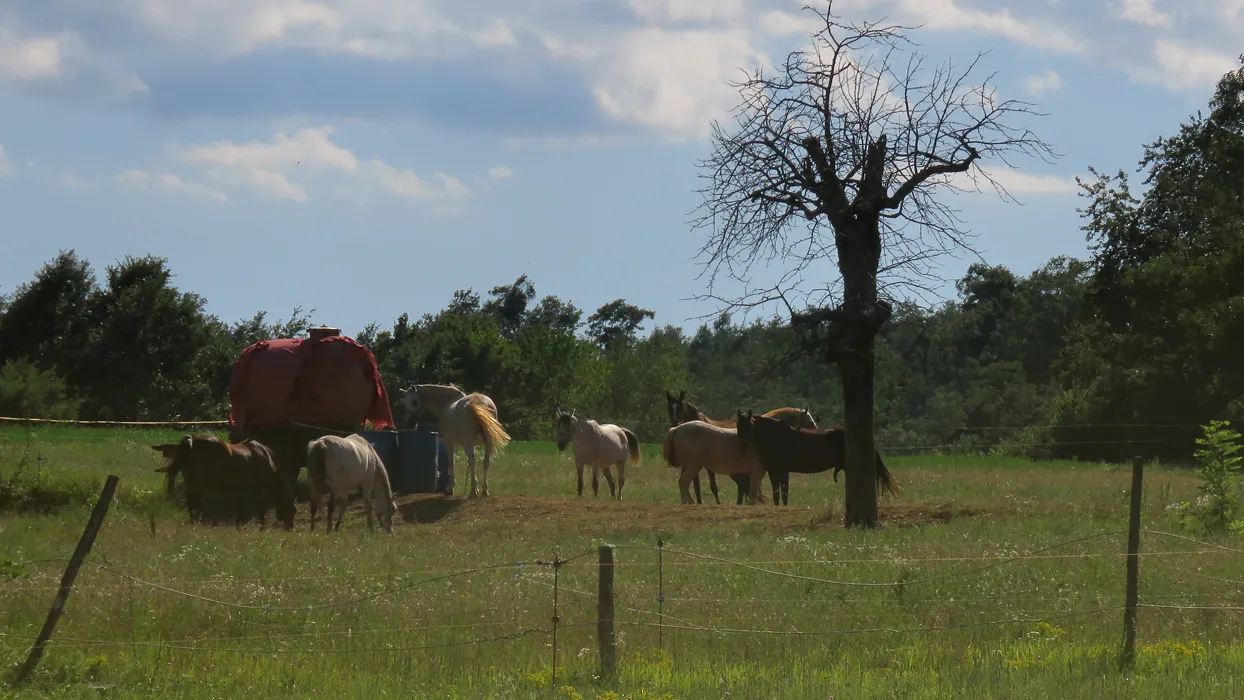
... so we stopped when we saw some horses along the road.

We watched them for a while ...
... I took these few shots ... and then we continued.
At one point, when we did approximately half of the way that leads back home, a friend said : Hey, let's go to Kringa, I need to experience something slightly creepy before the end of the day, and this is just a small detour. So we left the asphalt, and continued downhill on the unpaved road that leads to that town.
The afternoon was turning into evening, and the atmosphere was getting gloomy and dark, as we descended through the dense forest to the valley below ...
... but when we surfaced from the dark woods, once we arrived in the open space at the bottom of the hill ...
... things changed ...
... it was sunny again ...
... and sunflowers greeted us.

We spent some time among these spectacular flowers on tall plants ... they were almost 2 meters tall.
I found some insects ...

... and after a short struggle surrounded by swarms of hungry mosquitoes ...
... I managed to capture a few decent photographs ...

... without the macro equipment.
The sun was sinking fast ...
... the night was swallowing the sunflowers, their vivid yellow was disappearing in the dark.

I took only two more shots ... photographed this bee ...

... and the Dock bug. The valley was getting really dark, it was time to continue uphill ...
... to the next hill ...

... to Kringa.
If I hear someone say that would like to visit Kringa, a pretty obscure and unknown little town, I get easily sentimental and usually think to myself "Cool, another Vampire hunter" :D ... I'm not alone.
In the year 1656, in the local graveyard, the one you see on this photograph, villager Jure Grando, resident of Kringa born in the year 1579, was burried and nobody expected to see him again.
In his series of books, some sort of Encyclopedia published in 1689, called Glory of the Duchy of Carniola, a wide opus that incorporates Istra too, Johann Weichard Freiherr von Valvasor , a natural historian and polymath (an adventurer and traveler as well) tells a story he heard from the villagers in Kringa.

According to people back then, soon after the funeral Jure Grando was on his feet again, blood thirsty and ugly, wandering through Kringa at night, terrorizing the village.
In 1672, a man called Mile Radetich, the prefect of that area, led a group of 9 brave men to the graveyard to dig out the body and finish the thing with some old school hawthorn stake medicine.
When they opened the grave, they were shocked to see that Jure had a frozen smile on his face, that looked alive in a monstrous way.
The nine brave men ran away quickly, but the prefect got them back, brought the priest too, so they continued the dirty job, trying to put the stake into the body.
But the sharp hawthorn stake was just bouncing, the skin seemed impenetrable, protected by some strange, unholy presence.
After the long struggle accompanied by prayers, one of the 9 brave men, the one that was called Stipan Milashich and carried an axe, decapitated the vampire.
According to the story, the head, dislocated from the rest of the body, let out a long scream and the grave was flooded with fresh blood.
When they buried the thing again, Kringa finally had peace.
The town (just like Draguch before) was built on the remains of the Neolithic settlement ...
... and according to archeological findings, the area was continuously populated throughout many centuries dominated by the Roman Empire.
I like this little town and its sinister aura very much.
We walked around a bit ... a bit less than an hour or so ...
... while the sun was slowly disappearing behind the hills.
... we visited the graveyard when the night was eerily near ... and then sat in the car, drove through the same unpaved road ...








... I photographed this Kazun ( please see this post @borjan/portraits-of-istra-episode-16-a-short-visit-to-the-ancient-rural-architecture if you want to know what a Kazun is) and then it got really dark ... there were no more photographs, so this little post must end right here.
As always in these travels on HIVE, all the photographs are my work.