
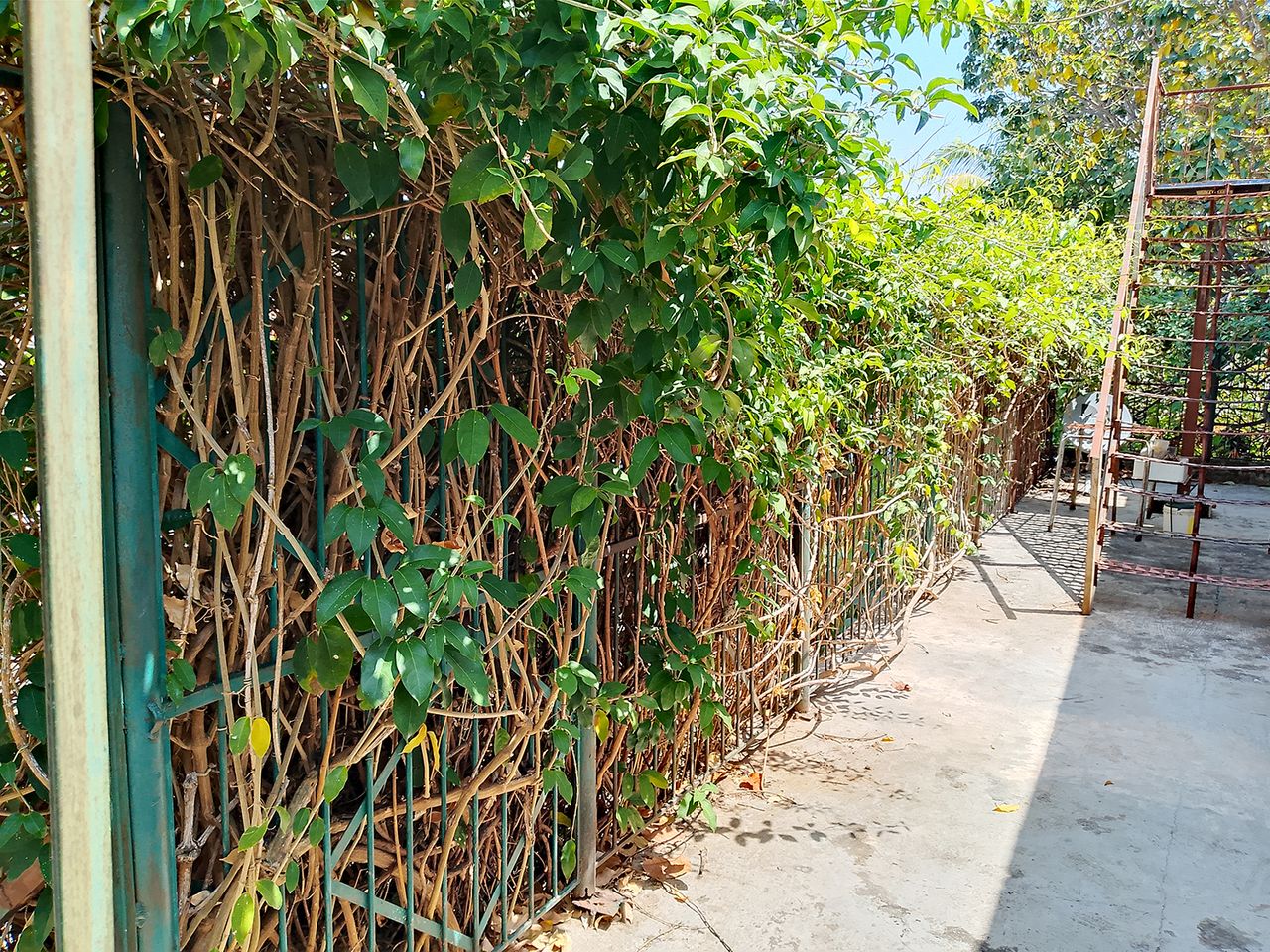
Mi casa es de 2 pisos, vivimos en el piso superior y utilizamos una escalera de concreto para subir. Al subir, hay una terraza que tiene una reja de entrada y el borde de la terraza se encuentra cercado con una baranda que tiene una planta trepadora del género Mansoa. Cerca de la reja de entrada, es habitual encontrar nidos de avispas debajo de las hojas de la planta trepadora, y nos enteramos porque al tropezar las ramas de la planta se alborotan las avispas y nos pican.
My house has 2 floors, and we live on the top and use a concrete staircase to get up there. At the top, there’s a terrace with an entrance gate, and the edge of the terrace is fenced off by a railing covered with a climbing plant of the Mansoa genus. Near the entrance gate, it’s common to find wasp nests under the leaves of the climbing plant, and we know this because when we trip over the branches of the plant, the wasps get agitated and sting us.

La baranda es larga y la planta se ha extendido por toda la baranda, pero por razones que desconozco, las avispas solo anidan en hojas de la planta cerca de la reja de entrada; allí han anidado por años. Ante esta situación, para no matar a las avispas, cuando encuentro un nido espero que sea de noche, que es cuando se encuentran todas las avispas en el nido, y con cuidado desprendo la rama donde se encuentra y la traslado hacia el final de la baranda, más allá de la escalera de metal que se ve en la siguiente fotografía; cerca de la antena para ver televisión por satélite.
The railing is long, and the plant has spread all along it, but for reasons I don’t know, the wasps only nest in the leaves of the plant near the entrance gate; they’ve been nesting there for years. Given this situation, so as not to kill the wasps, when I find a nest I wait until nightfall, which is when all the wasps are in the nest, and carefully detach the branch where it is located and move it to the end of the railing, past the metal staircase that can be seen in the following photograph; near the satellite television antenna.
En la siguiente fotografía señalo con flechas amarillas, los 2 últimos nidos de avispas en el final de la baranda que trasladé desde la cercanía de la reja de entrada. La presencia de los nidos se reconoce porque las hojas de las ramas donde se encuentran no son verdes porque se han secado.
In the following photography, I have marked with yellow arrows the last 2 wasp nests at the end of the railing, which I moved from near the entrance gate. The presence of the nests is evident because the leaves on the branches where they are located are not green, because they have dried out.

Las avispas son de la especie Protopolybia exigua y su picadura es moderadamente dolorosa. El primer nido que trasladé (de un solo panal) ya estaba sellado, y el segundo lo trasladé cuando construían el panal (se podían ver las celdas), pero pasados unos días ya estaba sellado. Ambos nidos fueron construidos con un solo panal pero los he visto con 2 panales.
The wasps belong to the species Protopolybia exigua, and their sting is moderately painful. The first nest I moved (consisting of a single comb) was already sealed, and I moved the second one while they were building the comb (the cells were visible), but after a few days it was already sealed. Both nests were built with a single comb, but I have seen them with 2 combs.

Por experiencia sé, que si una persona se acerca a los nidos las avispas no atacan, incluso uno puede hacer movimientos con un dedo muy cerca de ellas y solo siguen el movimiento del dedo, también se puede tocar el nido con las avispas que están afuera y a las avispas. Solo atacan si perciben golpes relativamente fuertes, como cuando tropezamos la rama donde se encuentra el nido, o cuando estoy podando la planta con un machete.
From experience, I know that if a person approaches the nests, the wasps don’t attack; in fact, a person can even move a finger very close to them, and they’ll just follow the finger’s movement. It’s also possible to touch the nest with the wasps outside it and the wasps themselves. They only attack if they sense relatively strong impacts, such as when we bump into the branch where the nest is located, or when I’m pruning the plant with a machete.

Esas avispas tienden a enjambrar, y como ha ocurrido anteriormente, en algún momento abandonarán el nido.
Those wasps tend to swarm, and as has happened before, they will eventually leave the nest.


