

Today begins a new microseason! If this is your first time joining us, scroll down past the forecast to read about what exactly a microseason is. For the rest of you, let’s jump in!
The Current Solar Term: Daikan
The current solar term, Daikan (大寒), began Jan 21st. We talked about this last time, so go read there if you are interested.
Daikan lasts until Feb 3rd.
The Current Microseason: Ice on Streams Grows Thicker
Today, Jan 26th, begins 水沢腹堅, the 71st microseason (候, kō) which is read Sawamizu Kōritsumeru and means Ice on Streams Grows Thicker. This is the second microseason of Daikan, which is itself the sixth solar term of winter.
The coldest time of winter continues, as the mountain streams are starting to freeze over and more snow is coming down. But don’t lose heart; the days continue to get longer and spring is coming.

Seasonal Fish: Japanese Pond Smelt
On lakes with thick ice, ice fishing for wakasagi (公魚), Japanese Pond Smelt, is common at this time. They are said to be at their best right now, having their best taste now and also full of eggs. They are good in tempura. They also make great snacks when dried.

Seasonal Event: Daruma Markets
Daruma markets (達磨市) take place during the entire New Years season, but many are overlapping at this time, so it gives us a good opportunity to look at them.
A Daruma doll is a round and hollow doll with an eyeless face painted on it. The face is a stylized drawing of Bodhidharma’s face, the monk who brought Zen Buddhism from India to China. His facial hair is painted so as to resemble a tortoise shell and a crane. In Japan it is said that cranes live for 1000 years and tortoises for 10,000 (鶴は千年亀は万年, tsuru wa sennen, kame wa mannen), making these very lucky.
One typically buys a Daruma doll at one of the many Daruma markets held at shrines across Japan, makes a wish or goal and paints in one of the eyes, then when the goal is achieved, one fills in the other eye. It’s a fun little tradition and a good source of revenue for shrines.
Daruma Market (達磨市, daruma ichi) also happens to be a haiku kigo (season word) for new years, for all you haiku poets.

Here is a haiku for this microseason:
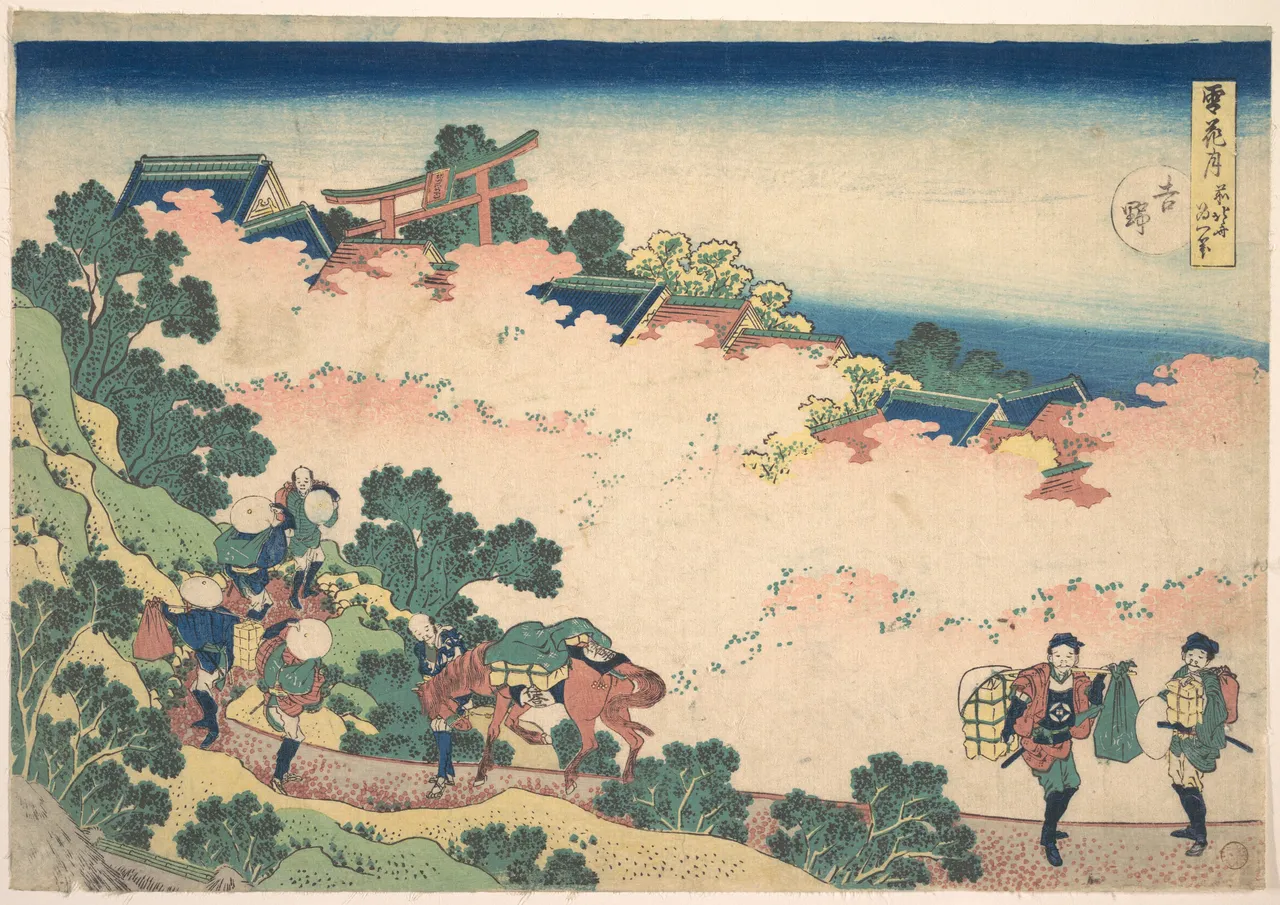
yukiore ya yoshino no yume no sameru toki
waking me from my dream
of cherry blossoms
—Buson
Many people right now are dreaming of warmer weather. It won’t be long!
The place he is dreaming of is Mt Yoshino, which is covered with cherry blossoms and has long been one of the most popular places in Japan to view them.
Yukiore (branch broken by snow) is a kigo for late winter.
Will move this info to another post one of these days, but for now, briefly:
- Each month has two seasons, called solar terms (節気, sekki), giving us a total of 24 seasons. This gives the system its name, the 24 Sekki (二十四節気). I usually refer to this entire system as The Japanese Almanac. It is more than a little similar to the American Farmer’s Almanac.
- Each of these 24 seasons is further subdivided three more times, giving us a grand total of 72 seasons, or microseasons (候, kō).
- Each microseason is about 5 days. With time periods so short, they can get pretty specific about what in nature we might expect to be happening around now.
- The system was originally from China, but it was reformatted during the Edo Era (1603–1868) to fit better with Japan’s climate. I find it also fits fairly well with much of the Midwest in the Eastern half of the US. But if you live in a different area, your milage may vary.
- The entire system is based on the equinoxes and solstices, so it is fluid and the exact dates will vary by a day or two from year to year. Luckily there are a great many Japanese sources that do the astrological computations for us and tell us exactly when each one starts and ends every year.

The next microseason starts on Jan 30th. See you then for the next forecast!