

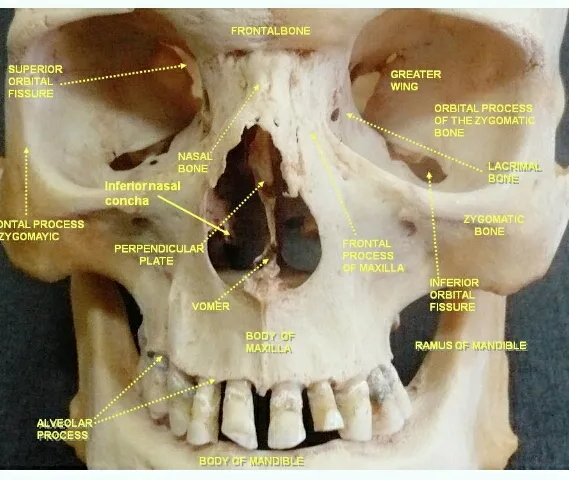
The compound with two triangular holes is seen above the mouth cavity, commonly called Taken At. In the anatomy, the nose is a swollen sensory organ in front of the face of the spine. Breathing air enters and exits through the nostrils.

The back of the nose contains the olfactory mucosa and sinuses. From behind the nasal cavity, air passes through the pharynx and divides into the digestive tract, and then enters the rest of the respiratory tract. In humans, the nose is centrally located over the mouth and serves as an alternative respiratory tract, especially for infants. In most other mammals, it is located at the top of the snout.

Air supply,
The nose is the first part of the respiratory system. It acts as a way to take in oxygen from the air and remove carbon dioxide from the body. As the primary coordination between the external environment and the internal lungs of the animal's body, the nasal air conducts adaptive functions such as: thermal control and filtration, and awakens the sensory perception of smell.

There are numerous hairs inside the nostrils to prevent any unwanted particles from entering the respiratory tract. They act as an initial layer of protection against dust, smoke and other static contaminants that may interfere with the respiratory process, and act as a detergent against airborne illness. In conjunction with the action of the filler, the mucus produced inside the nose complements the body's efforts to control the temperature and contributes to moisturizing the connected parts of the respiratory tract.
The capillary structure of the nose keeps the air entering the body warm and moist; Later, this role in maintaining moisture awakens the adaptive state of the alveoli for proper exchange (i.e., respiration) of oxygen and carbon-di-oxide between the lungs. During exhalation, the hair follicles re-cooperate in restoring some moisture, especially as a function of thermal control.

Direction determination,
It is also useful for diagnosing wet nose in dogs. The cold-sensing collector on the skin can determine exactly where the nose is getting the most coolness, and thus the animal can detect at that moment from which direction a particular odor is coming.

Structure of air-breathing parts,
••In mammals,
both nostrils are connected to one another. In most species they are extremely large, usually occupying up to half the length of the skull. However, in the case of some groups, including primates, bats, and cetaceans, the nose has become secondary, and as a result, the sense of smell of these animals is relatively reduced. The nasal cavity of mammals is partially dilated by the development of a palate, detached from the entire upper surface of the main mouth, leaving the palate as a surface of the mouth, resulting in a part of the nose. The dilated nasal cavity contains a complex rotary device forming a coiled scroll-like shape, which helps to warm the air before it reaches the lungs. The cavity also extends into the adjacent cranial bone, which forms the adjacent air cavity (known as the paranasal sinuses).
••Birds also have a nostril-like nose located on the back of the upper lip similar to that of reptiles. Their olfactory cavity is usually small due to its low olfactory capacity, although it contains three rotors, but sometimes resembles mammals in having such a complex structure. In the case of many birds, including pigeons and wild birds, the nostrils are covered by a horny protective shield. The casting organ of birds is either underdeveloped or completely absent, depending on the species.

In the case of fish,
Fish's sense of smell is generally weak, which is usually less important than taste in the aquatic environment. Yet, they have a nose for smell; However, unlike quadrupeds, it has no connection to the mouth, nor does it play a role in respiration. Instead, it usually consists of a pair of sacs located in front of the head or behind the nostrils on either side. In many cases, each of the nostrils is split in two by a fold of skin to allow water to flow through one side and out through the other.

Some nose problems,
Our nose is a very important organ. We mainly use the nose to breathe. Another very important part is that we get the scent in the membrane inside the nose. It is on the top of the nose. Both of these can cause work problems for a variety of reasons. Of these we often hear from patients with nasal congestion. This is accompanied by the discharge of cold from the inside of the nose. This can lead to sinusitis, headaches or even nasal bleeding. At the same time, various diseases of the throat and ears with different symptoms of the nose can create new complications. Pharyngitis can occur, if there is a problem with the nose, there is a risk of ear infection. Such is the problem. Patients can come to us with these symptoms in case of ear infection.
About me,
I am a new member of the hive family. I am regularly writing paragraphs and uploading pictures of different moments. Please- comment, follow and vote me to take my work further. I expect your love. And also thanks for support me.
**
*MD Jahangir Alam"
Assistant Teacher
Chhaliakandi IV high school,
Muradnagor, Cumilla.
Bangladesh.
E_mail: tuhin.shahalam@gmail.com