
ESPAÑOL
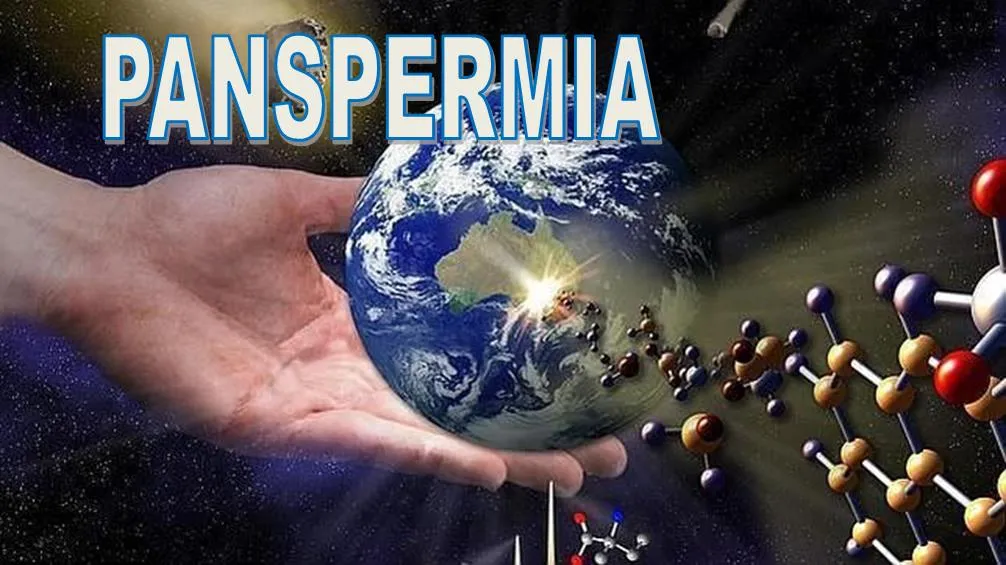
¿Quiénes somos? ¿De dónde venimos? ¿A dónde vamos? Son preguntas que nos hacemos asiduamente, sin encontrar respuesta alguna. Tan solo la palabra PANSPERMIA es sugestiva.
La PANSPERMIA es la hipótesis que dice que somos polvo cósmico y que la vida existe en todo el universo, distribuida por los asteroides, meteoritos, cometas… En definitiva, lo más probable es que fuimos sembrados en los planetas por seres de mayor inteligencia.
Es un hecho comprobado que los microorganismos pueden sobrevivir en condiciones muy hostiles como las radiaciones del espacio. Algunos de ellos pueden viajar inactivos por largos periodos de tiempo, activándose luego, donde encuentren las condiciones adecuadas.
Uno de esos microorganismos son las endosporas, que pueden soportar temperaturas hasta 420 grados centígrados.
La primera mención de la palabra fue hecha en los escritos del filosofía griega Anaxágoras siglo quinto antes de cristo. La propuesta comenzó a tener aspectos más científicos, con el apoyo de los estudiosos de la ciencia como Jöns Jacob Berzelius (1834) Hermann Richter (1865) Hermann von Helmholtz (1879) Kelvin (1871). Alcanzando su nivel de hipótesis científica explicada por el químico sueco Svante Arrhenius (1903).
Algunos científicos sostienen que este polvo cósmico que aún permanecen en el espacio, penetran la atmosfera terrestre siendo responsables de grades brotes epidémicos y de la novedad genética para la macroevolución.
Stephen Hawking dijo “La vida podría extenderse de un planeta a otro o desde sistema estelar a sistema estelar, transportado por meteoros".
Los experimentos hechos en el 2008 por la Estación Espacial Internacional, sometiendo a microrganismos al espacio por largo periodos de tiempo, unos expuestos directamente a las radiaciones del sol y al flujo del espacio y otros protegidos por estructuras parecida a los de los meteoritos. Los organismos protegidos por la capa de meteorito artificial confirmaron la probabilidad cierta de la hipótesis de la Panspermia.
En el 2013 un equipo de físicos afirmaron que los patrones matemáticos y semióticos del código genético poseen la firma de nuestros creadores.
Existe dos preguntas verdaderamente inquietantes, ¿Quién puso esas muestras de vida en un meteorito? y ¿Quién las creo?
Para quienes pensamos en todas estas teorías e hipótesis, debemos asumir una posición para no quedarnos con las manos vacías, ante estos temas tan importantes de la vida humana terrena.
ENGLISH
Who are we, where do we come from, where are we going, where are we going? These are questions we often ask ourselves, without finding any answer. Only the word PANSPERMIA is suggestive.
PANSPERMIA is the hypothesis that says that we are cosmic dust and that life exists throughout the universe, distributed by asteroids, meteorites, comets... In short, it is most likely that we were planted on the planets by beings of greater intelligence.
It is a proven fact that microorganisms can survive in very hostile conditions such as space radiation. Some of them can travel inactive for long periods of time, activating themselves later, where they find the right conditions.
One such microorganism is the endospore, which can withstand temperatures up to 420 degrees Celsius.
The first mention of the word was made in the writings of the Greek philosopher Anaxagoras in the fifth century BC. The proposal began to have more scientific aspects, with the support of science scholars such as Jöns Jacob Berzelius (1834) Hermann Richter (1865) Hermann von Helmholtz (1879) Kelvin (1871). Reaching its level of scientific hypothesis explained by the Swedish chemist Svante Arrhenius (1903).
Some scientists argue that this cosmic dust that still remain in space, penetrate the Earth's atmosphere being responsible for large epidemic outbreaks and genetic novelty for macroevolution.
Stephen Hawking said "Life could spread from planet to planet or from star system to star system, transported by meteors."
Experiments done in 2008 by the International Space Station, subjecting micro-organisms to space for long periods of time, some exposed directly to the sun's radiation and the flow of space and others protected by meteorite-like structures. The organisms protected by the artificial meteorite layer confirmed the certain probability of the Panspermia hypothesis.
In 2013 a team of physicists affirmed that the mathematical and semiotic patterns of the genetic code possess the signature of our creators.
There are two truly disturbing questions: Who put these samples of life in a meteorite? and Who created them?
For those of us who think about all these theories and hypotheses, we must assume a position so as not to remain empty-handed in the face of these important issues of human life on earth.
LA INFORMACION FUE TOMADA DE WIKIPEDIA
Link