
This week I thought that I wouldn't have anything good to participate in "mypictureday" contest run by  and sponsored by
  and
and  , and I mean it, since I can't go out on the street because of the quarantine, and being locked up all day in the house is boring, besides I haven't gone to work with my brother because I was very stressed and needed to rest, but that's another story, on Friday I'll go again.
and sponsored by and , and I mean it, since I can't go out on the street because of the quarantine, and being locked up all day in the house is boring, besides I haven't gone to work with my brother because I was very stressed and needed to rest, but that's another story, on Friday I'll go again.Thinking about that I decided to start doing some housework that I have left pending, and one of them is, change my small (tenebrios molitor, español) mealworms of home, these small worms are part of the feeding of my fish that I have with me always where I go, if I change my city they go with me, unless they are already very big then I change them for other smaller fish.
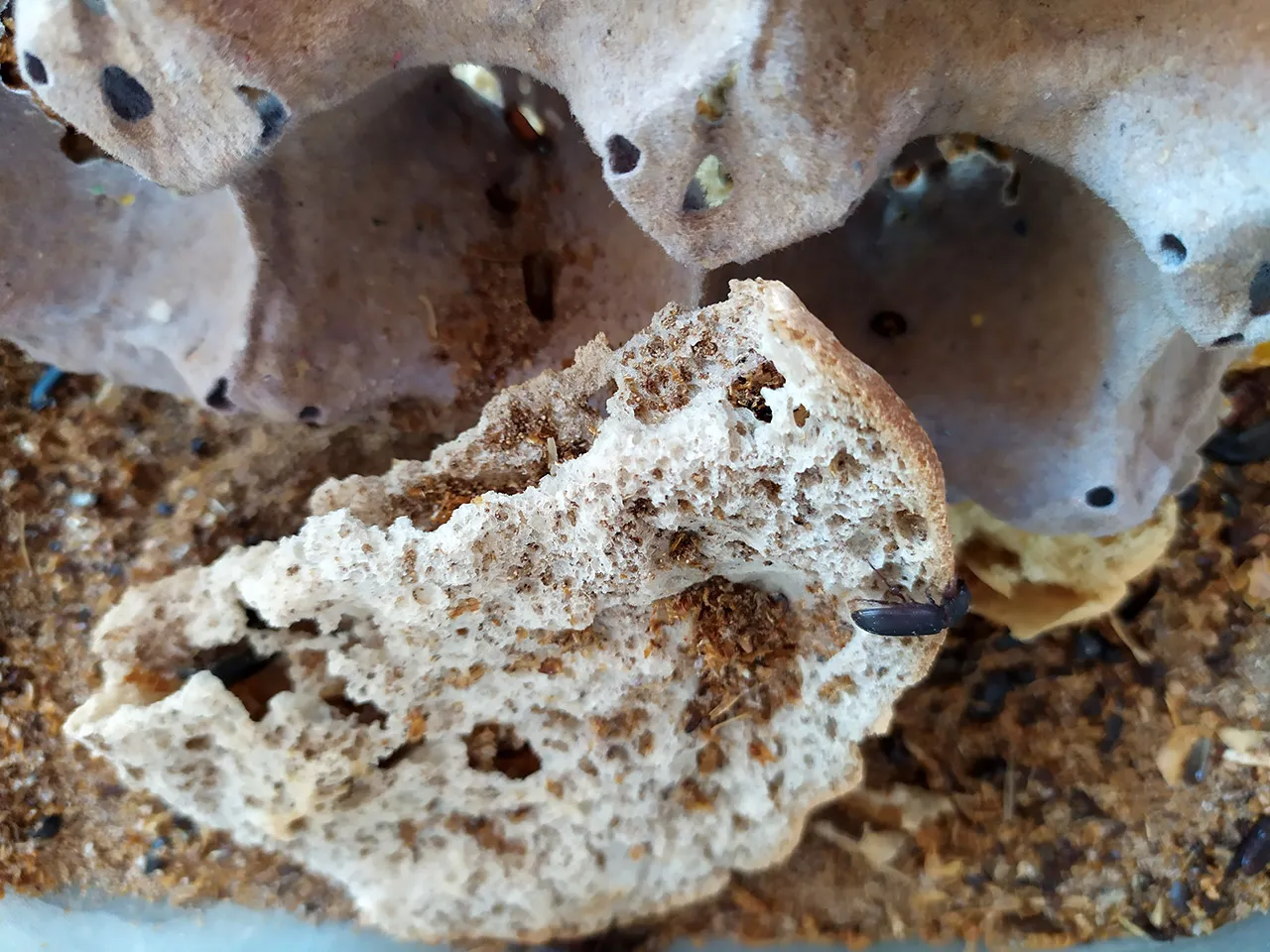
Anyway, this post is to show you them, since probably many of you don't know this little live fish food, besides presenting a few macro photographies I took like the following one:

camera: Canon EOS Rebel T6
lens: Canon 18-55mm
aperture: f5.6
shutter speed: 1/25
focal length: 55mm
ISO: 400
flash: no
Well, let's get to work, time to start with the post so you can see the dirty home they were living in, it's normal that it ends up this dirty, I've even seen worse than mine, I really neglected them the last weeks for many reasons, the work, the photography and the time I spend on it, the time I spend on HIVE has also been part of the cause.

From the first moment, I see all the chaos in which they live.
These small worms constantly change their skin as they grow, that increases even more the dirt, some of the worms in their adult phase, are dying at the end of their reproductive cycle, some corpses are visible.

After moving them out of the container so that I can clean everything completely, I wash the container where they live in.

I start collecting them one by one, here I took the picture of one in the adult phase, which is when they reproduce.

Now a picture in their mealworms phase, which is when they are appropriate to feed to fish, birds, and different mammals that can be fed with them, this is the stage where they are full of protein, they are also the stage where many people are afraid of them.

Slowly I'm picking up as many as I can, the orange beetle looks like this because it has a few hours to do out of the "Pupa" stage which is the intermediate between a worm and an adult beetle.

The container has already dried up, and as there were not so many mealworms and beetles, I decide to put a part of the previous trash, as it is probably full of small millimetric worms that I cannot even see, and it is almost certain that there will be eggs too.

Now I add the food, in Spanish it's called "Salvado de trigo" and if I'm not mistaken it's called "wheat bran" in English, it's a pretty cheap food and very nutritious for them, even for us, many people use it as a complement within their diets.

Here I wanted to get a little creative by taking a picture when I added the wheat bran, the truth is that the picture looked better in my mind than what came out, so let's move on.
Canon T6, 18-55mm lens


I put everything I could collect in the container, already with their food ready.

As soon as they sit down in their new home they start to hide under the surface, surely they have already started to eat.

Now I need to add some fruit that they can eat, that serves them as humidity since I cannot put water in to drink directly, instead they get all the water they need from their food, in this case I put some jicama.

Now a little cardboard that they use to hide, lay eggs, have sex, oh yes, I've seen it before! They love to get up and get crazy, haha.

See? Quickly they start to get on the cardboard, they love that place.

Some mealworms are already on the jicama, eating and drinking as a family.

And now the Macro Photographies, the first one you already saw, is the one of the cover of the post, but here I put it again in case you forgot it. I must say that all the photos were taken with the 18-55mm lens, on the Canon T6 and the Macro Extension Tubes that I showed you the last week. (The other photos were taken with the Xiaomi Redmi Note 7)
To give you an idea of the real size, I put it on my lens cap, aren't they small?

The following two photos are from the "Pupa" stage, which is the intermediate phase of their life. In this stage they do not feed until they have finished their transformation to an adult.


And the adult phase, the most difficult to photograph, I had to take out the piece of cardboard carefully so as not to scare him, and prevent him from running.


That's all for today, I hope that seeing these bugs didn't give you a bad time, and if you want to participate in the contest I leave you the Link so you can see the rules, Thanks for stopping by, see you!