
| Latin Name | Observation Date | Location |
|---|---|---|
| Imperata cylindrica | April 28, 2026 | Purulia, Natore, Bangladesh |

After a long time, I was able to take pictures of these flowers. These flowers had been blooming on the pond bank next to my pond for a long time. Every day, I thought about taking pictures of the flowers and posting them on Hive, but for a few days, due to the intense sun and heat, it was not possible to take my mobile phone to the pond. Because when I took pictures with the mobile phone camera in the sun and heat, the phone was getting so hot that it felt like it would explode right away. Finally, on April 28, at noon, the opportunity came. There were clouds in the sky, so there was no sun, and there was a strong wind. Since the weather was cold, I did not miss this opportunity. I went to the pond with fish food in my bag and my mobile phone in my pocket, and went straight to take pictures with the fish food. These grass flowers bloomed all over the pond, how beautiful it looks from a distance! The white flowers looked like white clouds floating on the ground. Many people mistake it for Kashphul, but in fact, it is not Kashphul, it is our well-known 'Ulu Ghaas' or 'Chhon.

The villagers know it better as Cogon Grass or Ulu Grass. This grass is usually found in high, fallow lands, especially in sandy soils. Its roots penetrate very deep into the soil. It is a very tolerant plant that survives even in severe droughts.

After taking a picture and uploading it to the iNaturalist app, I found out that its English name is Cogon Grass and its scientific name is Imperata cylindrica.

I was curious whether cows and goats eat this grass, but later I saw that herders were cutting it to feed the cows. Although I don't think this grass is a favorite food of cows and goats. Because its leaves are quite wide and the edges are quite sharp. If you accidentally touch the side of this leaf, you are afraid of cutting your hand like a blade or paper.

Seeing this Ulu Grass field reminds me of my childhood. There was a time when most of the houses in our village were made of this ulu grass or straw. The farmers of the village would cut it from the fields and dry it in the sun to make a strong roof for the house. Those straw houses were quite cool in summer and not too cold in winter. But now times have changed. Now the villages have buildings, brick houses and shiny tin roofs, so it is no longer valued. So it can be said that this grass is no longer as valuable as it used to be. Now it only grows neglected on roadsides or wastelands. Now no one uses it that way.

However, betel farmers consider it very valuable, because this grass has been used for centuries to support betel trees, when cut and dried in the sun, it becomes very hard and when used in betel, it is very durable. This grass is also used to make brooms.

In terms of photography, taking pictures of this grass in the air is really a work of patience. In the windy afternoon breeze in the open field, the white cotton-like flowers were moving so much that it was difficult to keep the focus on the mobile camera. Whenever I brought the phone closer to focus, the wind blew the grasses to the other side. After some effort, I finally managed to frame a few pictures. I really liked the contrast of these white cotton-like flowers with the dark green background of the grass.


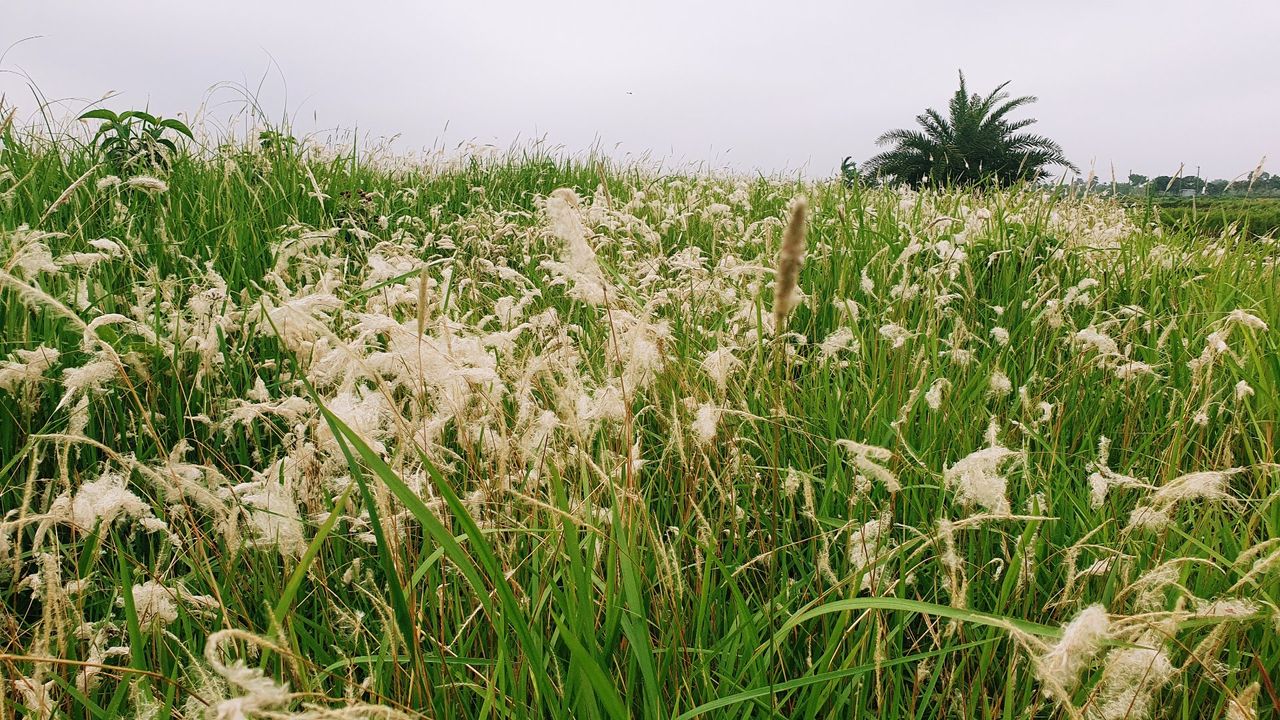


I hope you enjoy these simple but beautiful scenes captured on my camera.
You can tell me in the comments what this ulu grass is called in your area.
(All posts are written in Bengali and translated into English using Google Translate.)
.
.
.
| Camera Used | Samsung SM-C973F |
|---|---|
| F-Stop | F2.4 |
| ISO speed | ISO |
| Focal length | 26mm |
| Flash | No |
| Photography | Cogon Grass (Imperata cylindrica) |
| Photographer |  |
| Location | Purulia,Natore,Bangladesh |
| Link to original community |
|---|
| https://www.inaturalist.org/observations/357580428 |
| Latitude | Longitude | Map Link |
|---|---|---|
| 24.3376 | 89.1158 | https://www.openstreetmap.org/?#map=12/24.3376/89.1158 |