
Last year, I spent Holy Week in Italy. I stayed in Venice the first several days of my trip before heading to Vatican City for the Triduum Sacrum.
As I reminisce the time spent in Venice, I likewise want to share the enjoyable experience with you through this article.
The Water Taxi Ride to Venezia
Photos and gif in this article by silversaver888
Taking a water taxi when arriving in the evening in Venice, Italy is most convenient and picturesque.

 The downside is: the fare between Marco Polo Airport and my hotel in central Venice is pricey!!
 My hotel was located by the waterside, and the convenience of not having to walk some distance with my luggage in the evening on my first night in Venezia made taking water taxi a great use of travel money.
 It took 25 to 30 minutes for the trip between Venice Marco Polo Airport and this waterside hotel in the city center. This photo was taken approaching my stop. Going under this popular bridge to disembark in front of the hotel was just an added thrill for me and felt ceremonial, LOL!
Venice is a popular travel destination in Italy. Have you been to Venice and familiar with this bridge? The hotel is just on the foot of this bridge on the same side as the church steeple. Can you guess which hotel I am staying at? The Hotel carries the same name as this famous bridge in Venezia.
It took 25 to 30 minutes for the trip between Venice Marco Polo Airport and this waterside hotel in the city center. This photo was taken approaching my stop. Going under this popular bridge to disembark in front of the hotel was just an added thrill for me and felt ceremonial, LOL!
Venice is a popular travel destination in Italy. Have you been to Venice and familiar with this bridge? The hotel is just on the foot of this bridge on the same side as the church steeple. Can you guess which hotel I am staying at? The Hotel carries the same name as this famous bridge in Venezia.
The Rialto Market, Venezia
Photos and gif in this article by silversaver888Let us go to the market!


There is no farmable land here; so no meat, dairy or grains. Originally constructed of wood, the whole city was a fire hazard; so no wood-burning ovens for pizza. As a trading city though, Venice did have access to spices from around the world, not to mention endless access to fish.


Can you guess the other usual Italian dish using squid ink? I think I will post a recipe on a future article.
Piazza di San Marco, Venezia
Photos and gif in this article by silversaver888Piazza San Marco is in the heart of Venice. It is 590 ft (180 m) long and 230 ft (70 m) wide, and is the only “piazza” in Venice, since the rest of the squares are called “piazzales” or “campos”. It was established during the ninth century, but adopted its current size and form in 1177, and was paved one hundred years later. The Piazza San Marco is one of the most beautiful in the world. Napoleon called it “the world’s most beautiful drawing room”.
I took a series of photos so that I can share a sort of a 360 degrees views of the Piazza di San Marco.

The top attractions in the piazza are:
1. The Basilica di San Marco (St Mark’s Basilica) is the cathedral church of Venice. It houses Saint Mark’s relics. Basilica is built in the shape of a Latin cross and has five domes with over 4,000 square meters of mosaics, some from the thirteenth century, and 500 columns from the third century.


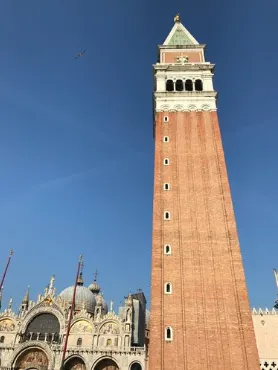
2. The Campanile di San Marco, the bell tower of St. Mark’s Basilica.
It is the tallest building in Venice. At the top of the Tower is a golden statue that represents the archangel Gabriel.
The original tower was used as a lighthouse for the sailors, as well as a belfry.
3. Palazzo Ducale, the Doge’s Palace. The Palazzo Ducale was originally a fortified castle founded between the tenth and eleventh centuries. The building has been the doges residence and public offices since the old castle was built in 810. During nearly 1,000 years, 120 doges ruled over Venice from the Doge’s Palace.


4. It is also worth highlighting the Columns of Saint Mark and Saint Theodore. The two columns are made of granite and marble and were placed near the entrance of the square in 1172. During the eighteenth century, public executions were held between the two pillars.
You can see the Columns of Saint Mark and Saint Theodore on the photos below.

One of the rules of Piazza San Marco: it is forbidden to throw rubbish or feed the pigeons. Obviously the rules are not enforced.


I have many other photos to share with you, but chose mostly those that are not usually shown of Venice.
This last photo was taken the morning of Palm Sunday, as the palms that will be used for the celebration were being unloaded from the boat.
From Venice, I headed to Rome and celebrated the Paschal Triduum (Holy Thursday, Good Friday, and Holy Saturday) and Easter Sunday at the Vatican.
[//]:# (!pinmapple 45.488226 lat 12.315127 long d3scr)

Thank you for stopping by to view this article.
I post an article daily, and I hope to see you again soon!

 is a proud member of #silvergoldstackers and the #ladiesofsgs4eva

 for this banner and for including the Silver Saver Bar in this banner!
