
Compost derives from the Latin componere or compositum and is therefore closely related to the word composition, which originally meant merely a "mixture of things". The practice of composing is as old as the evolution of the word, in Asia, for example, it dates back thousands of years; in the Western Hemisphere, more than a hundred years ago, different forms of composing and their applications were already listed.


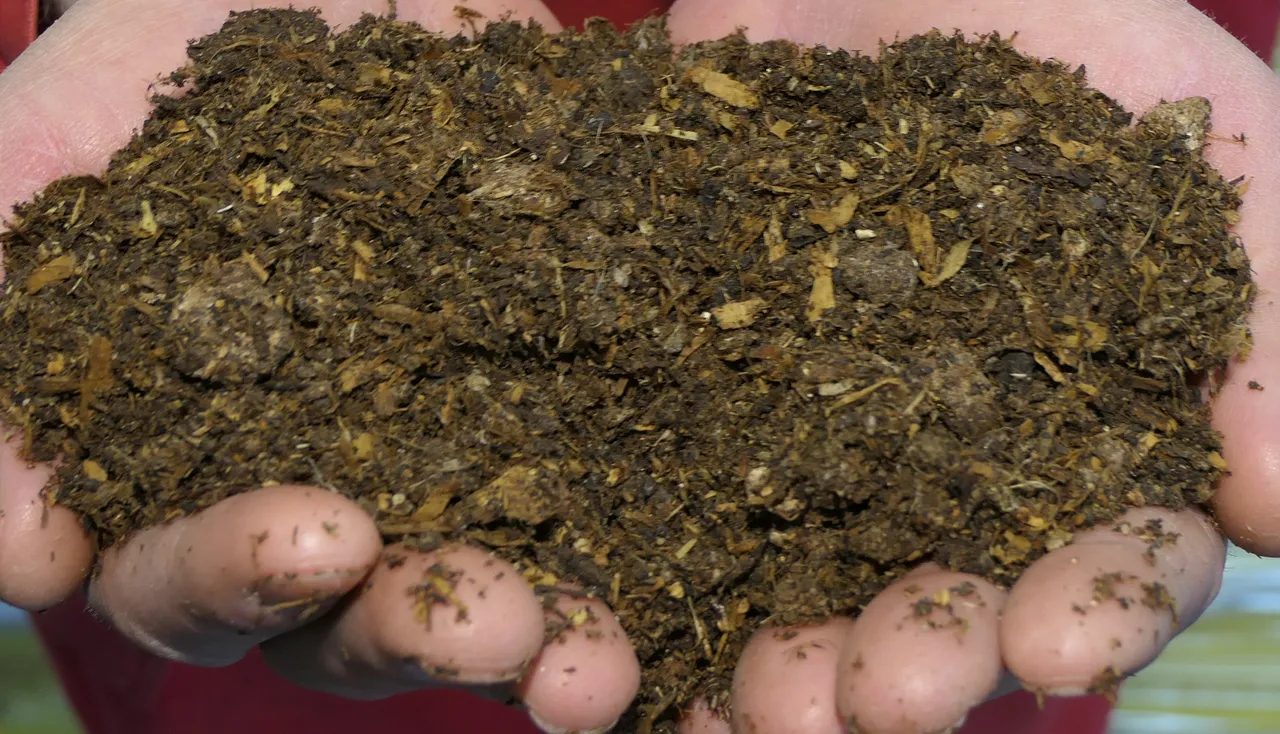
▶ In everyday vocabulary, compost can refer to the mixing of various waste materials so that when they decompose they become humus. However, this term applies specifically to the finished product that is ready for use once the organic matter has decomposed, even though it is still a mixture.

▶ Credits: Jfpriceco. – [Image of Public Domain]
Composting is a process of biological decomposition and stabilization of organic matter, carried out by macroorganisms and microorganisms. The former (worms, earthworms, mites and spiders, centipedes, beetles and others), grind the waste and perform the function of breaking down and disintegrating the materials, facilitating the action of the microorganisms.
In order to reproduce and grow, microorganisms must degrade waste to form energy and synthesize new cellular material. Energy can be obtained by respiration and fermentation. These reactions release energy in the form of heat and form organic compounds that are used to complete the degradation of the waste.
Prior to the process, the initial materials must be conditioned and mixed; regulate their water content, particle size, eliminate non-transformable elements and adjust an adequate C/N ratio. Since the composting process is an exothermic (heat-generating) process, it takes place in a series of stages characterized by temperature variation: mesophilic stage, thermophilic stage, cooling mesophilic stage, maturation stage and refining stage.
The most frequently used are Eisenia fetida and Eisenia andrei. They belong to the ecological category of epigea, which live on the soil surface. They therefore maintain high rates of consumption of organic substrate, which accelerates their degradation.
NOTE: Reference material.