


Sugarloaf volcano


Right after landing on the beach, we took some time to look at the landscape and the rock formations. There are several possible trails to choose from. It is possible to walk only 2 kilometers to the Sugarloaf volcano. At a junction we must choose either to turn inland towards the salt mine volcano or along the coast to the fur seal caves. We choose the coastal route.

Landiguana

The name of the island was originally James Island. At that time the king of England was King James II. The islands have become known when Charles Darwin arrived the Galápagos archipelago in1835. He learned from some Spaniards that further inland on Santiago, a group of men were there to catch the giant tortoises. Like the island of Isabela, Santiago was used as a stop over for sailors and whalers who needed water and food supplies (tortoises). When the Galápagos National Park was established in 1959, the population of giant tortoises had already been reduced.


Snake skeleton


When Darwin was on Santiago he gave a written description indicating that the island had a large population of land iguanas. Today they are almost extinct on this island. We saw only two on our walk. Just like its cousin, the marine iguana, this guy does not look pretty, but a complety harmles vegetarian, eating the cacti. But, they are quite big. Those two that I saw on this island were close to one meter. Automatically you will look at it from a distance!


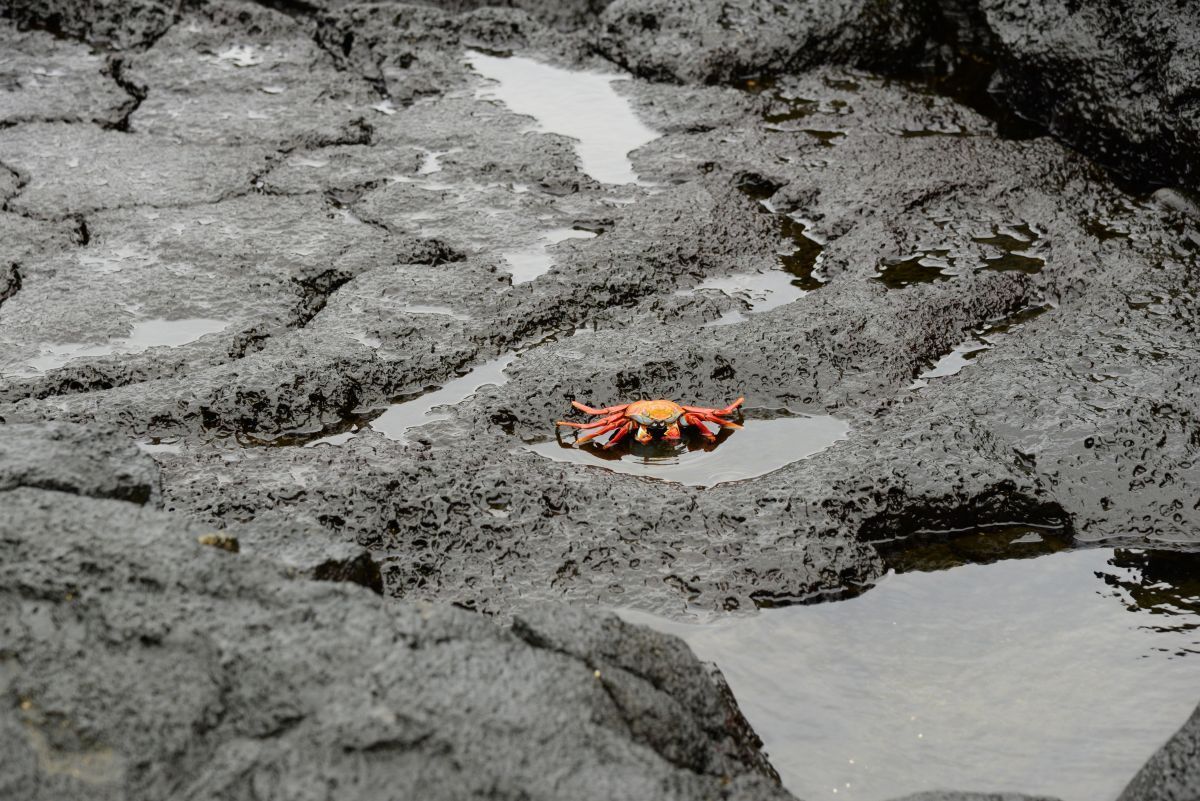


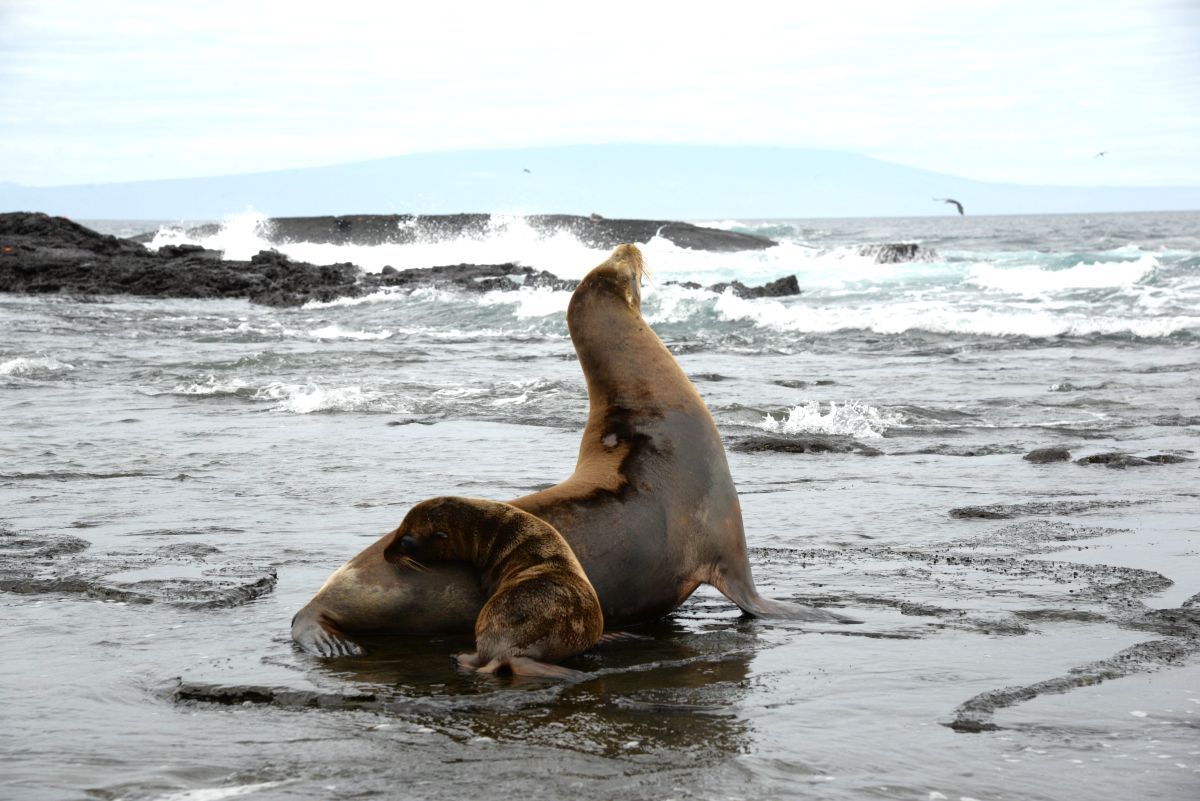
It becomes a somewhat rocky walk as we approach the fur seal site. The black lava rocks dominate the shoreline. We made a stop here to see the seals, but they were not the only species here. Birds, pelicans, marine iguana, crabs etc were quite plentyful. The fur seal is more introverted than the sea lion. They do look very much like its cousin, but it has a layer of fur for protection. There eyes are a little bigger than the sea lion and the ears differ a little too. It can be a bit difficult to tell the difference. They are endangered and only found here at Puerto Egas and also on Ilsa Genovesa.



Although Santiago is uninhabited, it has a history similar to the inhabited islands. Companies that were going to extract salt arrived in the 1930s and the island was attempted to be colonized / settled in the 1930s. But even roads and houses were built, it was never colonized succesfully.


On our way back to the landing place, we focused on plants and landscape as soon as we move away from the black-lava rocks. We were told that pigs, goats, rats and mice (among others) were introduced to the island (just as the other islands). Plants had followed the people who came to work and live here. These plants have spread throughout the island.


These animals managed to destroy many of the natual woodland, changing it to grasland. The pigs destroyed the nest of tortoises among others. But, today the island has no pigs (by 2000) and no goats (by 2006). The goats did keep the imported plants in check. That became a problem when the goats were gone. But, most of the vegetation is restored. The focus on conservation work on Santiago in the last decade has resulted in rapid recovery of much of the vegetation and many of the native species.
Yet again, a wonderful walk through unique landscape, seeing several species of animals for the first time.
Please do follow if you want to keep up with my next travel story. Any upvotes or reblogs are hugely appreciated!
Latest wedensday walk, check out:
Wednesday Walk Challenge : Afternoon walk in volcanic landscape on Isla Isabela, Galápagos
U.J
Kristiansand, Norway
All the photoes are mine, Ulla Jensen (flickr, Instagram and facebook)
[//]:# (!worldmappin -0.24272 lat -90.85643 long Wednesday Walk Challenge : Morning walk on Isla Santiago, Galápagos d3scr)Follow us for our street art contest and blogs about travel, art, photo, crypto & gaming
