
August 23, 2023
Have you wondered how different colors in neon lights are created? They are undoubtedly bright and colorful that are usually used in street and shop signs, and road strips. After checking the Manchester United Art Exhibition in Tai Kwun parade ground, I discovered the Vital Signs Neon Lights Art Exhibition located at the former Police Headquarters that is extended to Laundry Steps.
Photos mine, edited in Canva

There's always something new to see at Tai Kwun, so it's always worth it to visit this historical compound. I started at Laundry Steps where glowing shop signs await arranged on both sides of the staircase. This place is called Laundry Steps as it was the former laundry area of the prison compound back in the day. In case you are curious about the history of this place, you can check the Tai Kwun link above.

The staircase is transformed into a photo booth for Vital Signs Neon Lights Art Exhibition. Colorful neon lights glow in different shop signs. These are traditional Chinese shop signs that are intricately made by professionals. You will know how these neon signs are made as you read along.

I proceeded to the former Police Headquarters building where the main exhibition is located.

The first part is the introduction to the united colors of neon. This exhibition is held by a non-profit organization dedicated to rescuing and conserving Hong Kong's authentic neon identity.

The Table of Elements is posted on the wall to introduce other elements used in creating neon lights, such as Helium, Argon, Krypton, Xenon, Silicon, Phosphorus, and Mercury.

On the other side are installations of glass tubes in the rainbow display, and as you take closer to them, the flowing movements of the noble gas inside can be noticed as it reacts to the electrical charge. It's kind of hurting to the eyes when seeing them up close though, so my sunglasses come in handy.

On the other side is another set of glass tubes where I activated the electrical charge myself by pressing the buttons that correspond to the glass tubes. This display shows the basic elements in action to produce colored lights.
For instance, the clear glass tube + neon gas + electrical charge produces red color light. The yellow-colored glass tube + inside coating of phosphorus powder + argon gas + mercury + electric charge produces a yellow-colored light. (Information posted on the wall next to this display)
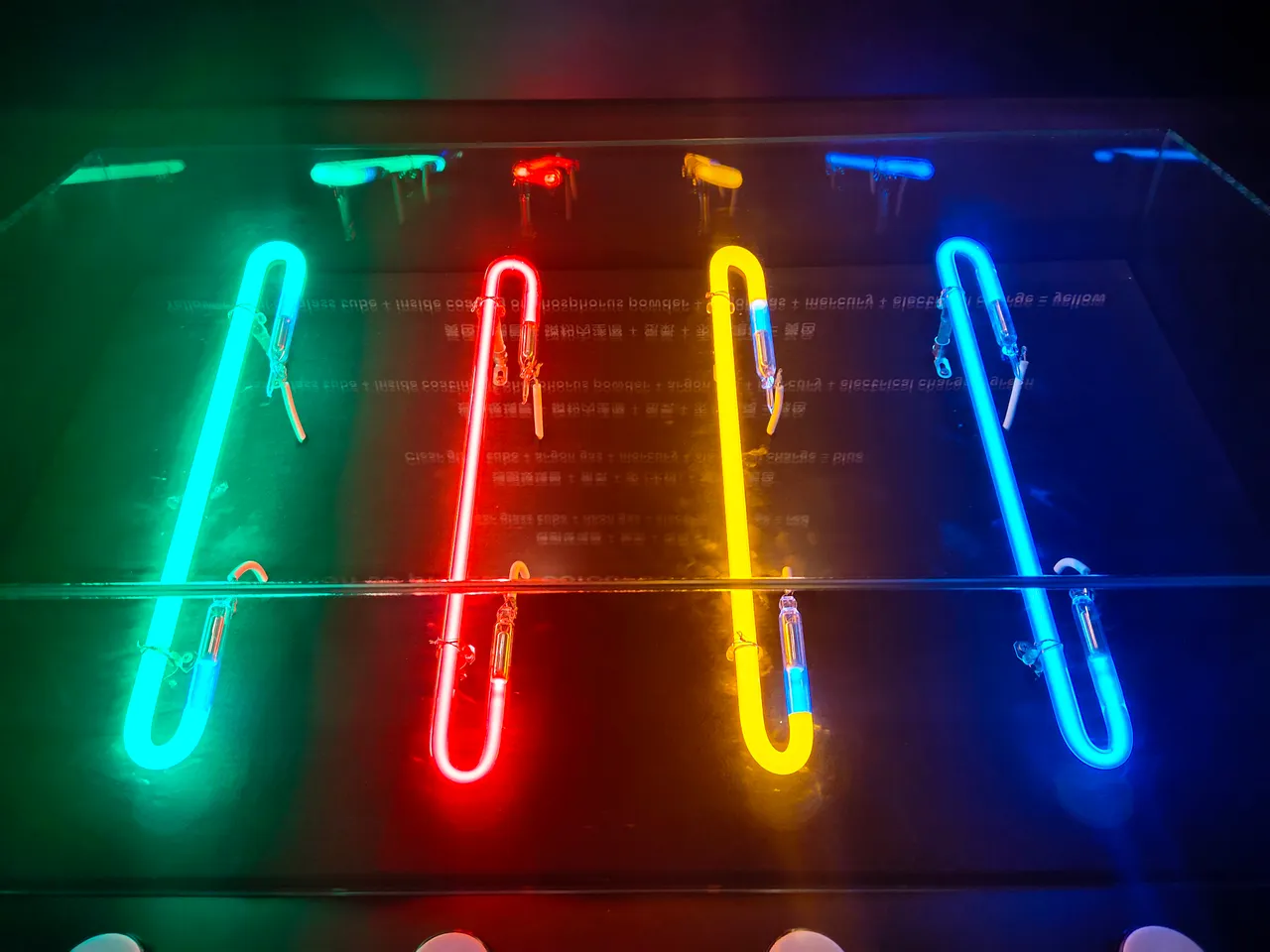
The light only lasted for seconds before returning to off mode. This part is pretty interesting and I learned enough science information about basic light production. I looked forward to learning more information, so I joyfully headed to the next room.
In the next part, I learned about some renowned Chinese individuals responsible for creating authentic Hong Kong neon light installations. The exhibition is called The Hand of the Masters. And below their names are materials and samples of their works.

Five professionals are introduced here:
The Calligrapher - Master Fung. An in-demand calligrapher and the man behind so many Chinese signs and posters using neon technology.
 |  |
|---|
The Tube Bender - Master Wung. He's experienced in neon tube bending. Below his name are some of the materials used in tube bending.
 |  |
|---|
This is called Neon Neon, a newly made piece of Master Wung.

The Metal Master - Master Ng. He is said to be one of the only two metal masters practicing neon who still make the metal sign boxes by hand and from scratch using traditional techniques.
 |  |
|---|
The Sign-Painter - Master Yau. At the age of 17, he started as an apprentice for sign painting, he is now one of the active in neon sign painting and has made some of the pieces in the Vital Signs exhibition.
 |  |
|---|
Lastly.
The Sign Installer - Master Shu. A well-experienced sign installer working at a height to maneuver metallic boxes of neon signs along busy streets.
 |  |
|---|
Looking at these five masters and their works, you can figure out the process done in creating neon signs. Their hard work in creating authentic neon signs is commendable. They are those men behind gigantic, colorful, and attractive neon signs in the streets of Hong Kong.
More neon light signs are installed on the exterior facade of the building that can be seen from the window and is attractive.
 |  |
|---|---|
 |  |
Meanwhile, these pieces are made by Hong Kong artist, Jive Lau who discovered the concept of 3D neon sculpture creating new signs of life and glimmer of hope.

The other interior facade is covered with street neon signs wallpaper and installations that serve as the photoshoot backdrop.

There's an interactive room as well showing video installations about the making of neon signs and related videos.

A bunch of used glass tubes are also part of the exhibition as it has significance in creating neon signs.

As I navigated to the next room, I was captivated by the glowing Neon Metropolis. A collection of paper miniature buildings is formed into a cityscape that resembles Hong Kong.


These art pieces are freshly made by participants of the workshop through the Vital Signs exhibition in Tai Kwun inspired by dazzling and authentic Hong Kong neon signs on display.

This exhibition is made to pay tribute to Hong Kong's neon-lit nightscape. You can watch a short video of the Neon Metropolis here.

An old and deteriorating neon sign is also on display along with a video installation taken at the origin of the removed neon sign.
 |  |
|---|
As I continued walking to the next hall, I spotted more giant neon signs installed on all corners alongside video installations regarding the displayed neon signs.


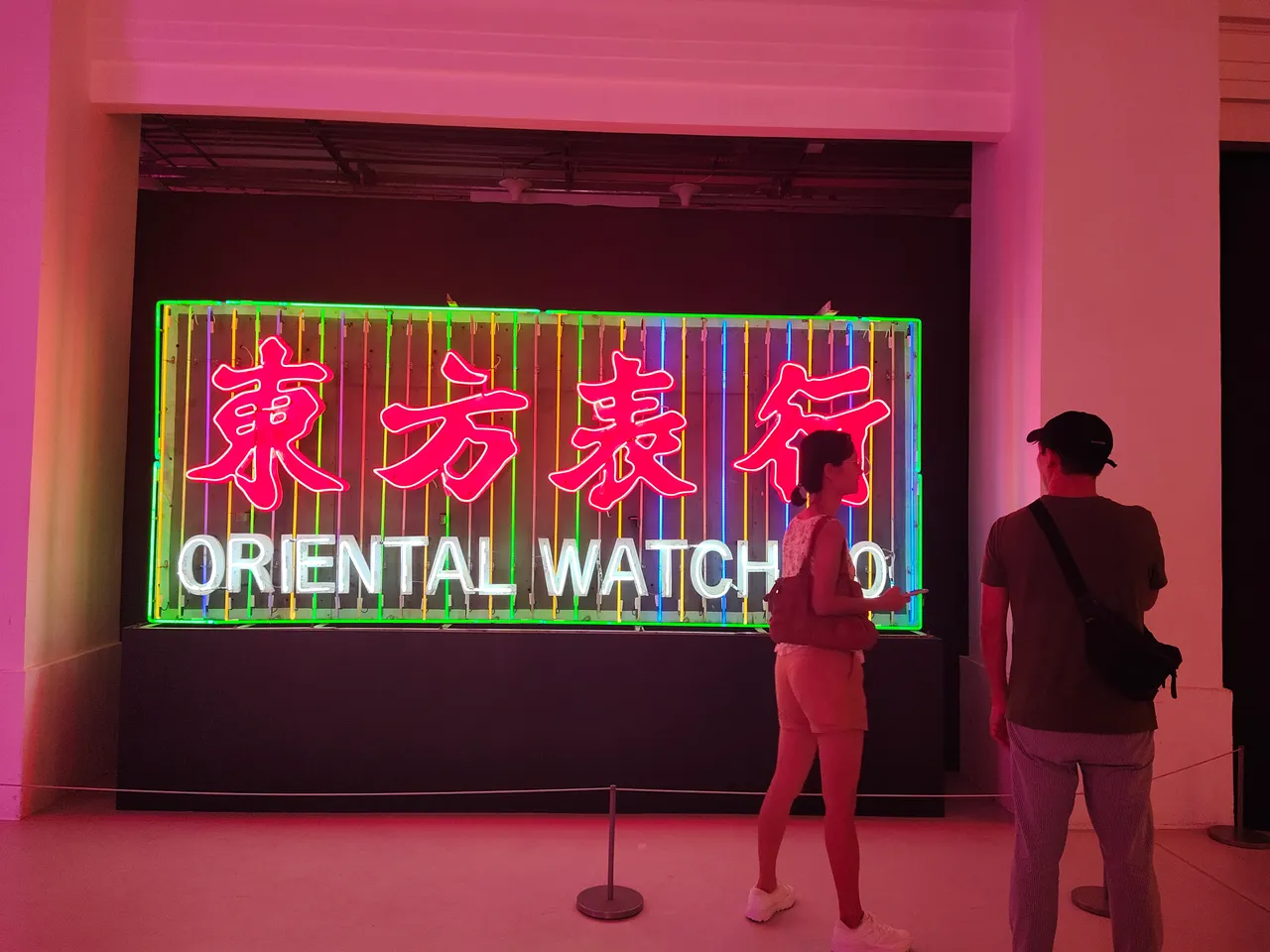
Can you see how tall this neon sign is? That's 19ft! Which made me look tiny and short when I stood beside it, lol.

My favorites are these creative neon art pieces and signs created by different artists.
These are typical Chinese symbols, a koi fish and a red Chinese lantern.

The lady look like a peacock as she stood in the middle of the neon art installation which I immediately captured.

Dazzling and beautiful dragon and phoenix neon sign.

This is an authentic and one of the remaining Hong Kong iconic neon signs.

As innovation brought by modern technology evolves in the city, these kinds of traditional neon signs are slowly disappearing. There are a few cities in Hong Kong though where you can still see lots of authentic neon signs. Mong Kok and some parts of Central, for instance, two of the oldest and densest cities in Hong Kong have a lot of neon signs that makes the city attractive at night. This exhibition is held to pay tribute to neon masters and to help conserve historic neon signs. Even though neon signs are slowly disappearing, the historic and cultural legacy still lives in the people's hearts and minds.
(All photos are mine)


Join her on her quest for self-discovery and wanderlust. If you like her content, don't hesitate to upvote, drop a comment, reblog, and follow for more wonderful adventures. |
|---|
You can also reach me on my socials and let's be connected: