

The first association that comes to mind for any person who hears the name of this neighbourhood is the milkmaid who hurries to the market early in the morning with a jug of milk. This persistent association comes from Alexander Pushkin's poem "Eugene Onegin". I wanted to add a quote from this poem to the text to illustrate my statement, but it turned out to be unexpectedly difficult: I realised that I couldn't stop, I rewrote stanza by stanza... So if you want to reread a fragment of the poem with this line, just open the book, you need chapter 1, stanza 35. There you can read about the milkmaid, the peddler, the baker, and other characters of morning St Petersburg.


But this walk in the historic Okhta neighbourhood had nothing to do with dairy farms. I wanted to take a close look at the historic fire station building and also look for some sights in the neighbourhood. The firehouse building was built in 1867. You can't go wrong with the purpose of this building: there is still a fireman on duty at the firehouse. The firefighter figures were installed some time ago on the old fire towers. Unfortunately, the fire tower is quite tall and I didn't have my long lens with me, so I couldn't take a close-up photo.

When I say "fire station" I'm simplifying things a bit. Now this building does house firemen, but in the 19th century there was no clear distinction between the different services in the city. So this building housed not only the fire department, but also the police. The tower was not only for duty, it was also used to raise warning signals during fires. For example, a red flag signalled a general gathering of the fire brigades. The building of the fire station stands out from the surrounding buildings and attracts attention, it is considered one of the symbols of the neighbourhood.


After seeing the building from different sides, I continued my walk. In a small garden at the corner of Bolsheokhtinsky Prospekt there is a monument to Aliya Moldagulova, Hero of the Soviet Union. Aliya Moldagulova was born in Kazakhstan. The street, on the corner of which the monument is placed, was named in memory of Aliya Moldagulova in 1980, as there was a school nearby where Aliya went to study in 1939 after her family moved to Leningrad. There is a memorial plaque on one of the houses. The monument to Aliya Moldagulova was installed in 2019, it is a gift from the Republic of Kazakhstan.

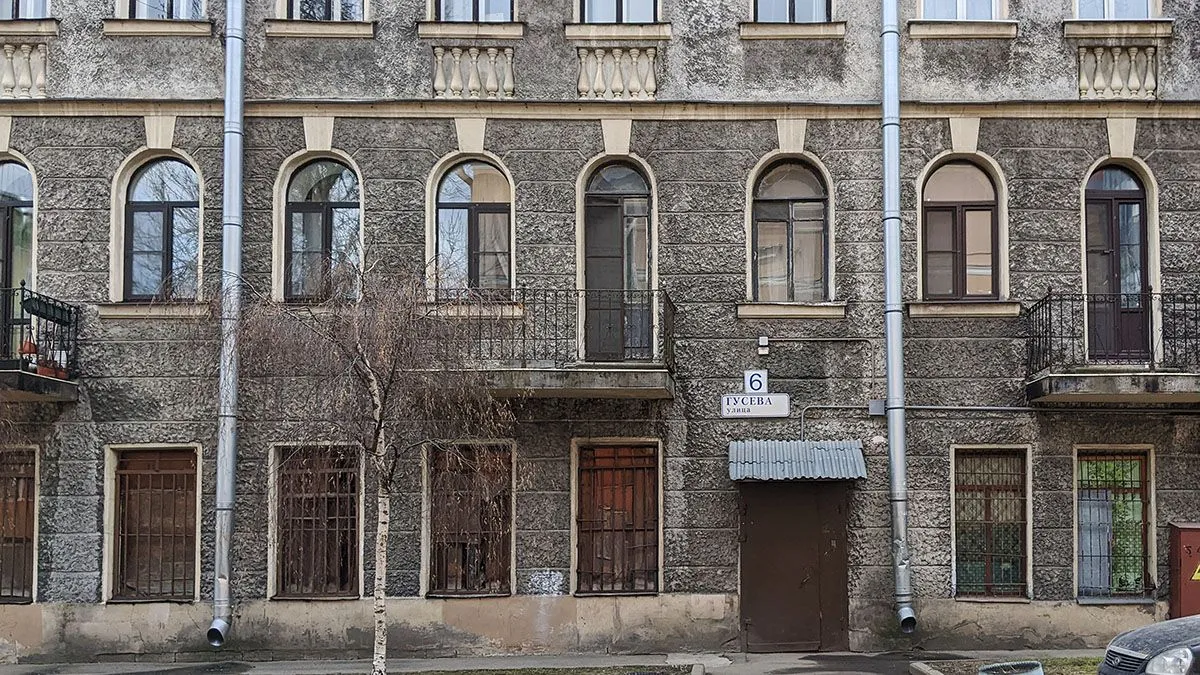

At a quick glance it seems that the architectural appearance of the neighbourhood is formed by buildings constructed in the middle of the twentieth century. Perhaps, they are indeed the architectural dominant of the neighbourhood. But at the same time it is fair to say that Okhta is one of the oldest districts of the city. The old buildings have hardly survived because they were mostly quite simple buildings. Okhta was separated from the city by the wide, full-flowing Neva River, and wealthy people were reluctant to settle here. Active construction began only after the Bolsheokhtinsky Bridge appeared. Nevertheless, among the buildings of the XX-XXI centuries one can sometimes find older buildings with characteristic architectural details that allow us to assign them unambiguously to the XIX or, at the latest, to the very beginning of the XX century.


One of the goals of my walk was to visit Polyustrovo Park. The name Polyustrovo comes from the healing springs. I remember well glass bottles with mineral water "Polyustrovo", which were sold in all grocery shops during my childhood. It was very tasty water with a slight iron flavour. Then something happened: either the reserves of mineral water were small, or the water horizon was changed due to construction works, or "effective management" showed all its "efficiency". Anyway, I haven't seen this mineral water on the shop shelves for a long time.


The spa near the mineral springs was established in the 19th century, but it was located a bit away from the mineral springs, and the water flowed towards the spa via a long straight canal. The area near the mineral springs was swampy and did not look very presentable. Polyustrovsky Park was planned and organised on this place in 1967. To commemorate this event, a stele with a hammer and sickle was erected in the park. I did not find any other monuments in this park, but the park itself is a very pleasant place to walk around.


| ○ | ○ |
|---|---|
| Smartphone | Google Pixel 3a |
| Location | Saint Petersburg, Russia |
This is my entry for the #WednesdayWalk challenge by 