

A walk along Ligovsky Prospect is not the most suitable activity for recuperation or for calming the mind and heart. Ligovsky Avenue is one of the busiest transportation arteries in the center of St. Petersburg. There is a large train station, several hotels, and shopping centers nearby - in other words, it is a crowded, automobile and noisy place. Usually I build my route along one of the neighboring streets if I find myself in the area. But this time I decided to change my habit and look into the courtyards of Ligovsky Avenue.

I expected to see something unusual: old doors or windows, walls with original textures, graffiti, and the like, but the first few courtyards disappointed me. They were all too clean, with obvious signs of recent renovation. The walls were painted solid color, the lawn was neatly trimmed, the windows and doors were new... clean, comfortable, but not photogenic! Besides unusual wall texture and graffiti, I wanted to find the remains of an ancient glacier terrace, but this goal turned out to be difficult to achieve: all passages in the right direction turned out to be blocked by locked gates.


But I knew in advance that at least two courtyards were ahead of me, where I was sure to find something interesting. These are the courtyard of the legendary art center "Pushkinskaya, 10" and the yard of no less legendary "Castle Rock" store.
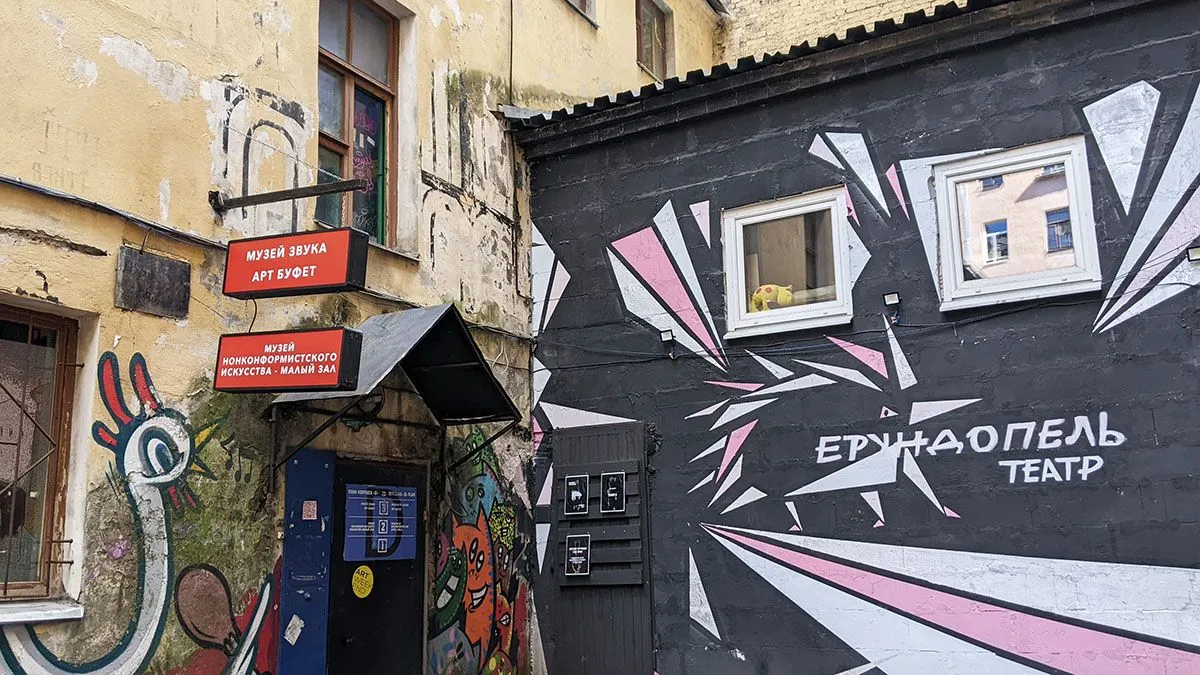
"Pushkinskaya,10" is a creative space that combines several art galleries, workshops and music clubs.


Now, in the 20s of the XXI century, such a creative space doesn't seem anything unusual. Young artists often come together to rent workshops, put on exhibitions or concerts - you can find something like this in any neighborhood of the city. But what's easy and natural nowadays - you only have to raise a small amount of money to rent a space - was inaccessible to artists and musicians in Soviet times. Independent art was underground art.


That started to change in the 1980s. Underground art became too visible and popular, and it turned out that it was no longer possible to fight it by force or ignore it. But to simply allow new ideas also seemed an impossible action.


The Soviet leadership looked for ways to integrate and control the new art. For example, the Leningrad Rock Club was created, bringing together young rock musicians. But more often another way was used: young artists were given freedom of action within certain boundaries and watched closely to see what would come of it.


One of the serious problems of young artists was the lack of workshops. It was not possible to freely rent any space. It was possible to get studios through the Union of Artists, but that way was not available for young independent artists. An unconventional way was found. The center of St. Petersburg is built up with old apartment buildings in need of repair with the replacement of the ceilings. Such buildings are repaired after tenants are completely moved into new apartments.


The resettlement of tenants is quite a long procedure, which takes several months, and in some cases even years. As long as at least one apartment in the house remains inhabited, all communications continue to work: water supply, central heating, gas, electricity - all this continues to work in the empty apartments, too.


Young artists occupied such apartments on their own and set up studios there. Often these apartments also served as housing, especially for those artists who came to Leningrad in search of creative atmosphere from various cities and villages of the Soviet Union.


That's how the creative space "Pushkinskaya, 10" appeared. This house was not unique in its time, there were quite a few other similar addresses. What made it unique was that it was able to survive the 1990s. The Artists Association was able to retain some of the premises in the renovated house and organize there not only workshops, but also art galleries with stores, a recording studio, an art cafe and concert halls.

To get to the creative space "Pushkinskaya, 10" from Ligovsky Prospekt, you must not only pass the front door and a small lobby, but also go down a few steps. Remember, at the very beginning of my story, I said that I wanted to find elements of relief that remind of an ancient sea that once existed on this place? The steps at the entrance to "Pushkinskaya, 10" are one of the few preserved relief elements in the center of the city.

Littorine escarpment stretches parallel to Ligovsky Avenue, the height difference reaches two meters. Almost everywhere this ledge was torn down when laying the streets, but in some courtyards you can still find it.


I left the courtyard of "Pushkinskaya, 10" and went to the next courtyard, where the Castle Rock Shop is located. It's the oldest rock store in Russia. I'm going to tell about this store later - I took a lot of pictures both inside the store and outside, in the courtyard.

This courtyard is also interesting from a geological point of view: here you can find the remains of a lithic escarpment, not disguised by steps and not hidden inside any structures. This is one of the few places in the city where you can freely view the remains of an ancient geological site.


My walk is still not over - but my story is already very long. Well, that's it for today, I hope to continue for another time!
| ○ | ○ |
|---|---|
| Smartphone | Google Pixel 3a |
| Location | Saint Petersburg, Russia |
This is my entry for the #WednesdayWalk challenge by 
