

Chess has always been an indelible mark in my memory, something I carry with me like a second heartbeat. It shaped my childhood and youth, and it remains a theme I often return to here on Hive, especially in my posts within the Chess Community. Back in my primary and secondary school years, I lived the game with passion, representing my province, Santiago de Cuba, in the National School Games. Competing in the 13–14 and 15–16 categories was a source of pride and growth; every match taught me something new, every victory felt like a step forward, and every loss was a lesson etched into my mind.
Later, when I entered the Vocational Pre-University Institute of Exact Sciences, I faced a surprising reality: among the students living in the dorms, there were no opponents at my level. Many of my classmates barely knew the basics of chess, and most had never even heard of algebraic notation. That’s when I became a teacher of sorts. I taught some how to record moves, others how to play from scratch, and gradually I managed to spark curiosity and enthusiasm for the game. It was then that I realized chess is not only played—it is shared, passed on, and kept alive through teaching.
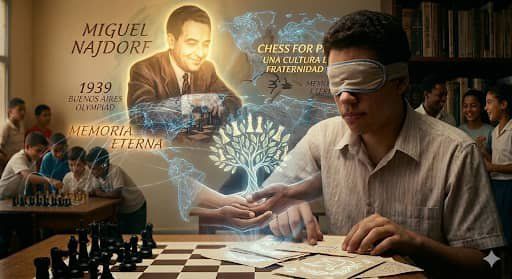
During those years, my admiration for the great masters deepened. Capablanca, our Cuban genius, was always a beacon of clarity and elegance. But another name resonated strongly with me: Miguel Najdorf. His story struck me as both heroic and tragic. He had traveled to Buenos Aires in 1939 to play in the Chess Olympiad, and while he was there, the war broke out. Najdorf stayed in Argentina, but his family in Europe suffered the horrors of fascism and the Holocaust. He never saw them again. That loss shaped his life, and it’s impossible to separate his chess legacy from the human pain behind it. Najdorf turned the board into a sanctuary, a place where memory and hope could coexist.
Inspired by him, I dared to try blindfold chess myself. My personal record was modest—three simultaneous games without looking at the boards. Yet for me, that was a triumph, a humble tribute to Najdorf and to all those who proved that chess can transcend the visible. I still remember the tension of holding the positions in my mind, the pieces moving like shadows in an imagined space. It was my way of connecting with something larger than myself.

Najdorf’s feat in São Paulo in 1947 remains one of the most extraordinary episodes in chess history. He played 45 opponents blindfolded, keeping every board alive in his memory for nearly 12 hours. His result—39 wins, 4 draws, and only 2 losses—was astonishing. But beyond the numbers, what moves me most is the human dimension: Najdorf hoped that news of his record would reach his lost family, that somehow his name would echo across the world and reconnect him with those he loved. That makes his achievement more than a sporting record—it becomes a cry of hope, a testament to resilience.
When I look back on my three blindfold games, I know they were small compared to Najdorf’s monumental effort. Yet they were mine, born of admiration and humility. They were my way of saying: from Santiago de Cuba, a young student also wanted to honor the memory of a man who turned pain into greatness.

And so, as I share this story here in Hive, I do it with gratitude. Najdorf taught me that chess is not only about calculation and strategy—it is about memory, endurance, and the human will to dream. My modest record may be just a whisper next to his immortal voice, but it carries the same spirit: the belief that in every board, whether visible or invisible, there lies a fragment of eternity.
Text by the author. All Rights Reserved (AR).
Images created with Nano Banana.
