
Around six years ago, I fell in love with Hyakunin Isshu after watching the anime Chihayafuru which involves a Japanese traditional card game called Karuta. Not only was the anime amazing, but the poems mentioned in the series really caught my attention.
I have been writing poetry since I was a high school student... so for 20 years now. I haven't kept all the poetry pieces I wrote back then, but I do still have hundreds of them that I could keep... and I've shared a lot of them on my blog. (I'll be writing poetry again soon, so check it on my other account)
Even though I enjoyed Chihayafuru, I'm going to introduce another anime related to Hyakunin Isshu. I've watched this before but chose to rewatch it with the goal of reigniting my passion for poetry. (And it sure helped!)
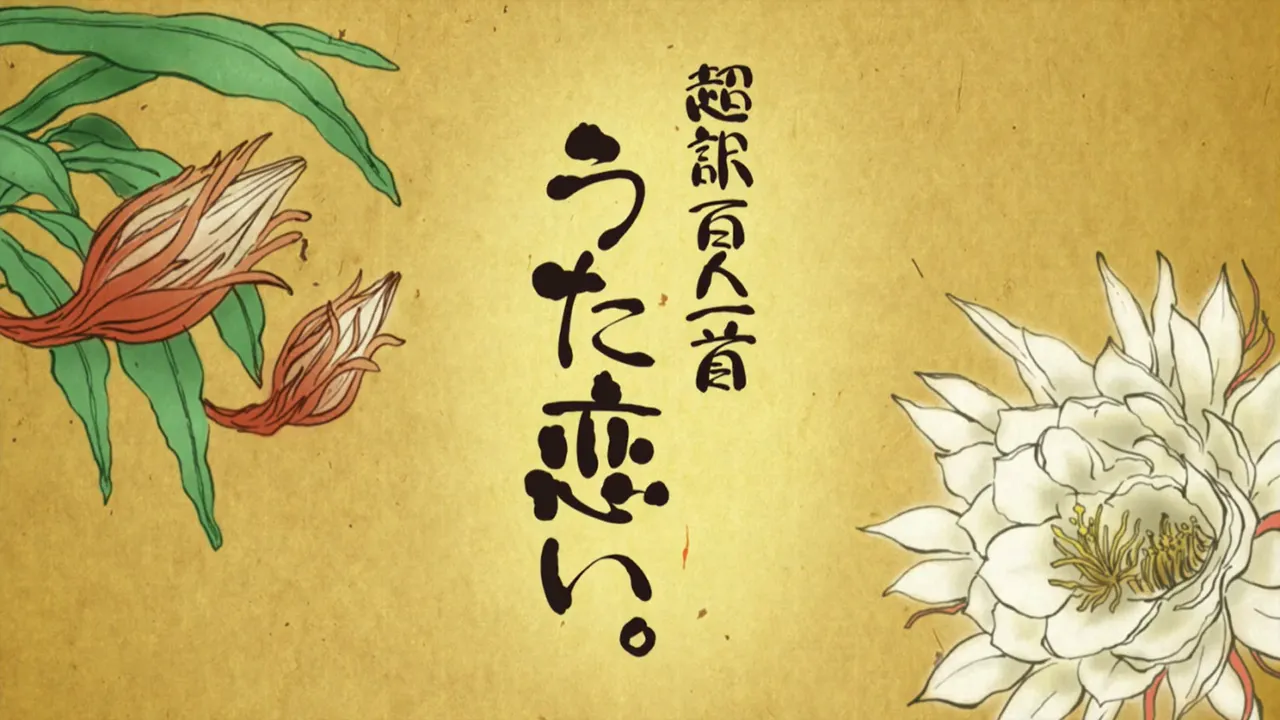
Let's talk about Chouyaku Hyakunin Isshu: Uta Koi!!!
NOTE: All photos are screenshots I took while watching the anime.
Before discussing the anime, let me tell you what Hyakunin Isshu is first. This poetry compilation is originally named Ogura Hyakunin Isshu. Ogura is a district in Kyoto which was the capital of Japan during the Heian Period.
Hyakunin Isshu literally means one hundred people, one poem each. So, it's a collection of 100 poems made by 100 people during that era. Heian is such an interesting period in Japanese history. There were so many amazing poets and writers during those years and I'll be mentioning some of them later on.
I love Heian Period!!! One of my students (she's a Japanese history freak and is a tour guide) often calls me Heian otaku. hahaha She's more into Sengoku and Edo period, but it's ok... we still enjoy talking about Japanese history in general. :)
Hyakunin Isshu was compiled by Fujiwara no Teika who also came from a family of poets. In the anime, he usually does some introduction of the poem they're about to portray. He does it alongside Utsunomiya no Yoritsuna and sometimes with Ki no Tsuriyuki.
Yoritsuna is a good friend of Teika and he's the one who commissioned the latter to compile Hyakunin Isshu. It was originally selected to be made to decorate screens at his residence in Mt. Ogura. Seeing both of them talking about why Teika selected certain poems in the anime was so interesting to watch!
The anime Chouyaku Hyakunin Isshu: Uta Koi is basically a liberal interpretation of some of the poems in Hyakunin Isshu. It was said that more than 40% of the poems in the anthology are about love. The anime shared stories for more than 10 of them. <3
Earlier, I mentioned that Ki no Tsuriyuki sometimes appeared with Teika and Yoritsuna in the anime. Actually, he also made an anthology that featured these six writers.
Except for Otomo no Kuronushi, poems from these poetic geniuses were featured in Hyakunin Isshu.


These are Ono no Komachi, Funya no Yasuhide and Ariwara no Narihira. (If you're into Chihayafuru, Narihira wrote the poem in the Chihayaburu card). They're part of the Six Geniuses... I love their relationship! ^^
The first part of the anime (episodes 1-5) featured writers from the early Heian period. Narihira is such a casanova, but it's sad how his true love ended. It was said that Murasaki Shikibu's Genji Monogatari was based on him.
Murasaki Shikibu = another writer in the Heian period.
Genji Monogatari = first novel in the world
Episode 6 was a filler episode, but it was so funny. It involved several portions like:

- Teika's Room = talk show
- Heian Grand Prix = an ox race featuring the writers from the first few episodes
- Heian Host Club = this got me laughing so hard!!! xD
The second half of the anime featured poems and stories from the mid to late Heian period.
The poets and poems featured here are also really amazing. There are various kinds of romantic love... and some of them are really relatable.
Sei Shonagon was involved in several poems... though her poem was also among the chosen ones. Aside from poetry, she's known for writing "The Pillow Book" which is a collection of her observations and musings while she served as a court lady to Empress Teishi.
Aside from her, Murasaki Shikibu (the author of Genji Monogatari) was also a part of Hyakunin Isshu.
It's just amazing that in a world and era dominated by men, there are these three magnificent female writers. Ono no Komachi, Sei Shonagon and Murasaki Shikibu are sometimes called "Three Heian Women".
Knowing these three makes me motivated to continue writing. :)


I wrote this poem almost six years ago. This was also inspired by a poem from Hyakunin Isshu. Though Oe no Chisato's poem wasn't featured in the anime, this is among my favorite pieces from the anthology.
Anyway, reviewing the anime is tough because I might be pretty biased. However, I recommend this especially when you're a poetry lover just like me. It's truly inspirational... and the art style is stunning!
The songs used in the anime were also really good, especially the opening song. I couldn't find any trailer online, but let me share the opening song below.

VIDEO SOURCE
I hope you give this anime a shot. Hopefully, through this you won't only appreciate the beauty of Japan's Heian period, but also the value of poetry. Hopefully, you'll enjoy it as much as I did.
Thanks for reading and see you around!