
Villa Farnese, 50 km north-west of Rome, Italy. https://en.wikipedia.org/wiki/Villa_Farnese

Although this structure is unequivocally a pentagon, there is a noticeable desire in the architecture of Villa Farnese to resist the use of the pentagon for indoor spaces. There is a rejection of the 108 degrees angle on which the overall plan is based. This is clearly visible on the black and white drawing below.
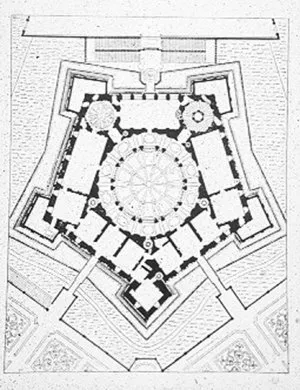
Circular central courtyard, orthogonal bastions--although the clash of angles with the main structure at each bastion creates a potential-filled dissonance--and orthogonal/hexagonal interior spaces are at odds with the building's overall shape. It's like they revolt against their pentagonal parent which they, of course, cannot fully avoid.

One possible reason for these choices is that rectangular and circular spaces provide a more comfortable psychological experience than polygons with an odd number of sides such as the pentagon, the triangle (which I find claustrophobic) or the heptagon (heptarchitecture may deserve its own community).

I find the experience of living in a pentagonal space to be disorienting at first, then expanding and eventually liberating. We are so used to live in orthogonal environments, those large chunks of world defined by 90 degrees angles, that stepping out of that paradigm is hard to wrap our minds around at first.
The Superstition Bungalow project is an exploration of the possibilities that open-up to humans when they start living in pentagonal spaces. The message is simple: Free yourself from the tyranny of orthogonality!