
Today’s destination: Rosslyn Chapel. This site has been on my bucket list since reading Dan Brown’s 'The Da Vinci Code'. For those who have read the text, you'll gather why the book's core protagonist, Professor Robert Langdon, enticed me into signs, symbols, and stenography… (I even went so far as to take a course at University in Middle Egyptian hieroglyphics! Yes, I'm that kind of nut.)
Although my journey since hasn’t involved a battle between the Priory of Sion and Opus Dei over the possibility of Jesus Christ and Mary Magdalene having had a child together, the lure for unravelling the deeper meanings of objects didn’t leave me. As a painting's conservator, iconography is an additional delight fuelling the art historical element of my treatments. I may not be Robert Langdon, but what I do is still kinda Holmes-ish.

Rosslyn Chapel, or the collegiate chapel of St. Matthew as it was once known as, was founded in 1446 by Sir William St. Clair. The building was still incomplete at the time of his death in 1484. With provost and prebendaries resigning in 1571 because of the endowments being “taken by force” into secular hands at the influence of the Reformation, it seemed unlikely the building would ever be fully completed or properly cared for. When Cromwell’s troops attacked Rosslyn Castle in 1650, they even stabled their horses inside the Chapel!
It was only during the Victorian period of repair and restoration that Rosslyn Chapel was rededicated and weekly services began again. The 1950s greyish sludge caking the interior walls was a poor attempt to quell the damp. The guide told us that the cementitious slurry was silica fluoride magnesium, applied at a rate of 11b per two galleons of water! Yikes. Prior to this, the green algae that had commandeered the decorative schemes was scrubbed from the stone with stiff brushes doused in a solution of .880 ammonia and water! I mean, thank god for progress in conservation. You wouldn't see these kinds of treatment decisions playing out nowadays. The damage incurred during this restoration led to a major conservation project being undertaken by Rosslyn Chapel Trust in 1995.
A free-standing steel structure was erected to cover the Chapel to enable the stone fabric of the roof vaults to dry outwards, away from the carved interior surfaces. Thermographic scanning was also undertaken to locate areas where the stone was particularly damp. Cracks and delamination were treated in a visually discreet manner, and conservation of the glass windows addressed severe paint loss within the imagery. Overall, the treatment was handled incredibly well. But the expense...! How fortuitous, then, that Rosslyn Chapel came to worldwide prominence in 2003, when Dan Brown released 'the Da Vinci Code'.

In the novel, a murder prompts protagonists Robert Langdon and Sophie Neveu to follow a trail of clues from London up to Scotland. The Chapel becomes a feature point in the quest for the location of the Holy Grail. In the tour, our guide jokingly reminisced that prior to the book being released Roslin was a quiet little village with one gatekeeper minding the property. If you were lucky, he might have given you a slice of shortbread on Sunday during mass. The year 'the Da Vinci Code' was released, however, visitor numbers spiked at 176, 000 – quite alarming for our wee gatekeeper who went from handling a tiny trickle of passer-byes to lines that stretched on for hours. However, despite the negative aspects of tourism, the book and its controversy, the sudden boost in popularity paid for the Chapel’s conservation and continues to cover future preservation plans.


The entranceway is flagged by two waterspouts in the form of menacing gargoyles. Although, according to the guidebook, one respectable architectural historian describes them as “jolly”, haha. (** Before I continue, I have to note that I was only able to take a handful of images before being told that photographs inside the chapel are forbidden for preservation purposes. So, do bear that in mind if you decide to visit yourself. I recommend that you buy the official guidebook sold on-site!)
First impressions... When I entered, I felt magnetised to the mystery of the Chapel’s sheer, overwhelming symbolism. Its elaborately carved barrel-vaulted roof is carved into stone ribs displaying four-petalled flowers, multi-lobed leaves, double roses, lilies and stars. Mounted at column tops are dragons, unicorns, lions, and keystones of Sinclair-engrailed crosses.

The Chapel is also rich with carvings of the Green Man – a profusion of foliate heads – not unexpected in an area this influenced by the Celtic tradition but still surprising amongst all the biblical references. (The green man symbolised the capacity for great goodness and scope for evil. According to the guidebook, the story of Robin Hood had its origins in this legend, and gypsies from the period would perform it in maytide plays.) It’s no wonder the conspiracy theories are rife. On that note…
Fun fact: when you next watch the 2006 film adaption of 'the Da Vinci Code', starring Tom Hanks and Audrey Tautou, look out for this ultimate clue… Positioned above the entrance to the "crypt" is a Star of David, seamlessly woven into the Chapel's adornments. While it appears very much a part of Rosslyn’s interior, it's actually a fake addition. Dan Brown had to incorporate it into his novel to align with the narrative. And this needed to be offset in the film world. So, with a little craftmanship and spray paint, they attached a fake Star of David to the entrance of the crypt. Inadvertently, this has left a faint black circle on the stone, now affectionately dubbed the “Hollywood Circle”. While not as catastrophic as the impact ‘The Beach‘ had on Phi Phi Leh Island in Thailand, it is nonetheless a tarnish to the overall aesthetic…


Also, all filming of the exterior of Rosslyn Chapel is based off a model, seeing as the site was undergoing conservation with its steel-roofed top at the time. And when Robert and Sophie enter the “crypt”, they walk to a door blocked by a chain - they break and enter a tiny anteroom marked “Private”, otherwise known as... Paramount Pictures, London. Haha! The next few minutes were filmed in a little studio, a mere 323 miles south. But that’s the film world for you!

There're so many rabbit holes I could explore in this review… Instead, I will leave you with one more tale about the infamous Apprentice Pillar.
According to legend, upon completing his carving of the twelfth pillar – refined, detailed and skilfully construed but plain – the Master Mason was asked by the Founder to construct the thirteenth and final column in imitation of those he’d seen in Jerusalem. This promised to be a harder, gruelling, more challenging task for the Master Mason. Hesitant, he left Scotland, travelling abroad in search of inspiration, leaving in his absence an eager-to-please apprentice.
This young boy, aged twelve or thirteen, picked up a hammer and chisel and carved, in his Master’s stead, the most sumptuously ornate pillar – deemed a perfect marvel of workmanship. The Master, on his return, discovered the exquisite work and was so mad with jealousy he picked up a mallet and struck the boy dead right there in the chapel. Subsequently hanged for his rash and cruel act, an impression of the Master Mason’s face was carved above the chapel’s exit. His eyes strain across the aisle, directly at his apprentice’s pillar… trapped in stone for the rest of eternity, forced to stare at the thing of beauty that led him to his downfall. Opposite him is another face with a cleft scalp, and along from that a mourning woman. These are presumed to be the faces of the young apprentice and his mother.

The finer details have always intrigued me, and I suppose that’s why I was so enraptured by the sacristy. Its walls were enshrined in elaborate schemes of transfigurations, working drawings, and masons’ marks. Masons, unable to sign their names, would mark their work to ensure they were properly remunerated for their labour. One of those signs is captured below.


The village of Roslin, the Chapel, Castle, and earldom Rosslyn, derive from the Celtic words: ross – “a rocky promontory” – and lynn - “waterfall”. The glen finds its source high up in the Pentlands near the boundary between Midlothian and Peebleshire. It passes through Carlops, once a village of weavers, through Habbie’s Howe and into the woods surrounding Penicuk. It eventually rejoins the South Esk to enter the Firth of Forth at Musselburgh. I followed this route on my bike last weekend, recorded here by #strava2hive. I hope to make the trip again soon.
The ancient woodlands - a mixed deciduous valley of wood of oak, ash, and elm - is entrancing. There is a reason why centuries of poets and painters alike are drawn here. The ground flora is alive with dog’s mercury, ramsons, golden saxifrage and wood sorrel. It’s magic. Sir Walter Scott’s 'the Lay of the Last Minstrel', capture’s the building’s folklore, architectural wonder and history. Romantic painters like Joseph Mallord and David Roberts were likewise enriched by the surrounds.


I highly recommend you go, with open mind and spritely step. Oh, Rosslyn: with your sealed crypts steeped in legend and motley casts of faces, cushioned in the wild glen… what a wonderful treat you are.
After posting this I’m going to sit back, relax and enjoy a wee pint - appropriately Rosslyn-themed. Because, 
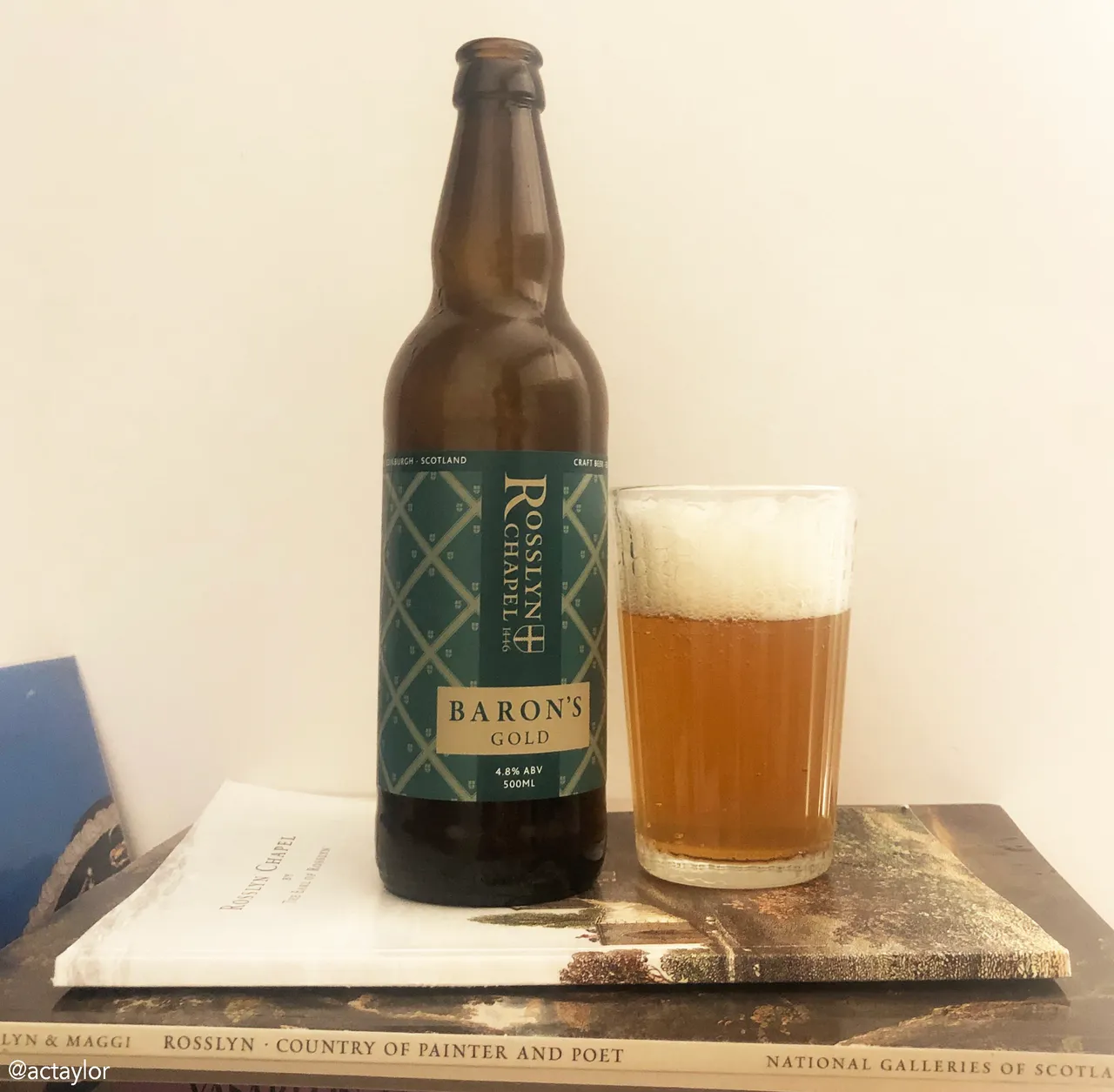
Until next time, Hivers!
Enjoy the rest of your weekend!
Live a little.
Disclaimer
Blogger:
Photographs: unless otherwise noted, all images were taken by me with an iPhone 8.
