


Venice Nine Years Ago
THE WEALTHIEST CITY IN EUROPEAN HISTORY?

Venice is one of those places that most people have heard of. It's another top 100 on global bucket lists. Apart from being an absolutely stunning place, if you're into that sort of thing, it's also one of the most written about places in history. Because of it's geographical location, it's one of the most travelled parts of the world. Most people that received a British or American education would have read The Merchant of Venice by Shakespeare at some point.

Venice is a city located in northeastern Italy, situated on a group of islands separated by canals and linked by bridges. The aforementioned geographical location has made it a major centre for trade and commerce since ancient times. Due to its position on the Adriatic Sea, Venice became a hub for the spice trade, which brought in a great deal of wealth and helped to establish the city as a major maritime power.

Venice is known for the Canals and is often referred to as "The city of canals". However, it's also referred to as "The city of many islands" as well as "The city of bridges".
Venice was also an important centre for art and culture during the Renaissance, attracting some of the greatest artists and thinkers of the time. One of the most famous Venetians was the explorer Marco Polo, who traveled extensively throughout Asia and wrote about his experiences in his book, "The Travels of Marco Polo". It's now debatable whether there was an actual "Marco Polo", like many historical figures of his renown, but the story has been one of the things that put Venice on the map - literally.
I stayed in a very small, smelly, room right in the middle of the busiest part of Venice. There was so much foot traffic that it merged into a buzzing hum akin to white noise. When I was there certain types of baggage was banned from the city. It seemed a little strange at first until you realise why. The floors are stone-paved which means that heavy wheeled baggages made a monumental amount of noise, especially when there are tens of thousands of them. Banned from the main city were also cars and motorbikes. This was a huge relief because, having been to Napoli prior, the fear of being hit by a motorbike always takes away from these beautiful Italian cities.

Like I said, the room was old and damp, with creaky furniture, but it was endearing in a way. It wasn't cheap though, so it wasn't because I was trying to save money. The view outside the window kind of made up for it all however. It looked like a crushed version of Prague with clay roof tiles and rustic coloured walls, but right up close that I could reach out and touch the rooftops of other buildings. The buildings are so tightly packed together in that area and, as a result, the ally ways are some of the narrowest I'd ever experienced in Europe.


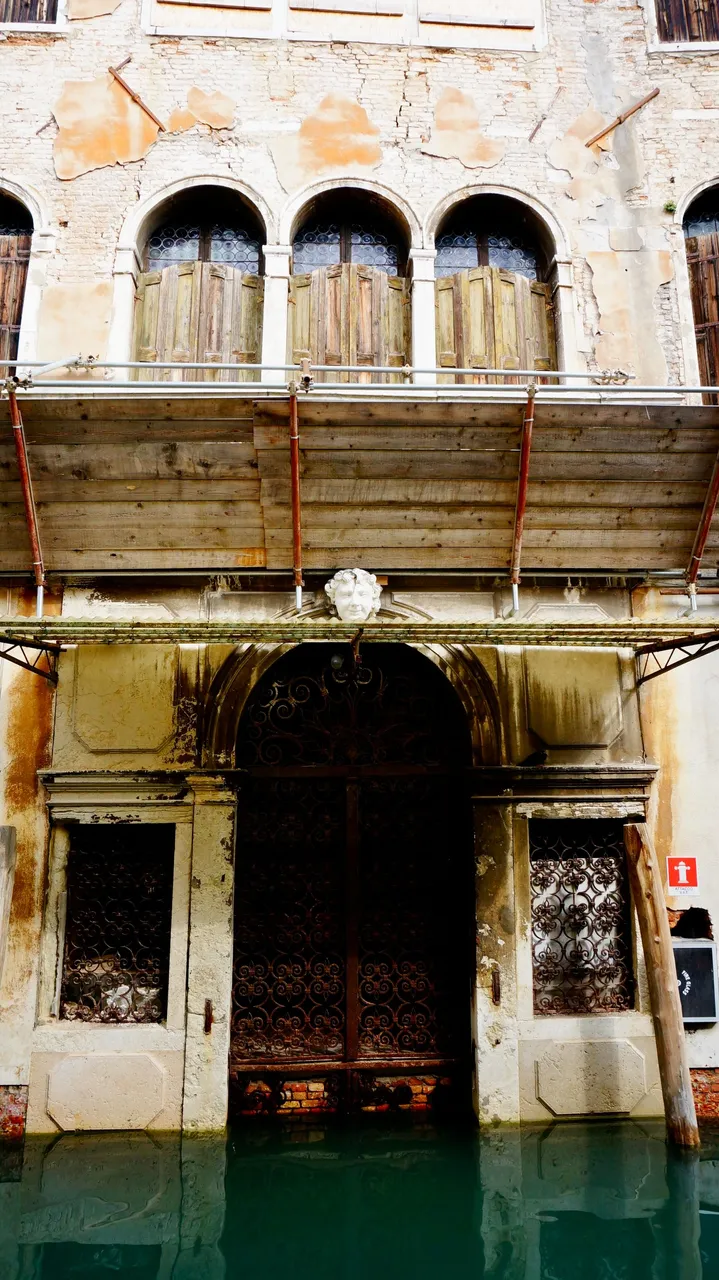
Talking of ally ways, a lot of these are actually alley water ways. Apart from the many canals, the city itself is slowly sinking. It means there are paths that were previously land, that's now water. many of the buildings' lower floors are no longer inhabitable. Some are used for storage, on boats, or of boats.
That's the other thing; Venice is a historic tourist attraction and many of the buildings are protected and owned by the state or very wealthy individuals and are used as museums and the like, but Venice still has a sizeable residential population. People who are from Venice. People who still have to live their daily lives - have families that have to be fed, educated and entertained. People work and live and pay bills just like everywhere else. I can't imagine what life must be like for some of these folks.


 |  |  |
|---|
I soon realised that I had to wake up bright and early to get photos of places in Venice before they got totally clogged by tourists. I also figured out that taking the backstreets and less popular routes can actually be much more scenic. I saw some beautiful photo opportunities, probably the best ones, in such backstreets. Unfortunately a lot of them terminate in watery dead ends. If I were a local, I'd have a little canoe/boat and would have no such problem. I even saw an emergency ambulance boat speed past a back-street that I doubt I'd have seen on the Gran Canal.

Another great way to see the city is to actually jump on a gondola. Most people go on the Gran Canal for that. While the Gran Canal is indeed grand, and you get to see the Rialto Bridge in all its glory (if it's not covered in advertising posters or political protest banners), the gondolas that traverse the smaller canals are actually much more pleasant - for me anyway. My gondola driver was the coolest ever. He even provided audio entertainment the whole time in the form of song. I think he could have easily made a career being a singer in one of the opera houses or theatres.


I saw all the usual attractions too, of course, even though I had to queue for a pretty long time to get in. Once in, it' was an experience of a lifetime and totally worth it. I noticed a lot of people look at Venice and the structures here with the same eyes as they do any other "tourist attraction". However, if you're familiar with the history of Venice, it's a very humbling feeling to be standing in front of some of the things I saw there.
First the nearly 1000 year old St. Mark's Basilica which is supposed to be standing on the corpse of the actual St. Mark himself who was one of the four authors of the New Testament of the Bible. According to legend, the body of St. Mark was smuggled out of Egypt and brought to Venice in the 9th century, where it remains to this day. The importance of the saint to the Venetians is reflected in the fact that his symbol, the winged lion, can be seen all over the city.
In the Basilica you can see an even older thing - The three horses that can be seen above the main entrance of St. Mark's Basilica, made of bronze, were originally part of a larger group that adorned the Hippodrome in Constantinople (now Istanbul), but they were stolen taken by Venetian soldiers during the Fourth Crusade in 1204. The horses were later installed on the facade of the basilica in the 13th century, where they have remained ever since. The horses have a long and storied history, having survived fires, earthquakes, and even Napoleonic looting!! Replicas of the horses can also be seen inside the basilica, though photography was forbidden when I was in there.
I also saw copies of originally hand-scribed bibles dating back to the very early days of Christianity. Some of those scribes may have even known the saint himself. Mind boggling stuff.

I went up the Bell Tower of St. Mark for some stunning views of Venice, including the Plaza from above. I couldn't really capture the view like my eyes saw it, but I tried my best. It's truly one of the best views to witness in all of Europe. There are so many canals, beautiful bridges, grand mansions, intricate church buildings, bell towers and such, that you can't but imagine what this place was like hundreds of years ago when it was at it's peak as the most opulent city in Europe.


As a final reflection, Venice was possibly the city with the highest concentration of the ultra-wealthy in history. Mansion after mansion, each more grandiose than the other, line the Gran Canal and other parts of the city. Many owned by merchants that controlled the water ways and critical strategic routes carrying goods into and out of Europe in ancient times. A good portion of stuff coming from Africa and Asia into Europe would have used the ports in Venice - especially by Austro-Hungarians, Balkans, Germans and Czechs that have a good part of their countries land-locked. I can imagine a good chuck of the wealth in Vienna, Prague and Berlin arrived via these ports of Venice.
The amount of stuff I saw that were "removed at", "take from", "acquired in" other parts of the world - notably Egypt, Libya, Turkey, Lebanon and Palestine, makes one realise that the majority of the wealth at Venice was quite simply stolen, plain and simple. It makes one realise that empires have been looting each other for time immemorial and that things haven't really changed much. As I write this, empires are currently looting other fallen empires. That's just how things are I guess.
Peace & Love,
Adé