
Baja California Sur: 2.0
In fact, I have been here more than two times (I think I remember four times, it could be one higher as well). The reason for the title is this post from 2022. I was checking worldmappin for pins in the area, and I am glad to see that I am local expert of Baja California Sur, just kidding! There are not many pins here, so it is easy to become the local expert, if there is such a thing.

I am staying at the Westin again, I like it here and familiarity is something my family prefers as well. One thing I enjoy about hive these days that I can pull up a old post about something and reflect on it. It is fun to see if my views on the subject have changed or not, or if the place that I visited changed or not. Here I can confirm that Los Cabos haven't changed much. In fact, I am coming here for a decade now, the first time I came here was 2013 and I don't think the place changed much.

The area around the hotel, including the beach sports a lot of rock outcrop which I like a lot. All these are part of Los Cabos Batholithic Complex (LCBC), and mostly Granite, Granodiorite and Tonalite rocks. If you think this is an alphabet soup, worry not! Batholith just mean a very large (think many square kms to hundreds of square km) igneous intrusion deep inside the earth's crust. So the question is how is that at earth's surface now? Mostly by uplift and erosion due to plate tectonic movements.


Anyhow, from these two maps above you can see that most of the southern part of the Baja Peninsula is covered by these various shades of pink color, which is the Granite-Granodiorite-Tonalite complex of Upper Cretaceous in age.
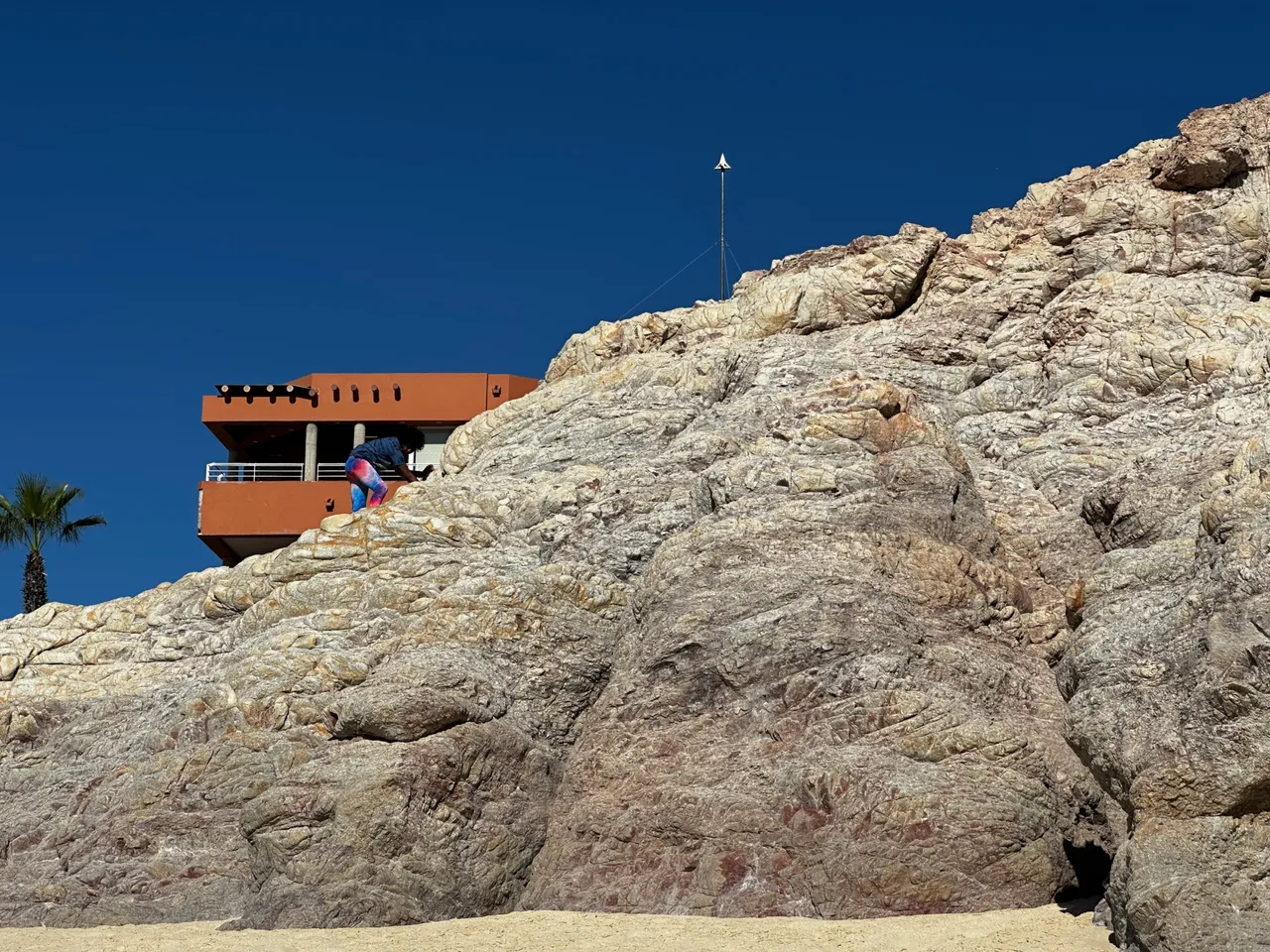
If you look carefully at the picture above, you will see a young geologist in the making! I am kidding of course! Who know what my daughters will be, but the younger loves to climb on rocks and collects rocks.
Lot of uncontrolled developments
One of the problems with various part of Mexico, especially here (and elsewhere) is massive real estate development. The resort properties and associated golf courses, as you can see below along the coast, support the local economy in a big way. But mind you, Baja Peninsula is a desert, and it perhaps rains here once in ten years! So all the water needed for the golf courses are essentially ground water. As I explained earlier that most of the BCS is on granite without any large sedimentary basin (except San Jose del Cabo basin) ground water is scarce, and doesn't recharge often.

Demand from growing cities (La Paz, Los Cabos) and agriculture exceeds recharge, severely depleting aquifers, with some areas already in "red zones". The water situation in Los Cabos, Baja California Sur, has reached a critical tipping point as of late 2025. The region faces a chronic "water deficit" of approximately 600 liters per second, primarily due to the exhaustion of its two main aquifers: San José del Cabo and Cabo San Lucas.

As the Sun sets...
The depletion of ground water is driven by a "perfect storm" of rapid development and environmental constraints:
Explosive Demographic Growth:
Los Cabos is one of Mexico's fastest-growing regions. Its population has ballooned from 44,000 in 1990 to over 350,000 today, with projections reaching 600,000 by 2035. Infrastructure has failed to keep pace with this 10% annual growth.
Tourism vs. Local Demand:
High-end tourism requires massive volumes of water for golf courses, lush landscaping, and luxury pools. While many resorts now use private desalination, the sheer scale of the industry still places indirect pressure on local resources and labor-force housing.
Massive Infrastructure Leaks:
Approximately 57% of the water produced is lost before it reaches a tap. This "Non-Revenue Water" (NRW) is caused by aging, brittle pipes and unauthorized "clandestine" connections.
"Flashy" Hydrology & Climate Change:
The region depends on infrequent hurricane-driven rain for aquifer recharge. Rising temperatures and prolonged droughts (especially severe in 2024–2025) increase evaporation and prevent rainwater from soaking into the ground, a problem worsened by soil erosion in the Sierra de la Laguna mountains.
I don't want to sound melodramatic or pessimistic, but if I drive on the East Cape Road this trip, I will be able to show you the contrast between the resort areas and the rural areas where locals live. A stark divide exists between the "green" tourist zones and the "brown" local neighborhoods (colonies). Residents in areas like Leonardo Gastélum often go 2 to 8 weeks without running water, forced to buy expensive water from private tanker trucks (pipas).
More on that later....

