
It may seem unusual for a simple walk in a park to be worthy of #haveyoubeenhere. Especially since it is a small park surrounded by blocks of flats and buildings, flanked by crowded boulevards in the middle of the Romanian capital, that is in Bucharest.
Some information about Bucharest. This is the largest city in Romania, with a population exceeding three million. This is not a great happiness for the inhabitants because it is the busiest city, the traffic is infernal and the pollution from the hundreds of thousands of cars that cross it every day is annoying. All this does not prevent it from being a beautiful city, which you love and hate at the same time.
One way to forget about pollution and congestion is to walk through the parks. It's one of my pleasures.
There are several parks that are my favorites, such as: Bazilescu Park, because it is fifty meters away from my house, Herastrau Park (now called King Mihai Park) and the Circus Park. Now I'm going to talk about the Circus Park.
When someone visits a city they haven't seen before, I don't think they go to see a park. There are many more points of interest, such as the architecture of important buildings, museums, old quarters, restaurants and terraces. For this reason, I think it's interesting to present a park that, even if it's in the middle of the city, is little known and especially that few know what treasure it hosts in its middle.
I will talk about this treasure at the end of this blog so whoever is passionate about travel and is curious to see new things will have to read to the end.
Photograph and travel are connected, I can't separate them and I don't know if I'm traveling to take pictures or taking pictures because I'm traveling.
A walk in the park at the end of autumn can offer a lot of subjects for a photographer (even amateur). What is special is that now we are already in winter in this hemisphere of the earth but winter is not yet shown. It is a consequence of global warming that the temperatures at the end of December will be the same as in October.
Bucharest Circus Park, in an autumn that has gone far beyond its limits.

This park is arranged in a pit from which the clay used for the manufacture of bricks was extracted, between 1865 and until the beginning of the First World War. Because of this the park has the shape of a crater and in the middle is a small pond. A pond formed due to nearby springs. A pond that hosts the main attraction of the park.

Autumn colors everything and takes advantage of the fact that winter has not yet turned everything only into black and white. Among the many species of woodpeckers, on the shores of the lake are some conifers that lose their leaves in winter. These brick-colored leaves (interesting, if we know that bricks were made here one hundred and fifty years ago) give an extremely beautiful, unmissable image!


This park, any park in a city lined with concrete, buildings and paved streets is a blessing to the people. For those who live in nearby blocks of flats or for anyone who wants to take their eyes off the gray color of the streets and rest them on the green of the grass.


The children, of course, are the happiest because of the park and the still warm weather, which allows them to play, to run on the grass, to meet each other. Adults also walk their children or dogs.
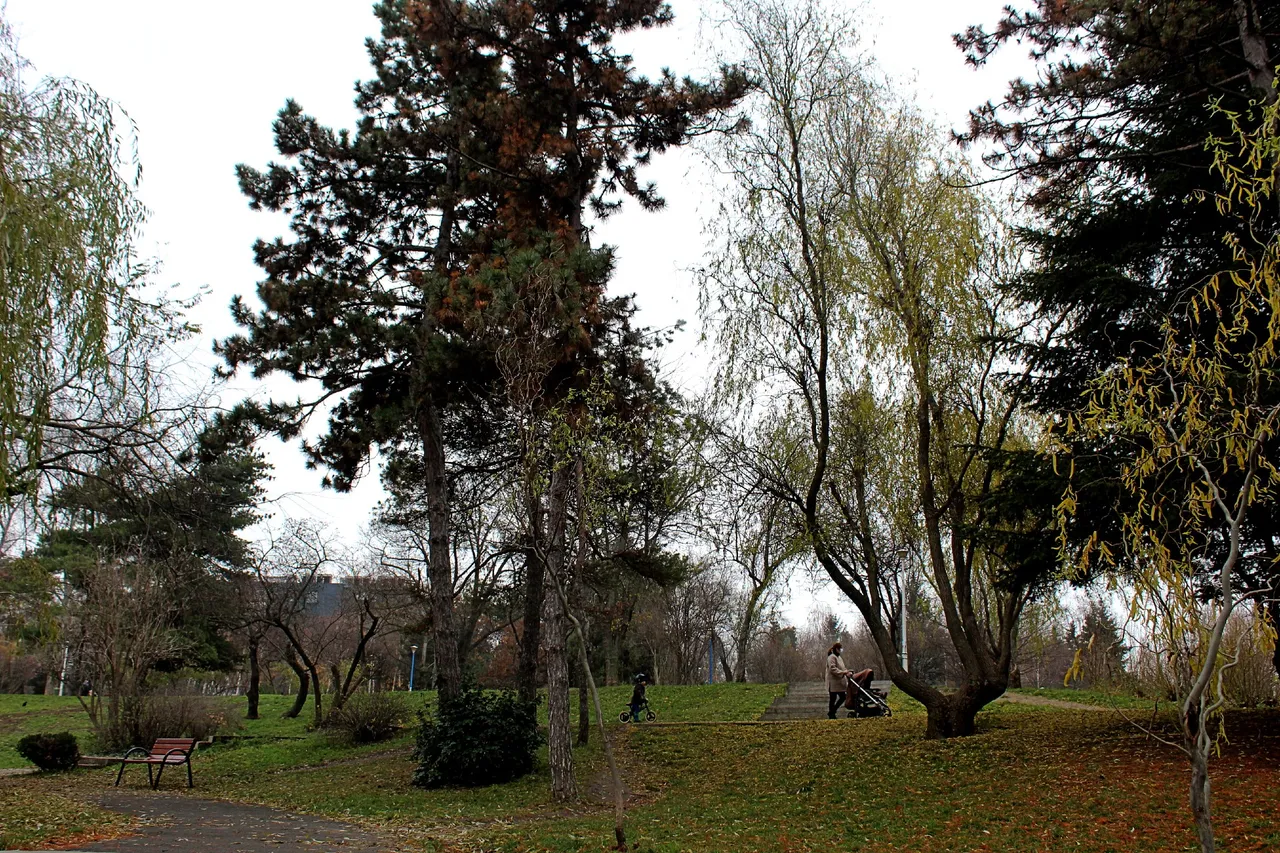


Not only the possibility of walking, running and playing attracts children, especially, but also other visitors, including me. Bird watching is a pleasure, in the small space on the surface of the pond and in the surrounding trees there are many birds, from wild ducks and seagulls to the common pigeon.


Park goers usually feed the birds. The closer winter gets, the harder it is for these birds to find food. The fact that people usually bring food and feed them determines them to choose to spend the winter in this place. When they are fed, the birds squawk and fly and make a show much appreciated by children and their parents, as well as by occasional visitors, so do I.


And yet, beyond the beauty of the trees in the autumn colors, beyond the beauty of the birds, you can see a pond invaded by a dry and not very attractive vegetation. This seems to lead to an impression of abandonment and lack of care ... and yet here is the value of this place!
Because these dried leaves and stems belong to lotuses. This lake is full of Egyptian lotuses (Nelumbo nucifera) / (Nymphea lotus), a protected flower, declared a natural monument since 1931. I do not understand how these tropical plants have adapted to the cold climate in Romania.


Because beyond the sad image of these remnants of dry and dead vegetation, here in summer the miracle happens. The tropics are moving to Romania, to Bucharest.
Spring brings the first lotus leaves to the surface of the lake.


After only two months follows the explosion of green and pink in summer. The true grandeur of this small place full of greenery in the middle of a city in a hurry in all its parts.


Although it may seem unbelievable, very few of the city's inhabitants know about this natural wonder that happens near them. I didn't know for many years either, but since I was in this park for the first time, I have become an admirer and I have not been missing in any year since the lotuses bloomed.
I believe that this place should be promoted by the city hall and introduced in travel guides, because many tourists would certainly be delighted by such a view.

It's a place I've been and I like to go. I think I'm lucky I don't have to go all the way to Egypt to see these wonderful plants.

