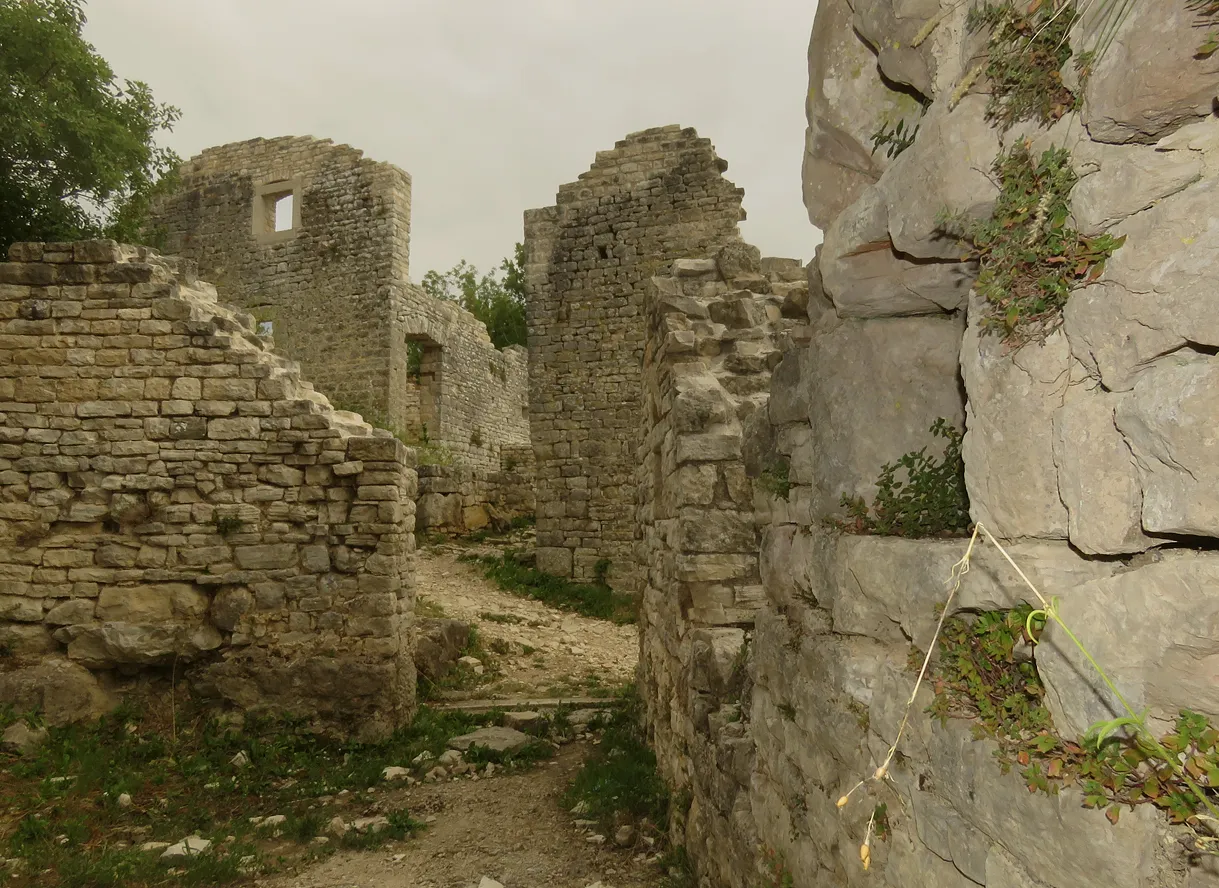
There is a mysterious ruin, on the hill along the ancient route that goes from inland to the sea, to the long bay that looks a bit like some Nordic fjord.
I mean, the place is well known and researched, there are no big mysteries about its history, just the usual small ones because is impossible to know absolutely everything about many layers of its past ... but it looks very solemn and mysterious ...
... covered with lush vegetation ...
... like some Lost City from the jungle. This small oak tree is sprouting from its thick walls ...
... and the Great mullein (Verbascum thapsus) plants are decorating the ancient rooms covered with sky as a ceiling.
What is visible now, are the ruins of a medieval town and fortress, shaped during the 13th, 14th and 15th century ...

... but the history of human settlements on and around this hill begins much earlier.
Neolithic pottery was found a bit lower on the slopes of the hill ...
... and there is a continuity of findings during the antique period, that suggest the existence of two towns, one on the hill and another in the valley.
That duality is incorporated in the name as well - Dvigrad, that means something like Double - town.
In the period of decline, and eventual fall of the Western Roman Empire, inland of this peninsula remained isolated and out of the most violent changes, for a few centuries more than the surrounding lands ...
... but disturbing news from the neighborhood were arriving, along with people on the run from northern provinces, Noricum and Pannonia. A series of new fortified towns appeared in that tumultuous period, the walls of the existing ones were made stronger, the population from the scattered settlements outside the towns was getting together for safety, and Dvigrad, both the town and the fortress, grew considerably in those times.
The 6th was a difficult century, with Longobards,Avars and Slavs that settled the northern mountain range, the natural northern border of the peninsula, attacking, robbing and occasionally devastating the inland, and at times arriving at the edge of rich southern lands around the biggest city, Pola.
This, kind of tense situation, didn't last very long (well, relatively).
During the second half of the 7th century, in a relatively quick and rather fascinating way, the interactions between Slavic people and the domicile population became less violent and more trading oriented. The archeological finds clearly show a merging of the two cultures, through many artifacts and the graveyards, different from those in the southern part and along the coastline, where there was no significant presence of Slavic settlements.
This dichotomy between the more sophisticated, urban, Italic Istra of the south and most of the coastline ... and the, kind of wild, Slavic spirit of the north and the inland was present throughout the Medieval times, dominated by the Venetian republic, was still visible until the recent history, the end of WW2 and the Yugoslavian chapter of this area ... and you can see some traces even now, if you know where to look. This of course was never a clear - cut situation, the cultures didn't only coexist, but mixed through times in a specific Istrian identity that has about 50 - 50 of Italian and Slavic (not only Croatian, although is mostly Croatian territory) in its history, dialect and overall look.
There is a lot more to say about the rich history of this place ...
... but I'm not a historian ...
... and I'm a bit exhausted from this trying to sound like one :D ...

... so I'll continue this post in a more relaxed way, like an occasional tourist, which I really was on that day ...
... on that little excursion, that happened last week.
When we arrived in Dvigrad ...
... I mean, me and a gang of friends ...
... the sky was overcast ...
... it was a thin layer of clouds, typical for the short summer cloudy conditions ...
... that gave a cool, a bit foreboding and dreamlike atmosphere to the ruins ...
... but that didn't last long ...
... we had clouds ... sun ... then clouds again ... followed by short outburst of sun ... followed by clouds ... followed by ... :D , and so on ...
... which is great ...

... it gave us the opportunity to see at least two sides of the Double - town in one visit :D.
It was a great day for photography ...

... because the changing light made the same vistas, not so much look, but definitely feel pretty different on photographs.
We arrived together ...
... but soon we got scattered all around the archeological site like loose stones and plants on these pictures ...
... each one in its own thoughts ...
... each one captured by different details ...
... in some magic, or metaphysical labyrinth.
There were other people too ... groups of people ...
... but somehow, was still easy to get lost and isolated in this place ...
... among the ancient walls and crawling vegetation.
It was partially a travel ... partially a lucid daydream.
And now ... as the post goes slowly to its end, I'm getting out of words ... I have nothing cool or interesting to say, so I'll tell you :D more or less what you already see on the pictures. The Verbascum thapsus plant here ... and then, under the following photograph ...
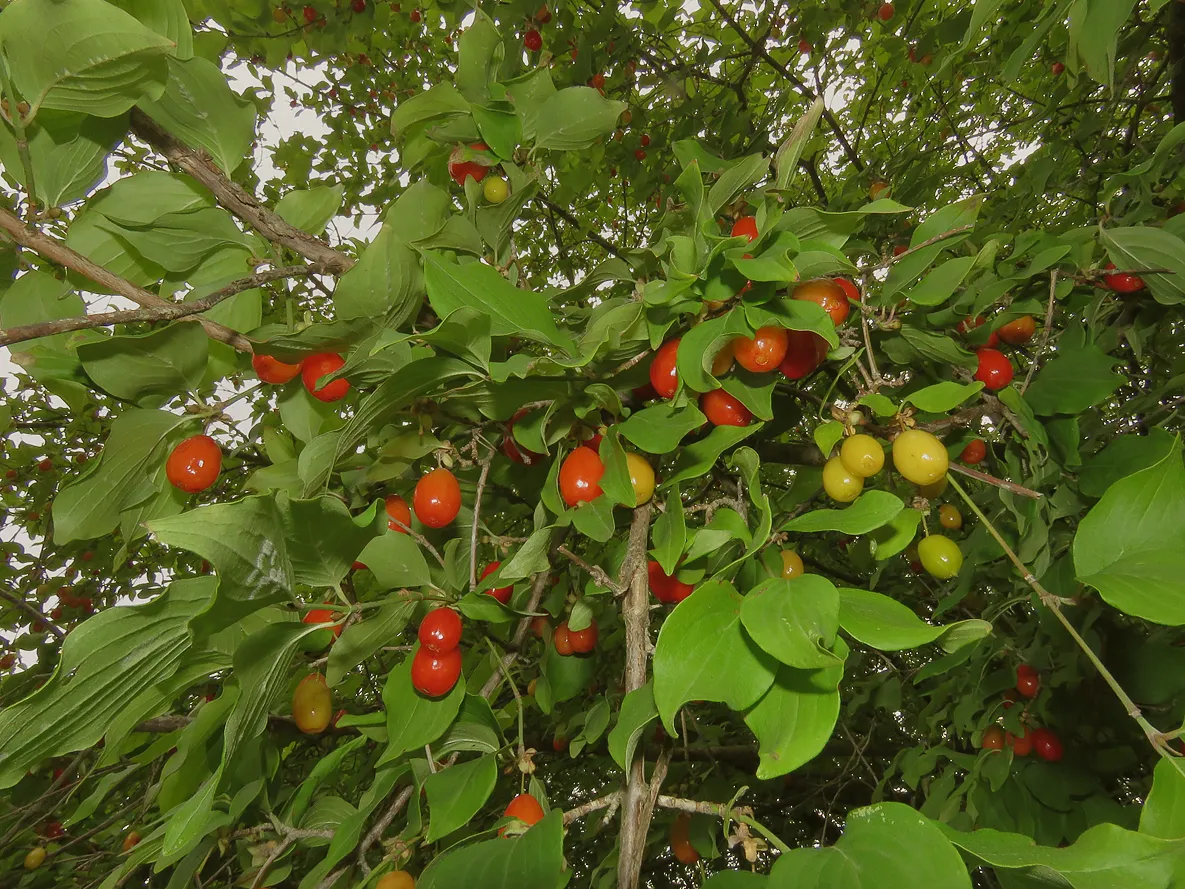
... some colorful wild fruits ...
... I don't know the name, but I know that these fruits are edible.
Someone ... ore some people ... built some little stone things under a large oak tree near the entrance to the town. This thing looks pretty cool ... mysterious and witchy.
A detail from the castle on the top of the hill.
Another herbaceous plant at the entrance of some room ...
... and here ... on the closing shot ... the ivy covered passage, photographed on my way back ... THE END.
As always in these travels on HIVE, all the photographs are my work.
[//]:# (!pinmapple 45.127542 lat 13.811631 long On the ruins of Dvigrad, a photography - oriented post. d3scr)