

At the entrance to the island at the box office you will find a map of all historical monuments, so do not worry, you will not get lost. Climb the path, it all starts with her.
Who would have thought that on such a relatively small piece of land, will gather such a huge number of historical monuments. On the island of Berezan we can say that three different epochs have left their mark. By the way, along the whole island to each monument are long earthen paths.


Just imagine, completely different people set foot on this earth during the turbulent flow of events of different times.
And perhaps I will begin my story with the northern part of the island where the ruins of an ancient city called Borisfenid, which was founded by the Greeks in the 7th century BC.


It turns out that at that time these lands were a peninsula, which was connected to the current Cape Adjiask by a spit. This spit was washed by the river Berezanka, which was also the main source of drinking water, because the Greeks would not build their city on land that is almost waterless.


But after a while the sea rose by 8 meters and flooded the river valley along with the strip of land connecting the island with the mainland and the Greeks had to leave this land.


Source
As the island is a branch of the National Archaeological and Historical Reserve "Olbia", archaeologists are very active here, probably excavating some important find.

Therefore, the part of the island that affects the ancient city is currently forbidden for tourists to explore. But we really wanted to get closer to the untouched excavations of the ancient city.


And they found a loophole between the prickly xerophytes, passing by the best-preserved piece of the ruins of the Greek city, and I took some funny shots against it.
And going further, we found the ruins of an ancient city, which were just in the pit. We were surprised because there was a strange entrance, like a tunnel covered with earth.

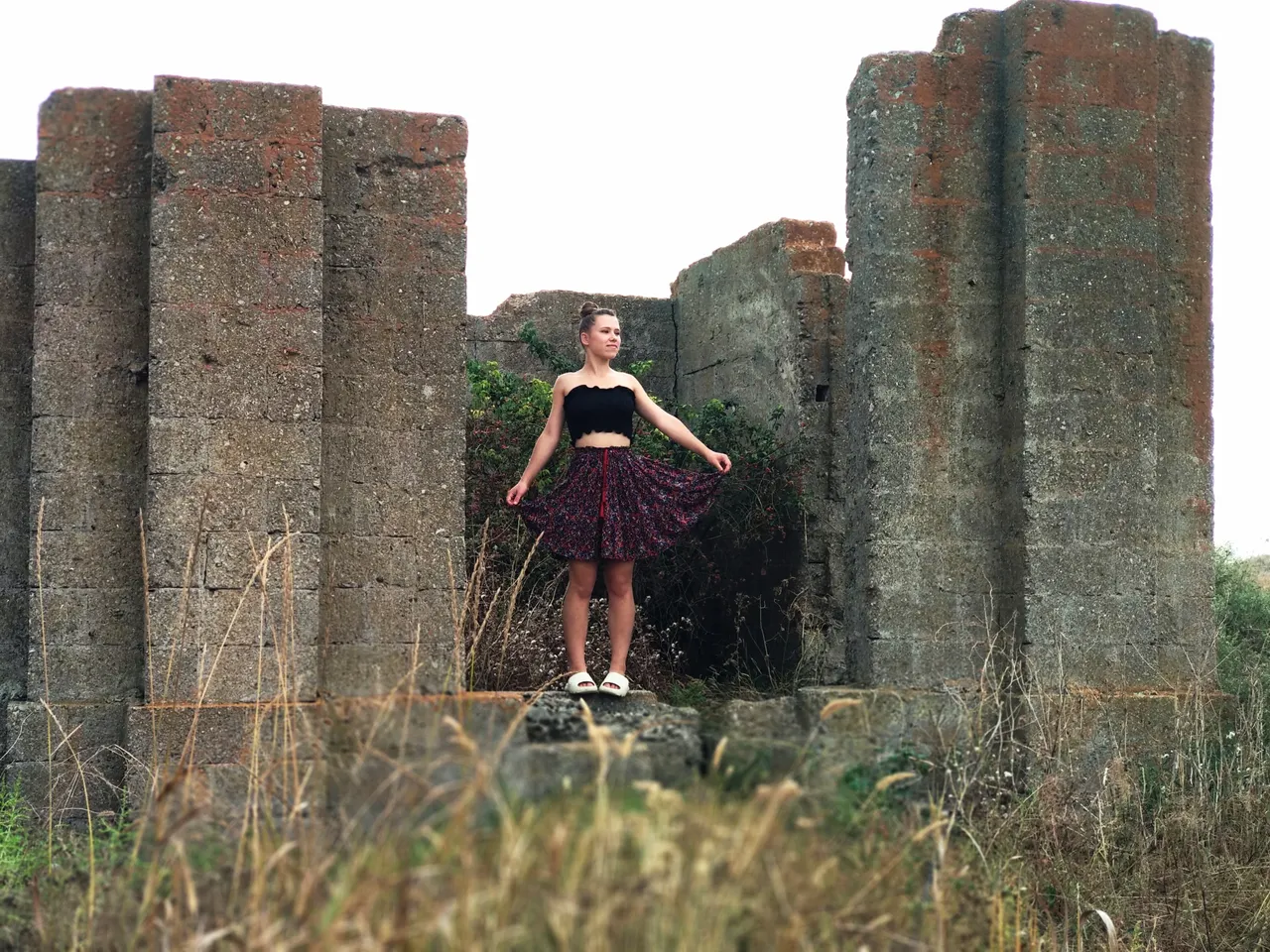
After digging through the forbidden zone, we pass to the middle of the island, where we see the next object, the center of rich historical action.
Here is a large land-underground stone massif of Russian fortifications.


Many tourists come here to climb the area, which consists of many underground passages. Going in from the back entrance, we thought that this way we would cover the entire territory of these abandoned Russian casemates.


We pass on a narrow road and among hard thickets we see a through entrance to a stone cave.
And then, the main is completely dark, like an endless tunnel. It's scary, but let's go...
Turning on the flashlights, we went to explore it. These labyrinths consisted of narrow passages and between them spacious rest stations with open ceilings.


And also in tunnels it was often possible to meet some hole which let in these derbies a particle of light from the sun.


And we enter the main halls, where you can find even real trees, as well as the remains of a metal garrison, you can see the many effects of experimental shelling.


In general, to climb these passages with windows is a very exciting thing. And once there were storage for weapons during hostilities.


In 1907, heavy fortifications began to be built here to withstand the blows of naval artillery.


And here we go out through the main entrance, where normal people come to look at the casemates.
And now we had the opportunity to climb to the surface of these casemates and see what they look like from above.


Here, as you noticed, there is a huge lighthouse and there is a regular patrol station.

From above, the remains of a metal garrison show even better how large-scale weapons were to be stored in this casemate.


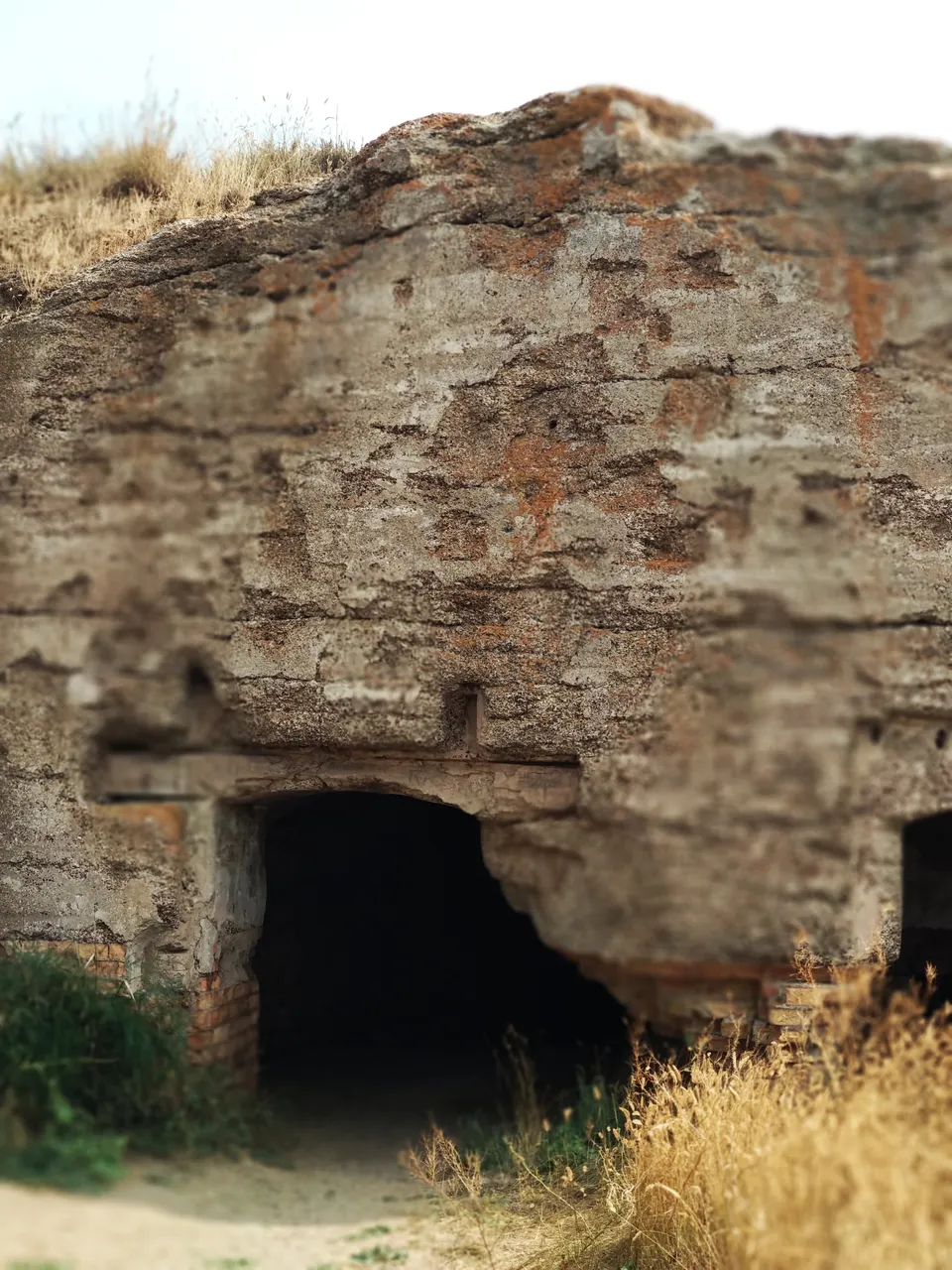
And then we move on to some mysterious remains of the fortress hidden in an earthen hill.

During the Russo-Turkish War, sometime in 1787, the Turkish fortifications of Berezani were captured by 800 Cossacks led by Anton Golovaty. Although you can often hear the opinion that this is a new Russian fort, but thanks to the characteristic archaic forms, you can clearly see the Turkish origin.


In fact, the fortress looks very majestic, although there is not much left of it. The underground tunnels here are not as multifaceted as in the Russian casemates, but they are also quite interesting. I really liked the front of the fortress, as majestic and spectacular as I think it is, the most beautiful of all built here on the island.


I came and at the same time saw a piece of Turkey in such an unusual way. Very beautiful arches and forms in this fortress.


There are a lot of earth mounds in the middle of the tunnel, and other interesting things we noticed are giant nails sticking out of the ceiling. Wow, the main thing is not to turn on them.


And here in the dead end of one of the corridors of the fortress we saw a narrow passage. At first we thought we wouldn't make it, but later 


Even my big dad was able to crawl after us, although there is really very little space, but we are not simpletons, nothing can stop us. So, this was our experience of this climbing among all these historical monuments of the island of Berezan.
The events of different times have left us a kind of monuments and we need to explore them, which we actually do with enthusiasm. Thank you for listening...

