
Immerse yourself in the depths of history and touch on something not typical of modernity - an attractive proposition.
The remains of the ruins are the remains of former buildings. This is a completely different view of construction, style, design.
Previous post

And the joke is that once for those people it was relevant and familiar.
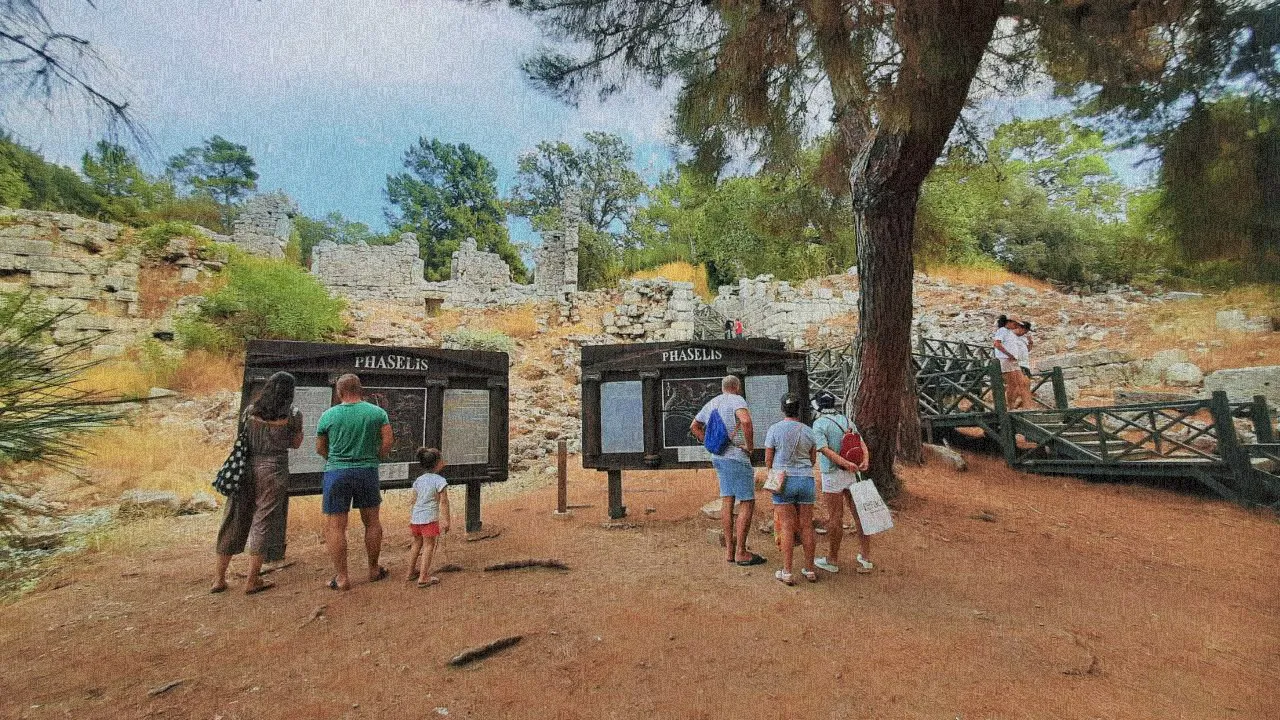
"Phaselis, Phaselis" - I could not understand about what the guide was telling us.

And it turned out that this is an abandoned ancient city, which originated far before our era, but despite this, there is still much to see.


So, according to legend, the city of Phaselis was founded in the 7th century BC by colonists from the island of Rhodes on a small peninsula stretching in the Mediterranean.

The city has an important geographical location and three harbors: one is located in the north of the peninsula, the other in the northeast and the third in the southwest.
The most impressive ruins of Phaselis are, of course, the aqueduct that rises above the parking lot.


To the right of the entrance to the city are the oldest walls of the city fortress, as well as the ruins, most likely, of the temple and monumental crypt.


When you walk along the street on the left you can see the nearest harbor from the entrance - the central one.


Later there is a turn to the left and you go out on the main street of the city, it stretches all the way to the southern harbor.


In 1158 there was a siege of the Seljuks. Subsequent earthquakes, as well as the growth of trade activity in the ports of Antalya and Alanya led to the fact that Phaselis in the 13th century lost its significance and was virtually abandoned by the inhabitants.


Most of the surviving ruins date back to the Roman and Byzantine periods and are located on the main street connecting the northern and southern harbors.


The main street takes us to a wide city square, we can say the center of all history. On the right side of the square there are several agoras.


Quite a large array of remnants of former ruins. By the way, in many places of this museum to step into the ruins for your safety, but we still climbed into this area, because it seemed safe enough.


Phaselis, together with the city of Olympus, was sometimes robbed by pirates, and in 42 BC. BC came under Roman rule.


Since then, the reconstruction of the city begins, its prosperity is growing. The city flourished for about 300 years.


On the south-eastern side of the town square there are stairs leading to the theater and the acropolis. The amphitheater is very authentic. As for his age, he is well preserved😉


The Phaselis Theater, built on the slope of the Acropolis, is relatively small and is a typical example of the Hellenistic period of the amphitheater.


It is said that during Roman rule, gladiatorial battles were fought here.
(bottom view, from the city square)


The ruins that have survived to the present day indicate that the theater stage was built by the Romans and used as part of the city wall in the late Byzantine period.


There were three agoras in the city: one opposite the theater, the other two on the right side of the main street leading to the southern harbor.


Inside the agora, opposite the theater, you can see the ruins of a small basilica of the Byzantine period. The city baths in the area of the city square are also impressive. Of particular interest are small baths, the heating system of which was typical of Roman baths.


Now we move to the southern part of the city, the second part of the street that takes us to the South Port. Perhaps this arch is the most distinctive in this area.


In 126 the city was visited by Emperor Hadrian. A monumental arch with a vault was built in his honor.
After that, a little wider ruins on the sides lead us to the last square or whatever you call it.


The large area is also important for the city.
Somewhere here are their graves, and some more stones and ruins around. Well, the toilet, apparently.

Phaselis was on the border of two historical regions, and sometimes belonged to Lycia, and sometimes to Pamphylia.


After Alexander the Great, the city passed from hand to hand several times, and in 167 BC. BC became a member of the Lycian League and minted coins on the model of coins of this union.


According to historians, the main goddess of the city was the goddess of wisdom and war Athena.


It is believed that the Temple of Athena and other significant buildings of the city are still hidden underground - in the area of the Acropolis, where the forest grows - and are waiting for their researcher.
I could have known even more if I had joined this pack of non-travelers.

But I decided to spare myself my beloved. I think from the photos and you learn so much.
Thanks if you read...
