
Every year, we try to visit at least one country which we haven't travelled to before. We have visited almost all European countries already, except of the Baltics and some countries in the Nordics. Last year, we started to explore the Baltics and spent 5 days in Latvia. We stayed in Riga and travelled across the country to visit different places.

From our hotel room we enjoyed the view of the Freedom Monument, Latvian Academy of Science and Latvian National Opera (in the middle of the photo from left to right). Apparently, we booked the nicest room in the hotel, and no it was not the presidential suite 🙂

We were supposed to arrive in Riga before lunch, but we spent about two hours waiting for our rental car, so we came in the early afternoon instead. The hotel restaurant only served snacks at that time, and we decided to walk to the old town for lunch.
On our way, we crossed Bastejkalna Park with its endless greenery, flower beads, canal, fountains, bridges, sightseeing boats, and many sculptures and monuments. The park was built in the 19th century after the city walls were destroyed.
This sculpture is called 'Peace Dance', and it depicts three nude women dancing in a circle.

We were expecting to have a lot of rain during our stay, but we were lucky with the weather. It was around 25 degrees Celsius which is unusually warm for Latvia. We had some clouds, but there was no rain. Even the receptionist told us that she couldn't remember when they had such a nice weather during 5 consecutive days. We came from the heatwave in Mallorca, so 25 degrees was like spring weather for us 🙂

This is one of many sightseeing boats that we saw. I will take you on a tour, but another time.

Bastion Hill is a small hill located in the park. I remember we were giggling when we found out that this was the highest hill in Riga 🙂

I must admit that it is a charming place that is so well organized. I like structure and look at these symmetrical walls. There are local trees as well as some rarities, such as gingko biloba (not on this photo though).

Looking at the park in this direction, you wouldn't say that it is located next to a busy road with trams and many cars.

Water is present in one way or another across the entire park. I remember that this slot was calming because of the gentle sound of water running down the hill.

Jacob's Barracks are located across the street from the park. It is a row of yellow buildings built in the 18th century used by soldiers who protected the fortification of Riga. Today, there are plenty of restaurants and bars in the complex, and we enjoyed our lunch in one of them.
This side of the barracks caught our attention because of its bright color and images of coats of arms of almost all Latvian municipalities. We found all the places that we planned to visit in these images.

Just a few streets away from the Jacob's barracks we arrived at the Dome square. The square was lively with many people walking around, and many terraces with employees preparing for dinner. We didn't have any plans for our first day in Riga other than exploring the old town, and when we saw that the Cathedral was open for one more hour, we decided to give it a go.
I don't remember how much we paid for the entrance, but it was not expensive. We thought that it was only a church, and found paying for the entrance strange, but then we realized that there was an extensive Gothic cloister in the complex too, so we had to hurry up to see it all in one hour.

The foundation of the Cathedral was laid at the beginning of the 13th century by Livonian Bishop Albert of Riga, and it is one of the oldest and biggest religious buildings in the Baltic region. It was built in the Romanesque style, and enlarged in the 14th and 15th centuries. There were other reconstructions and modifications during centuries, and the Cathedral as we know it now was finished in the second half of the 19th century. Today, it is used for ceremonies as well as for concerts. We have also learned that Riga Cathedral is a historic cultural monument of national significance. Cathedral
When we entered the Cathedral I was surprised by its size. It is much bigger than it looks from outside. The exterior is rather simple with almost no decorations. You can see that this is not a Catholic Cathedral where we would find lots of gold and countless ornaments. It is an Evangelical Lutheran Cathedral.

The altar is simple and small, in contrast to the thick high walls and huge space surrounding it. The stained glass windows are beautiful with a lot of detail.

The jewel of the Cathedral is its organ. It is considered one of the most valuable organs in the world. It was built in 1883-1884 by a German company. There are almost 7000 pipes made of different woods and metal alloys. The shortest pipe is 13 mm long and the longest pipe is 10 m long. Some of the pipes were lost during World War II and replaced in the second half of the 20th century. Organ
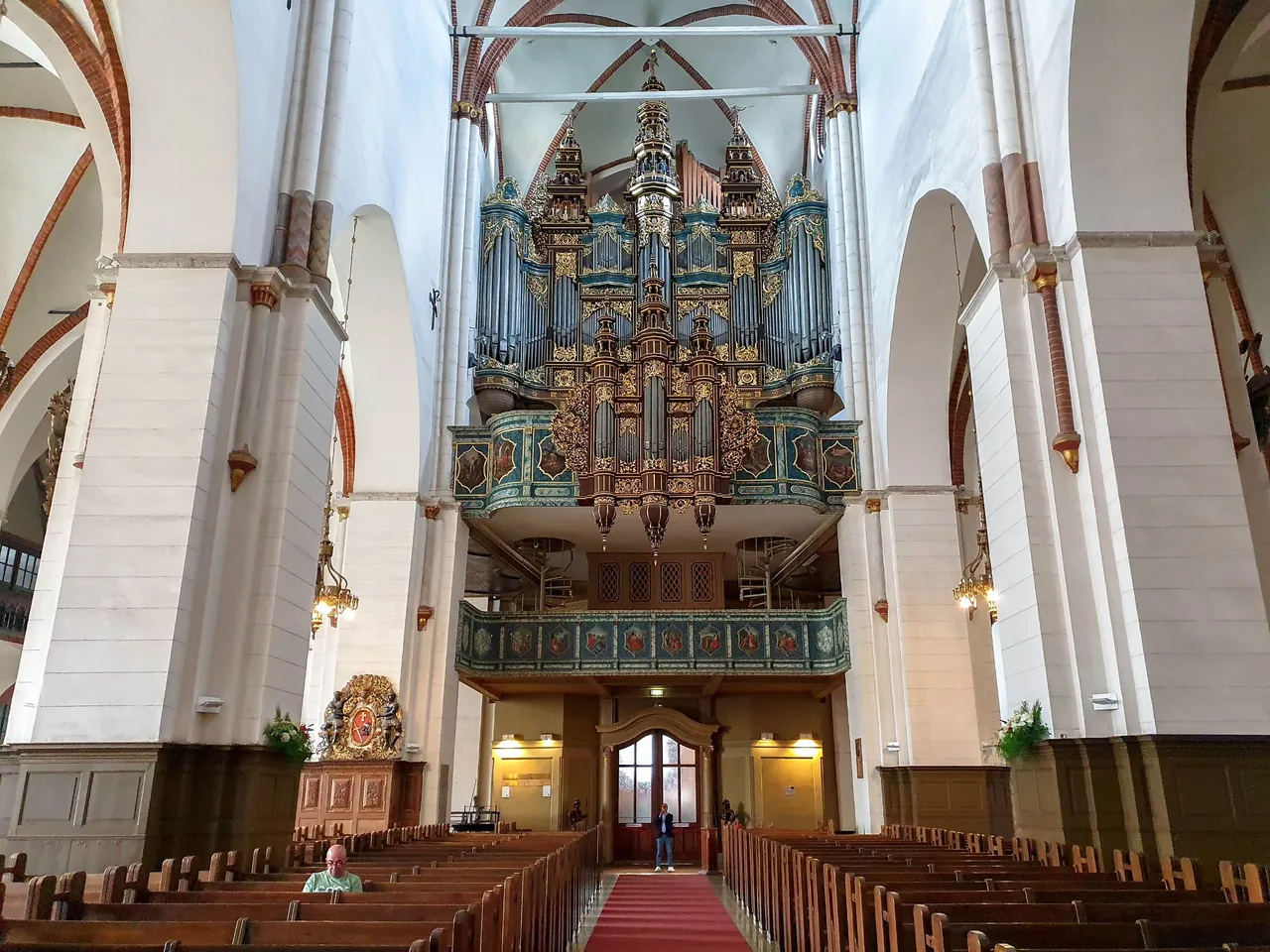

Let's explore the cloister now!
The Gothic cloister which was built in the 13th century connected the cathedral with former monastery, later the Dom Chapter house, and today The Museum of the History of Riga and Navigation. Nowadays, the museum displays many artifacts in the cloister.

It's a fascinating place, and I really liked that the gallery lacked maintenance, the walls were old and it looked like the artifacts were somehow randomly placed. Each artifact had a sign with some explanation next to it, so we learned some interesting facts too.

This monument to Peter I., Emperor of Russia was placed at the site of the present Freedom Monument for a few years at the beginning of the 20th century.
Peter I. was the Russian ruler to implement reforms that helped them make progress in various fields, such as economy, trade or education.

Apparently, this urn holds the heart of Carl Gustav Jochmann, important author, philosopher and critic of his times. It was his wish that his heart was placed in a porcelain vessel and sent to his friend Conrad Heinrich von Sengbusch. I'm not sure how I would appreciate such gift if I was the recipient 🙂

One more artifact before going to the courtyard...
This is the so-called Stone head from Salaspils. Its origins are unclear, but it is one of the greatest discoveries of Latvian archaeologists. The sculpture is shaped with primitive, but expressive human features. The sculpture is 93 cm high and it weights about 780 kg. It is a very heavy stone 🙂

The courtyard invites people to relax with its groomed grass fields and plenty of benches. It's a great place to sit down and just enjoy being surrounded by almost 1000 years of history. There is the Cathedral, the cloister, the sacristy, the chapel of St. John, large staircase and some rooms with unknown original purpose.

There were many charming corners in the complex...


Different architectural styles are blended perfectly here.


We didn't manage to climb the tower due to lack of time, but I'm sure that there were some great views of Riga waiting for us.

This was probably the most romantic slot in the cloister. I had to wait for some time to take a picture as there were a few couples ahead of me trying to take the best selfie with it.

Lavabo from outside...

If I remember correctly there was only two trees in the courtyard and I wonder how it is possible that they're almost in all of my photos 🙂


On the façade of the Cathedral there is a statue of Albert von Buxhoeveden, the founder of Riga.

A few last glimpses of the complex before leaving for dinner. Time flies so fast when you're having fun!


I hope you have enjoyed our tour of the Cathedral.
Thank you for reading.
Cheers!
Martina