
Some years ago, we were driving back home during a snowstorm. It was so bad that some roads were closed, and our GPS sent us through places that we didn't know before. It was late in the evening when we saw a castle on top of a hill. We checked the map as we always do and wrote down the name of the village. And of course forgot about it as we always do too.
Two weeks ago, I was looking for some old notes in my phone and found the name! We didn't have any plans for the day, so we jumped in the car and off we went. I will take you first to the castle, and then show you around the village.
Let's have a look!

The Regensberg castle is situated in the heart of the town Regensberg. It is built on top of a hill overlooking the region of Zürich and Aargau. Regensberg was built as a fortified town in the middle of the 13th century, but today there is no fortification walls left. The only original part of town walls that we can see today is the tower. This is also the only part which is available to public. But first, we need to get there.

You can reach Regensberg by car or public transportation. There is a bus which is coming here frequently as well as a large parking area if you decide to come by car.
The town itself is vehicle free (unless you live there), so either way you will need to walk uphill. The walk is only a few hundred meters long and the town is charming, so it's enjoyable.

It's a touristic town, so if you come outside of the main summer season you will enjoy the medieval tour almost on your own, but you will also have to accept that there will be no restaurants open, so take your own drinks and snacks with you.

Don't forget to look around you while walking towards the castle. When you're lucky you can see the full Alps range.


To reach the hilltop, you will pass through this narrow tunnel. I wouldn't believe that a car would fit through there if I wouldn't have seen it myself. It had about 1 cm from each side, but it fit!

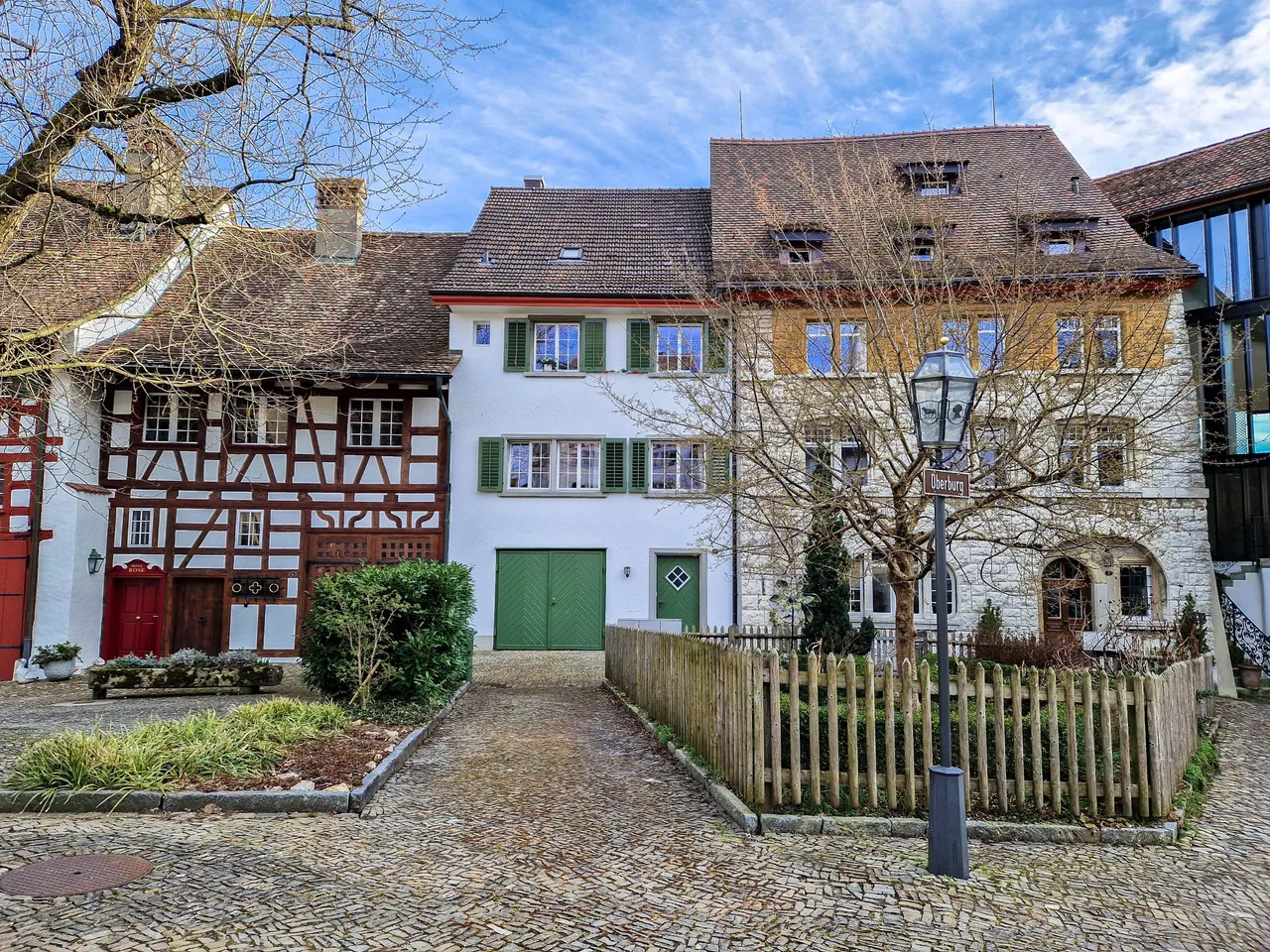
Once you cross the tunnel, you will reach the heart of the town called Oberburg or Upper Castle. It is a ring of buildings which replaced the original fortification. Today, most of the buildings are residential and there are a couple of small hotels too.
They were built in the 16th century after the original fortification was destroyed by fire. Luckily, the castle didn't have any damage as it was separated from the rest by a ditch. Oberstadt



The Regensberg castle with its tower is located on the far left of the Oberburg. The castle belongs to the Regensberg Castle Foundation and cannot be visited, but you can still climb the tower. The entrance fee is only 1 CHF, but the machine only accepts cash, so make sure to have it ready as you won't be able to enter otherwise.

I didn't know what to expect. Honestly, I thought that we would only walk up the stairs to see the views, but to my surprise there is a museum located in the tower.
The ground floor shows some parts of the medieval life including artifacts that were found on the castle grounds.

On the first floor we learned some interesting facts from the history of the castle. It's important to notice that all information in the tower is presented in Germany only. It wasn't a problem for us as we live here for many years.
The castle was built by the Barons of Regensberg in 1250, but it didn't stay in their rule for long.
The son of the founder of the castle had to sell it to the Habsburgs only about 50 years after it was built. The Habsburgs were much stronger than the Regensbergs, and they would destroy the castle otherwise. This is one of the ways how the Habsburgs accumulated so much wealth in Europe.
The Regensbergs died out in the middle of the 14th century.

The tower has an unusual round shape for the eastern part of Switzerland. The Regensbergs took their inspiration from the western part of Switzerland, namely constructions built by the Savoy family.
It was not always directly accessible from the castle. It was only connected during the reconstruction in the 16th and 17th centuries.


The second floor shows Regensberg from 1798 until today. You can learn about the social institutions, development of its population, changes in the infrastructure and its history of being the capital town of a district.
In 1803 Zürich state changed its structure and became a canton. Zürich canton had its district and Regensberg was a capital town of one of them until 1871 when this function was taken over by Dielsdorf. This is when Regensberg started to lose its importance in the region.

This parquet floor tile was placed in 1857. It's interesting that it has a lot of original text written on it. I have visited many castles before but I have never seen a tile with handwritten text.

Between the floors there is a model of the roof which was placed on top of the tower in 1994. It's not inspired by the original roof as there were no construction plans found.

Here we can see how the roof was placed...

When you're inside it seems to be much taller than when you look at it from outside.

Now we reached the third floor. This is the place where there was the original entrance to the tower.
There is also some information about the foundation that owns the castle today.


And finally we reached the most important part of the tower - the sightseeing platform!


Here we are looking at the Unterstadt or the lower town...

There was a board with names of all mountains. I learned to recognize Säntis (more on left) and Churfisten (in the middle). One day, I'll be able to recognize most of them 🙂

And Oberburg from above...

Last glimpse at the Alps before heading back to the town. It was too windy on the platform...

Let's explore the lower town now!
The oldest buildings in this part of the town date back to the 14th century. They are protected by law and any alteration to them needs to be approved by the local authorities first. I can imagine it must be a lot of paperwork if something breaks down and you want to repair it.


Pay attention to the wall next to the fountain as you will find there the tombstone of Ulrich I. von Regensberg who was the son of the founder of the castle. He was the first person to live in the castle.

I have no idea what this should symbolize. Is it a cat? Is it a lion? Any idea?

And of course I have to show some signs of spring 🙂


This was one of those trip when you don't know what to expect as you just blindly give it a go, but in the end you are happy that you did.
It took us about 1 hour to get there, so I think that one day we might come back. But it will be in summer as there are some restaurants with nice terraces and I think having a meal with those views cannot go wrong 🙂
Thank you for reading!
Cheers,
Martina