
Thousand years ago there were three settlements on the banks of the Gauja river - in Sigulda, Krimulda and Turaida. Today, I will take you to Turaida to explore the Turaida museum reserve which consists of multiple sections and archaeological discoveries.
The weather forecast for the day was not so optimistic, but we spent enough time in Riga, and really wanted to visit the reserve as we read great reviews about it, so we decided to give it a go. At the end, we were lucky with the weather again because it didn't rain, and we also enjoyed some sunshine 🙂
It took us almost two hours to get there. Actually, we were almost there in one hour, but then we got stuck in traffic due to some road maintenance. I haven't seen so much chaos on road in a long time. It took ages to approach the traffic lights and finally drive out of that situation.

The most annoying part was that for the entire time we were right in front of the reserve. It was the 'so close, but so far away' kind of a situation. We quickly found a parking slot and entered the reserve.
The entrance fee is 6 EUR per person which was a great price. Parking was for free. Unfortunately, the café was closed that day, so we couldn't get anything to drink. We had some water in the car, and returned back to pick it up as we knew we would spend a lot of time there after seeing the map of the reserve. We only hoped that the rest of our trip would be a bit more smooth. #
Let's start our tour!
The area is much bigger than we expected. We were not able to book a guided tour, so we could pick the direction of our sightseeing tour. We decided to go directly to the castle and do the open air museum afterwards.

The construction of the castle in Turaida started in 1214. It had an important role during the middle ages as a residence of a bailiff, an administrative center and a military fortress. The castle was protected by a high wall which was at its largest in the 16th century. There was a big fire in 1776 that was caused by a careless shot, and a part of the castle was destroyed. The damaged buildings were never rebuilt, and today the castle is partly in ruins. History
Turaida is an interesting place as you can enter some of the buildings and you can only see some walls of those buildings which were destroyed. We will also climb the tower to enjoy the views!
There is no audio guide that we could rent, but there were enough signs with interesting facts about the castle, so we didn't have to blindly walk around without learning anything.

The castle doesn't look so big when you approach it as it's hidden behind the trees. However, it covers a large area and if you like history and architecture there is enough to keep you occupied for some hours. There is also a jewelery shop in the tower which I couldn't wait to visit 🙂

We walked along the partly damaged medieval fortification walls.

Can you see the woman in the back? There were employees in each part of the castle to help people navigate, but they didn't speak much English, so it was not very useful for us.
Luckily, all signs were in English as well. The exhibition in the Turaida castle tells us about the Christianization, the building of the castle and its fortification, the wars and conflicts as well as the castle's position in medieval Livonia. Exhibition
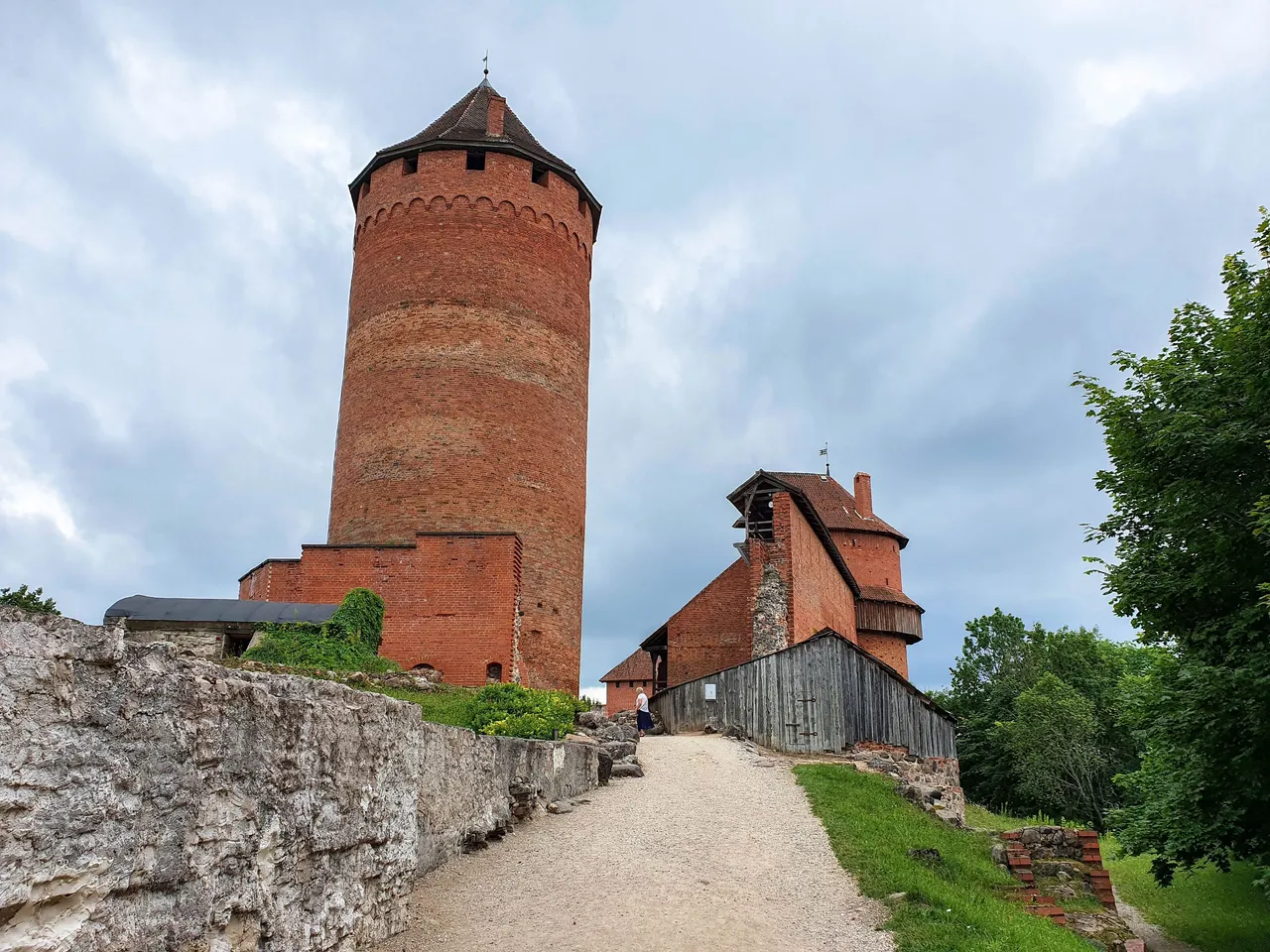
This part is called Zwinger or The Narrow Passage. If enemy soldiers entered the castle through this tower they had to pass the passage surrounded with high walls. They got blocked at the end of the passage by a gate tower. It's difficult to imagine its original state as the wall is about 1m high now.

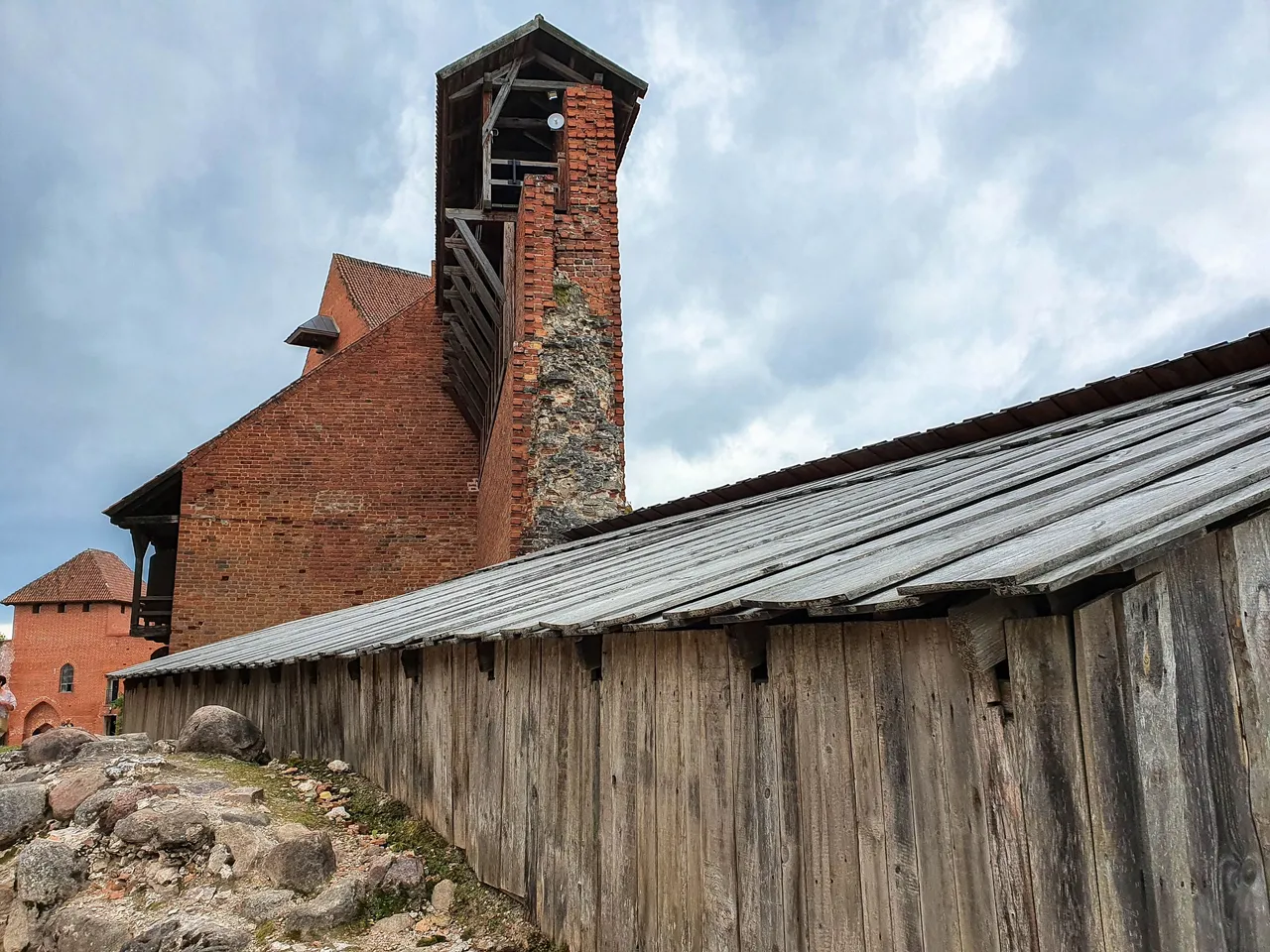
Once we passed the narrow passage we were at the open courtyard. From here we could enter all buildings and archeological finds.

This is probably the most preserved part of the castle and it is where we found the exhibition. It's called The New Hall and it was originally built in the 15th century. I liked the balcony on top floor which we could use to walk from one part to another.

But before we enter, let's look at the archeological discoveries.


We will go down to the basement that was built under residential chambers. It's a pity that this part was destroyed as I'm sure that residential chambers would have been my favorite part of the expositions. The basement had multiple stoves which were used to provide heat for the chambers above.

I liked that some parts were replaced by new red bricks, but there were many original bricks left in the construction too. It created an interesting patchwork.

The view from chilled basement...

The main tower was used as a watch tower. It has five floors and thick walls to protect it. It's almost 40 meters tall! It's the only Romanesque structure that can be seen on the castle. There are only a few openings on each floor to increase the protection.
The tower was restored about 70 years ago, and this is when the current entrance was built. Before that the entrance was accessed via the wooden stairs- you can see the old entrance on the left side.
It is the first thing that you see when you walk out of the basement.

This part of the castle is partly rebuilt, and we were able to walk up to the first floor to see the entire courtyard. It used to be the Palace with residential chambers (on the right you go to the basement and on the left you go up).

Here we go...

We could also see the Sigulda castle on the left...

Now, it's the time to go inside and check out the exhibition...

This part of the exhibition is dedicated to the wars in the 13th-16th centuries. This area often became the place of battlefield or negotiations between various parties. The castle was besieged on several occasions and the archbishops of Riga (one of them is on top) were captured and imprisoned.

Here we can see an early settlement and archeological discoveries.


Look at the thickness of those walls...

Let's go to the most interesting part of the castle: its Main Tower.
I loved this red brick cupola with medieval chandelier in the lower part of the tower. There were some interesting things on each floor, so it was not too bad to climb that many stairs. The tower dates back to the 13th century, and the staircase is typical for that time: narrow and steep. It's a bit challenging for people with slight claustrophobia like me, but I managed!

And my rewards were these views 🙂

The Gauja river is one of the greatest landmarks of Latvia. Its valley is almost 80 meters deep in some places which is quite a lot considering that the rest of the country is flat.
Adding up that the platform is at 30 meters above the ground we could see far away. It must have been a great point to spot the enemies on time.

On this side, we can see the museum reserve. It goes as far as that small tower on the right.

The New Hall in all its glory...

And back part of The Narrow Passage...


The archeological discoveries...

And last glimpse of the castle before going to the museum reserve...

The Museum Reserve is like an open air exhibition. There are many houses with various purposes which you can enter to see some items that were used for traditional crafts.
We will start in the The Cart House which exhibits items related to horse transport.

Inside there are several carts, wheels, sledges and harnesses. These were made by locals (mainly) in the 19th century. At that time, Turaida was a popular place for tourists. Many peasants earned their living by offering tours of surroundings in horse-drawn coaches.

This house is home to The Smithy. Originally, it was built as a distillery, and only recently it was turned into the smithy.

There was a smith working on his items which we could purchase. My brother likes such items, and I got him a couple of them - not those on the photo 🙂

We continued to The Bath House. It was a small house and I was surprised to find two spacious rooms inside. It was built in 1828 and initially it was used as a house for workers and gardeners. Later, it was turned into bath house.
Let's go inside!

I love herbs and wild flowers, and there were plenty of them in the bath house. It smelled so good! I could have stayed there for hours.

The owners of the estate didn't use the bath house. It was only used by peasants and the estate people had a room in their home which was used as a bathroom.
There was at least one bath house installed in each village. At the end of the 17th century a doctor described the Latvian bath house tradition by saying that peasants wash in the bath house often, almost every seventh day 🙂

People went to the bath house on Saturday after work to take a steam bath and purify themselves. It was also a mental preparation for Sunday celebrations. Men used the bath first, then they were followed by women and children.

The bath house is settled in beautiful area. There was a bench nearby and we sat down to eat our snacks that we luckily both in Riga in the morning. We were so hungry!

Duck visitors were not welcome in the bath house. They entered the house with so much grace, but were sent away quickly 🙂

There were several small lakes, and plenty of horse flies that kept attacking us.

The largest exhibition was in The House of Corveé Peasants. It covers a 100 year period between 1819 and 1920.
There are some every day as well as military items and a lot of political articles.


We could also take a peek at The Old Residence of The Governor, but the house was closed. We did look through the window though.
The house had a beautiful flower garden...

From the garden it was only a few meters to get to The Turaida Church which goes back to 1750. As per the sign, it is the oldest wooden church in Latvia and it's a protected monument.

We didn't want to enter it as there were people preparing wedding decoration for a ceremony (I guess it was for the next day as it was already late in the afternoon), but even from outside it looked charming.

We walked around a little bit more, and then we returned back to our car and drove to Riga.

It was a long day, but we enjoyed it. We couldn't wait to get dinner as those snacks were not enough. Lesson learned - always take more food than you think you need.
There were many life size models in various places for kids and as always we had to do our part too. Most of the photos are not publishable, but I decided to share this one of my husband getting to know a peasant from Turaida 🙂
I hope you have enjoyed our trip!
Thank you for reading!
Cheers,
Martina